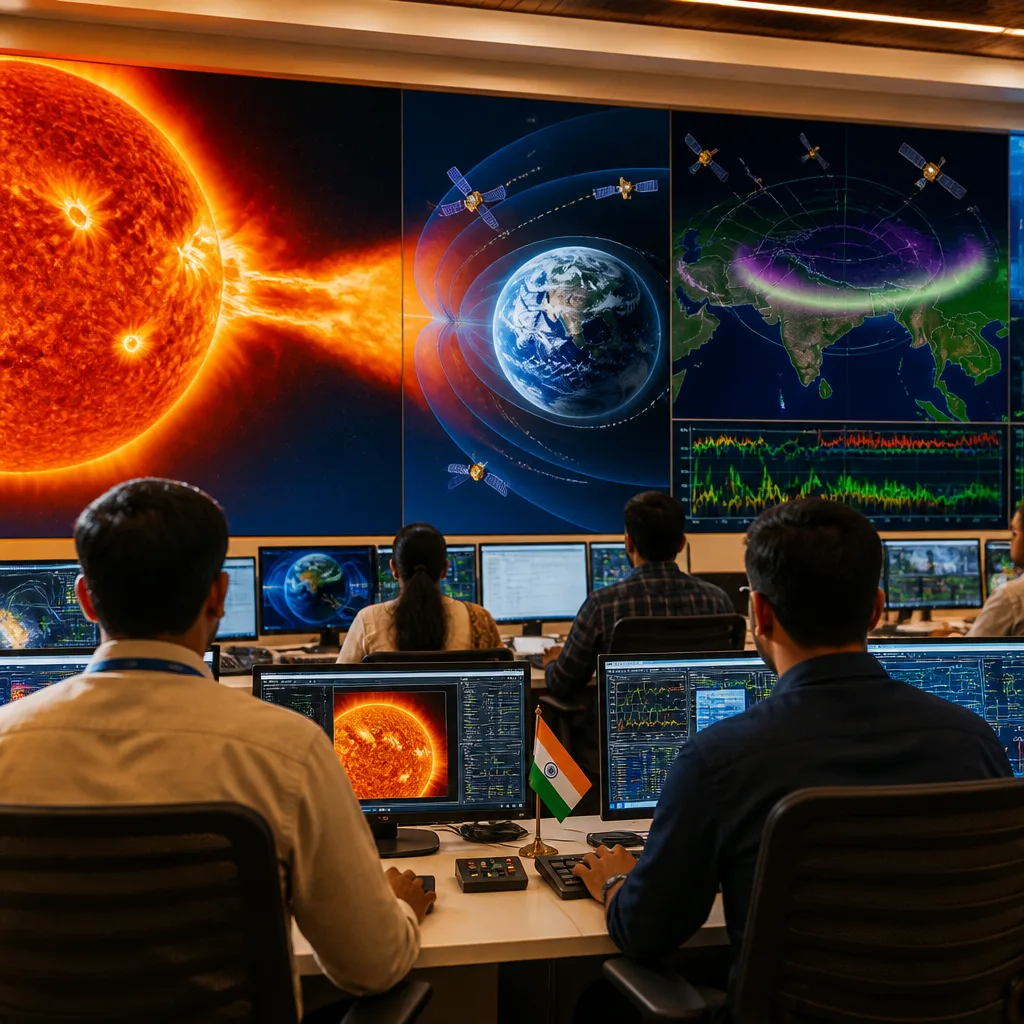
A powerful eruption on the Sun on 14 August hurled a large cloud of magnetised plasma into space, and space‑weather agencies now predict that the resulting coronal mass ejection (CME) will brush past Earth's magnetic field on 17 August. Forecasters describe the expected disturbance as a G1‑class geomagnetic storm, the lowest category on the five‑level NOAA scale.
What happened on the Sun
On 14 August a long magnetic filament on the Sun became unstable and erupted, launching a CME — a broad eruption of charged particles and embedded magnetic field. Instruments that monitor solar activity tracked the cloud as it travelled outward and modelled its trajectory, concluding that Earth will receive a glancing impact rather than a head‑on hit.
What to expect on Earth
Even a minor, G1 storm can compress the magnetosphere and deposit energy into the upper atmosphere. Typical effects associated with such storms include:
- enhanced auroral activity at high latitudes;
- possible degradation of high‑frequency radio propagation and brief GPS or satellite navigation disturbances;
- increased electrical currents in near‑Earth space that can affect sensitive satellites.
Forecasters emphasise that this event is expected to be modest compared with strong storms observed near the peak of the current solar cycle. Nonetheless, it provides both an observational opportunity for aurora watchers in northern latitudes and a reminder for operators of space assets to verify precautions.
Scientific context and monitoring
Solar activity has been elevated in recent months, with multiple filament eruptions, flares and CMEs as the Sun moves through an active phase of its ≈11‑year cycle. Space‑weather agencies continuously assimilate solar imagery and in‑situ solar-wind measurements to update arrival times and intensity forecasts. The predicted G1 rating places the event at the lower end of NOAA’s five‑step scale, but small shifts in the CME’s magnetic orientation or speed can change impacts at Earth.
| Parameter | Detail |
|---|---|
| Solar event | Magnetic filament eruption (14 August) |
| Phenomenon | Coronal mass ejection (CME) |
| Expected arrival | 17 August (glancing blow) |
| Forecast intensity | G1‑class (minor) |
Implications and precautions
A G1 storm is often notable for visible aurora at high latitudes but can also cause brief impacts to technology. The kinds of users and systems that may notice effects include satellite operators, GNSS/GPS‑dependent services, aviation HF radio users on polar routes, and scientific instruments measuring upper‑atmosphere conditions. Agencies that rely on precise timing and positioning routinely monitor space‑weather alerts and may activate contingency plans if conditions intensify.
Scientists say even small geomagnetic storms are valuable: they allow researchers to study how the magnetosphere responds and how energy is transported into the upper atmosphere. Continuous monitoring and modelling reduce uncertainty in forecasts, but forecasters caution that CME structure and magnetic polarity are key determinants of ground‑level consequences. A direct southward magnetic field within the CME tends to couple strongly with Earth’s field and produce larger storms; a glancing encounter or differently oriented field reduces effects.
For the general public in India, no direct impacts are expected from this forecasted G1 event. Those interested in aurora may follow updates from space‑weather centres and watch imagery from polar regions; satellite operators and navigation‑dependent services should consult their normal advisory channels for operational guidance.
Forecasters say the incoming solar material could trigger a G1‑class geomagnetic storm, the lowest category on NOAA's five‑level storm scale.