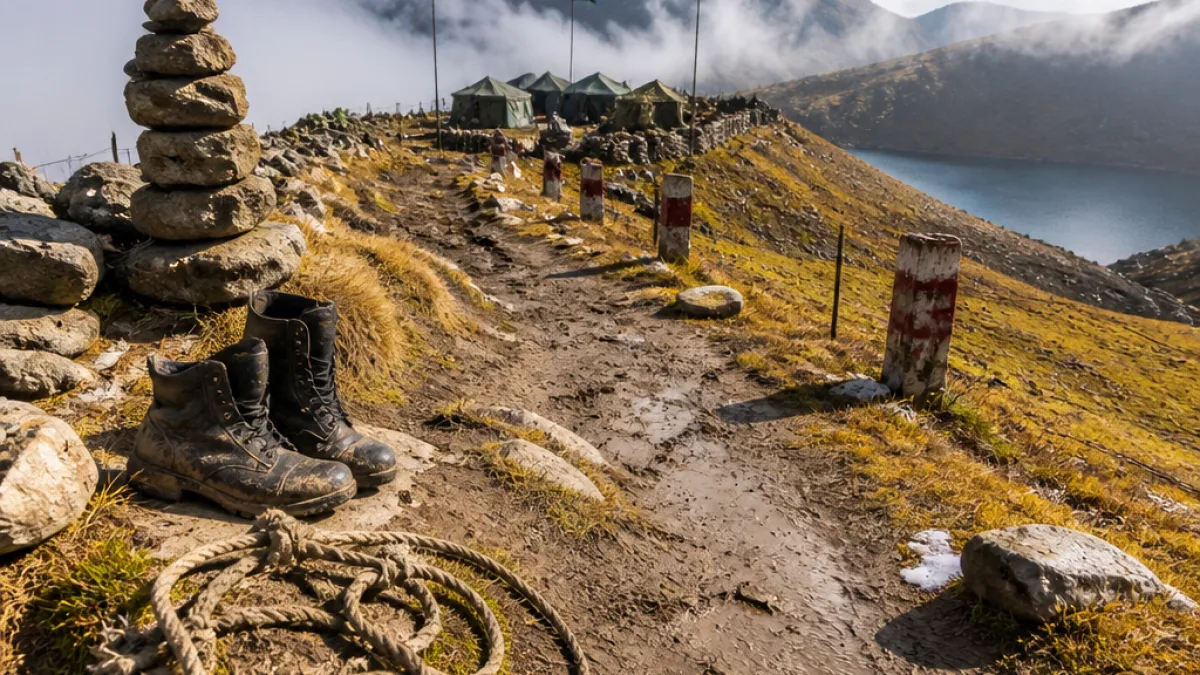
Reports of sustained Chinese People’s Liberation Army (PLA) activity in parts of Arunachal Pradesh have prompted renewed scrutiny of the state’s Eastern Sector frontier, with particular attention on Upper Subansiri, West Dibang and Anjaw districts.
Areas of reported activity
Regional newspaper accounts cited in recent coverage say PLA troops have "effectively denied Indian forces access to key patrolling points" in the Taksing area of Upper Subansiri district and are expanding control over traditional Indian grazing and hunting grounds along the Line of Actual Control (LAC). Other reports point to what is described as "aggressive patrolling" near the Iphi twin lakes area of West Dibang, close to the Zirkyen La pass, and activity in the Fish Tail-1 area of Dibang Valley and Fish Tail-II in Anjaw district.
Former Army officer and defence attache who served in the area warned that the Eastern Sector requires continuing vigilance because of a history of face-offs. The officer, Lt Gen S L Narasimhan (Retd), drew attention to a December 2022 confrontation near Yangtse, saying the episode involved several hundred PLA troops attempting to intrude into Indian territory. He said Indian forces were able to mobilise and push them back after minor injuries were sustained on both sides.
"We need to be careful all along the LAC particularly in the Eastern Sector. There have been precedence of face-offs like the one that happened in Dec 2022 in the area of Yangtse," Lt Gen S L Narasimhan (Retd) was quoted as saying.
Strategic context and implications
The areas named in the reports — Taksing, the Iphi twin lakes, Fish Tail-1 and Fish Tail-II — sit close to the McMahon Line, the de facto boundary between India and China in this sector. Observers say the terrain and the pattern of observation posts mean Indian positions often overlook Chinese-held ground, and past incidents have shown both sides can mobilise quickly in response to perceived incursions.
Reports also mention the Karbi Karpo mountain range in eastern Tibet as touching the McMahon Line in Arunachal, noting the wider geography where patrol patterns and seasonal use of grazing and hunting grounds converge with military surveillance and patrol routines.
Locations and reported incidents
| Reported location | District | Reported activity |
|---|---|---|
| Taksing | Upper Subansiri | PLA denied access to key patrolling points; expansion over traditional grounds |
| Iphi twin lakes / Zirkyen La | West Dibang | Alleged aggressive patrolling near mountain pass proximate to LAC |
| Fish Tail-1 | Dibang Valley | Reported PLA presence |
| Fish Tail-II | Anjaw | Reported PLA patrols further south |
What is confirmed and what remains unverified
Coverage to date relies on regional reporting and comments from a retired senior officer with direct experience in the area. The reports describe a pattern of PLA patrols and denial of access at certain patrolling points, but the details — including numbers of personnel involved and exact coordinates — remain unverified in official statements made public so far.
Past incidents, such as the December 2022 Yangtse face-off, are cited to illustrate how confrontations can escalate and how forces on both sides have previously suffered minor injuries before tensions were defused. The December 2022 case is presented as precedent rather than direct confirmation that an identical pattern is recurring in the new locations named.
Local and diplomatic significance
Any sustained change in patrolling patterns or denial of access to traditional grounds can have direct consequences for local communities that rely on these areas for grazing and hunting, as well as for border management practices used by the Indian Army and paramilitary forces. The reports come at a time when bilateral engagement and high-level diplomacy remain sensitive to developments on the ground, and they underline the need for close coordination between local military formations and national decision-makers.
- Vigilance along the Eastern Sector LAC: Retired commanders and local reporting both stress continued caution in the sector.
- Impact on local usage: The expansion of patrol areas can restrict access to traditional grazing and hunting grounds for border communities.
- Verification pending: Official confirmation with precise details has not been published at the time of these reports.
Officials in New Delhi and Army authorities typically respond to such reports through established channels; any formal statements or orders concerning troop deployments or diplomatic steps have not been cited in the recent accounts reviewed here. Analysts say that, in the absence of official corroboration, the situation warrants careful monitoring and continued reporting from the ground.
Given the history of intermittent face-offs in the Eastern Sector and the strategic sensitivity of the McMahon Line region, authorities and security analysts are likely to watch developments closely and verify claims before drawing definitive conclusions on intent or long-term change to patrol patterns.