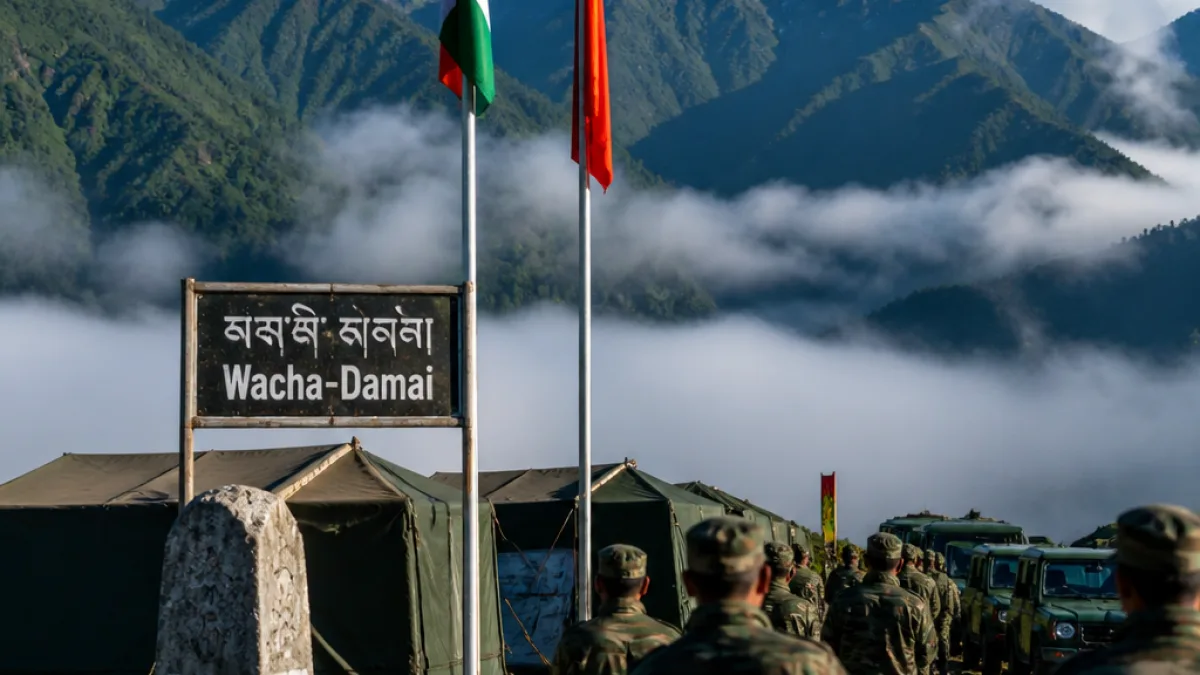
Indian and Chinese military commanders held corps commander‑level talks at the Wacha‑Damai border meeting point in Arunachal Pradesh's Kibithoo region on Sunday to review the situation along the Line of Actual Control (LAC) in the sector, officials familiar with the discussions said, according to PTI.
First such meeting in eastern sector
The meeting marked the first corps commander‑level engagement between the two armies at Wacha‑Damai. Until now, corps commander talks between India and China have principally taken place at the Chusul‑Moldo border meeting point in the Ladakh sector. The latest interaction established a dedicated military channel for addressing issues arising in the eastern sector of Arunachal Pradesh.
The Indian delegation was led by Lieutenant General Girish Kalia, the commander of the Indian Army's Dimapur‑based III Corps. The III Corps is one of the two corps formations within the Army responsible for the operational areas along the LAC in Arunachal Pradesh; the other is the Tezpur‑based IV Corps.
India and China discussed measures to maintain peace and tranquillity along the frontier, officials said.
Context and recent tensions
The talks come days after Special Representative (SR) level discussions in Beijing between national security adviser Ajit Doval and Chinese foreign minister Wang Yi on August 25. Those SR talks focused on delimitation of the frontier and sustaining trans‑boundary cooperation, and were followed by the corps commander meeting in Arunachal.
The meeting in the state also coincided with reports of assertive Chinese troop activity along parts of the LAC in the Upper Subansiri region of Arunachal Pradesh. The corps commander‑level engagement provided an immediate military forum to review local developments and seek de‑escalatory measures through established channels.
How the LAC is managed in Arunachal
India and China maintain differing perceptions of the LAC, which have periodically produced face‑offs and standoffs. In Arunachal Pradesh the Indian Army has two corps formations with responsibility for the border areas:
- III Corps (Rangapahar/Dimapur) — responsible for operational sectors along parts of the Arunachal LAC; III Corps was led at the meeting by Lt Gen Girish Kalia.
- IV Corps (Tezpur) — also responsible for sections of the state’s frontier.
| Indian formation | Base | Role |
|---|---|---|
| III Corps | Dimapur | Operational oversight along segments of Arunachal LAC; delegation led by Lt Gen Girish Kalia |
| IV Corps | Tezpur | Responsible for other operational sectors along the Arunachal frontier |
Official word and reporting
There was no formal press statement issued by either the Indian or Chinese militaries following the meeting, the sources said. Details of the discussions were reported to national agencies by people familiar with the matter, as per PTI.
Significance for Arunachal Pradesh
Holding corps commander talks in eastern Arunachal is significant for several reasons: it opens a high‑level military channel specific to the sector, enables direct discussion of localised incidents or patrol disputes, and signals a willingness by both sides to use military‑to‑military mechanisms to manage tensions.
For residents of frontier communities such as those in the Kibithoo and Upper Subansiri areas, such meetings can translate into faster resolution of immediate standoffs and clearer rules for patrolling and local de‑confliction. For New Delhi and Beijing, these engagements form part of a broader set of talks — including SR‑level diplomacy — aimed at stabilising the boundary and preventing escalation.
The meeting underlines the continuing use of layered diplomacy — from corps commanders to special representatives — to address the long‑running boundary question between India and China.
(Reporting by PTI was used in preparing this article.)