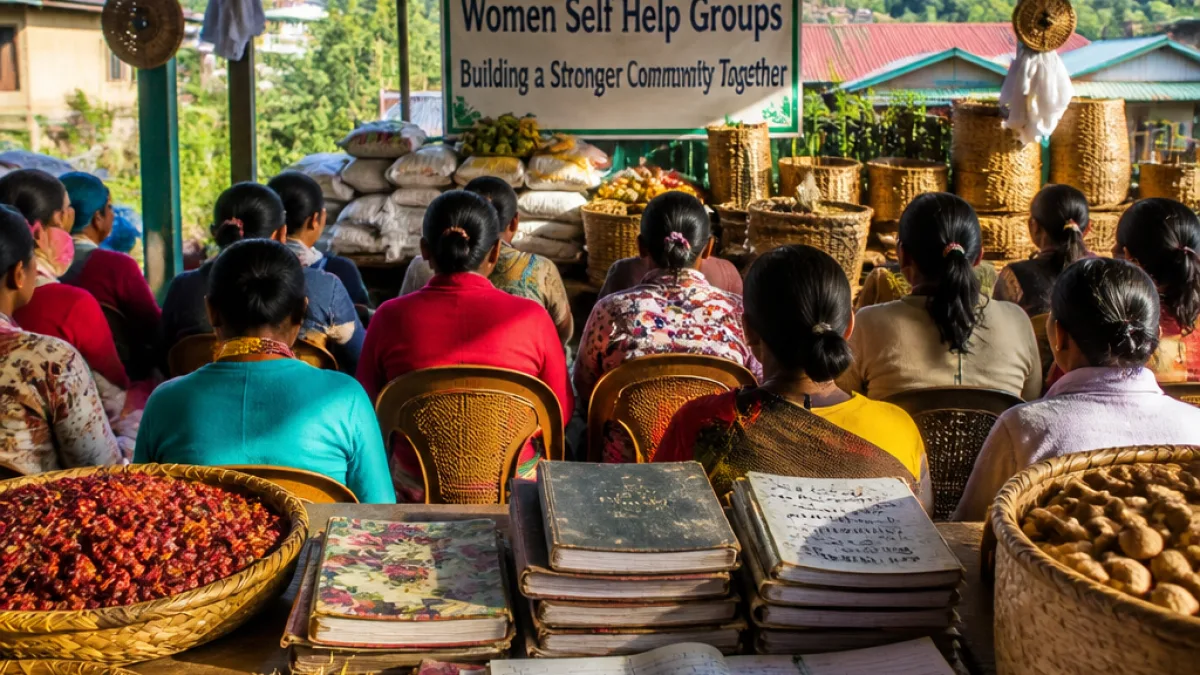
Itanagar: More than 16,000 women in Arunachal Pradesh have achieved the state's ‘Lakhpati Didi’ milestone, Deputy Chief Minister Chowna Mein said on Monday, signalling a major push in the government’s efforts to expand rural livelihoods and women’s economic participation.
Numbers and institutional reach
In a social media post outlining progress under the Arunachal State Rural Livelihoods Mission (ArSRLM), Mein said nearly 1 lakh women have been mobilised into 15,999 self‑help groups (SHGs). The state has also formed 1,488 primary‑level federations and 91 cluster‑level federations (CLFs) to support SHG members in building sustainable livelihoods, according to details shared by the deputy chief minister, who also holds the finance, planning and investment portfolios.
Officials said the objective of the Lakhpati Didi initiative is to enable women associated with SHGs to reach a sustainable annual household income of at least ₹1 lakh through a mix of diversified livelihoods, entrepreneurship, upskilling, financial inclusion and convergence with government schemes.
“When women earn, families gain greater security, communities become more resilient and local economies grow,”
Mein wrote, emphasising the state’s intention to scale up linkages to skills, finance, technology and markets so that beneficiaries move from economic participation to economic leadership.
Targets and pipeline
The deputy chief minister said an additional 36,000 potential ‘Lakhpati Didis’ have been identified across the state, indicating scope for expansion of the programme. The government has set a specific institutional goal of building 30 Viksit (developed) CLFs by March 2027, aimed at creating stronger, self‑reliant and sustainable women‑led institutions.
Officials described the current figures as part of continuing efforts under ArSRLM to promote women’s economic empowerment through SHGs and their federations. The approach combines on‑the‑ground mobilisation with efforts to ensure convergence with other government schemes and services.
What the scheme emphasises
- Income threshold: A sustainable annual household income of at least ₹1 lakh for women associated with SHGs.
- Institutional support: Formation of primary federations and CLFs to provide collective bargaining, market linkages and institutional finance access.
- Scale-up targets: 30 developed CLFs to be built by March 2027 to deepen women‑led institutional capacity.
Local impact and challenges
Mobilising nearly one lakh women into nearly 16,000 SHGs suggests a broad base of community organisation across Arunachal’s districts. Primary federations and CLFs can play a role in aggregating produce, securing credit lines and negotiating with buyers, officials said. However, analysts and development practitioners typically note that sustaining income gains requires consistent market access, quality control, product diversification and financial services tailored to small producers — pressures that the state will need to address as participation scales.
The identification of 36,000 potential beneficiaries points to a substantial pipeline, but converting potential into verified income gains will depend on delivery of skills training, access to working capital and reliable supply‑chain connections to urban and inter‑state markets, stakeholders have previously observed.
Officials’ stated priorities
According to Mein’s post, the government’s priority is to consolidate momentum by linking women with:
- skills and technology,
- finance and insurance, and
- market access and convergence with central and state schemes.
These steps are intended to help more women transition from marginal economic roles to leadership positions within local economies, the deputy chief minister said.
Data at a glance
| Parameter | Figure |
|---|---|
| Women achieving ‘Lakhpati Didi’ status | 16,000+ |
| Women mobilised into SHGs | ~1,00,000 |
| Number of SHGs | 15,999 |
| Primary‑level federations | 1,488 |
| Cluster‑level federations (CLFs) | 91 |
| Potential beneficiaries identified | 36,000 |
| Target Viksit CLFs by Mar 2027 | 30 |
Officials said the reported numbers reflect ArSRLM’s ongoing drive to integrate women into structured livelihoods programmes. The state will now focus on converting membership and institutional strength into measurable household income gains and sustainable enterprises, Mein indicated in his communication.
Further progress will be monitored against the stated targets, including the development of the 30 Viksit CLFs and the movement of identified potential beneficiaries into income‑generating activities that meet or exceed the ₹1 lakh threshold.