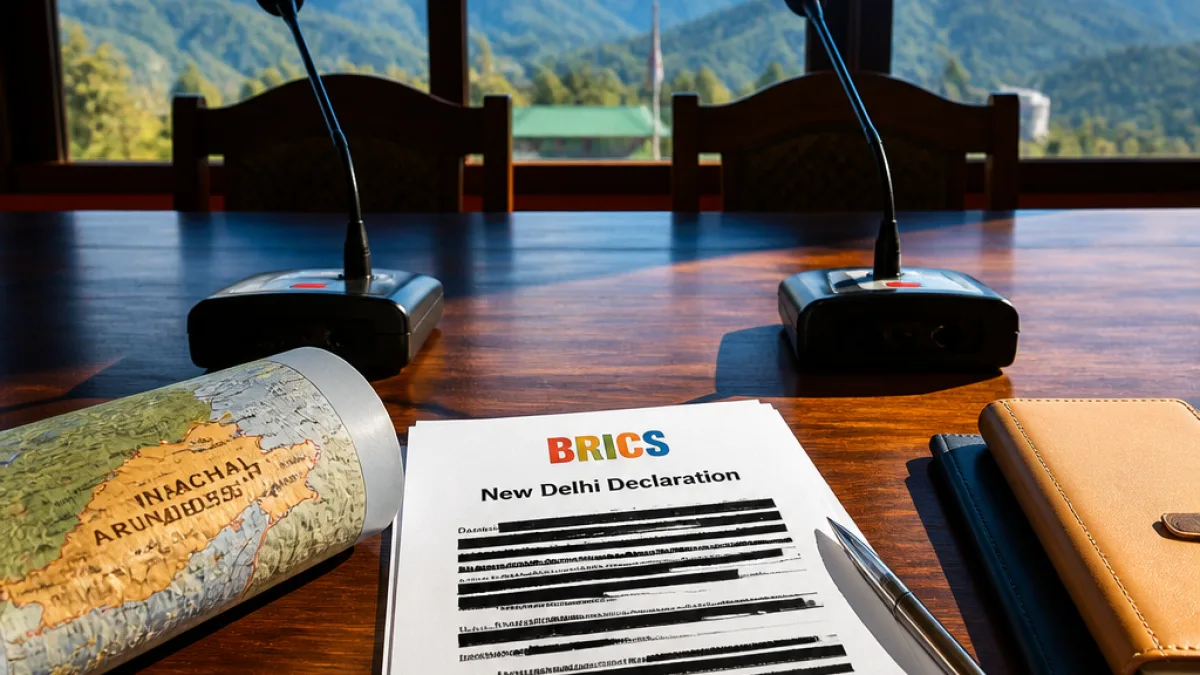
Senior Congress leaders on Sunday described the BRICS 'New Delhi Declaration' adopted at the 18th BRICS Summit as “incomplete”, saying it failed to address key security and territorial concerns raised by India. The criticism, voiced by AICC General Secretary Bhupesh Baghel and senior party leader Rashid Alvi, focused on the absence of any reference to the Galwan clash or China’s claims over Arunachal Pradesh and on the wording used to condemn a recent terror attack.
Leaders criticise omission of Galwan and Arunachal
Speaking to ANI, Bhupesh Baghel said the declaration, while condemning the Pahalgam terror incident, did not go far enough because it made no mention of the Galwan clash or of China’s claims concerning Arunachal Pradesh. He described the text as incomplete for not flagging several issues he said were of concern to India.
“The point is that while they protested against the Pahalgam attack, albeit after so much time had passed, they did not deem ‘Operation Sindoor’ to be right... so that's incomplete,” Baghel said. “Nothing was said regarding Galwan or Arunachal, concerning the claims China is making about them.”
Baghel's remarks came after BRICS leaders adopted the New Delhi Declaration at the summit, which included a formal condemnation of the April 22, 2025 terror attack in Pahalgam.
Questions on diplomatic impact and naming perpetrators
Rashid Alvi, while addressing the same declaration, expressed scepticism about its diplomatic utility. He said that a condemnation that does not name perpetrators or sponsor states limits the document’s effectiveness as a tool of international accountability.
Alvi told ANI that although the declaration condemned terrorism and specifically mentioned the Pahalgam incident, it did not identify who carried out the attack or who might be sponsoring such acts. He argued that without naming perpetrators or responsibility, the declaration falls short of delivering a meaningful diplomatic outcome.
- Declaration action: Condemnation of the Pahalgam terror attack (dated April 22, 2025) was included.
- Omissions flagged: No reference to the Galwan clash or China’s claims over Arunachal Pradesh, according to the Congress leaders.
- Diplomatic concern: Leaders questioned whether a non-specific condemnation without naming perpetrators has impact.
What the leaders said and why it matters
The criticisms from Congress leaders come in the immediate aftermath of a high-profile summit hosted by India, where members of BRICS adopted a joint declaration. The party leaders framed their objections on two counts: first, that references to incidents and claims directly affecting India’s security and territorial integrity were absent; second, that denunciations of terrorism without identifying actors reduce the force of collective statements.
Both points touch on broader debates about how multilateral statements should balance diplomatic consensus with clear attribution — an issue that can be politically sensitive and consequential for public perception and bilateral relations.
Summary table of key items and how they were addressed
| Item | Mention in New Delhi Declaration |
|---|---|
| Pahalgam terror attack (April 22, 2025) | Condemned |
| Galwan clash | Not mentioned (as per remarks by Bhupesh Baghel) |
| China's claims over Arunachal Pradesh | Not mentioned (as per remarks by Bhupesh Baghel) |
By raising these omissions, the Congress leaders have signalled an intent to press the government on issues of national security and territorial claims in public discourse. Their comments are likely to draw responses from other parties and analysts on whether multilateral declarations should be more explicit in attributing responsibility or addressing contested territorial claims.
The exchange also underscores a recurring point in Indian political debate: how best to leverage international forums to advance national positions while maintaining diplomatic consensus among diverse member states. The leaders’ critique centres on the tension between reaching unanimity and making specific, politically significant references in joint texts.
No official response to these specific criticisms was included in the remarks cited. The leaders’ statements were recorded in interviews with ANI following adoption of the New Delhi Declaration by BRICS members at the 18th summit.