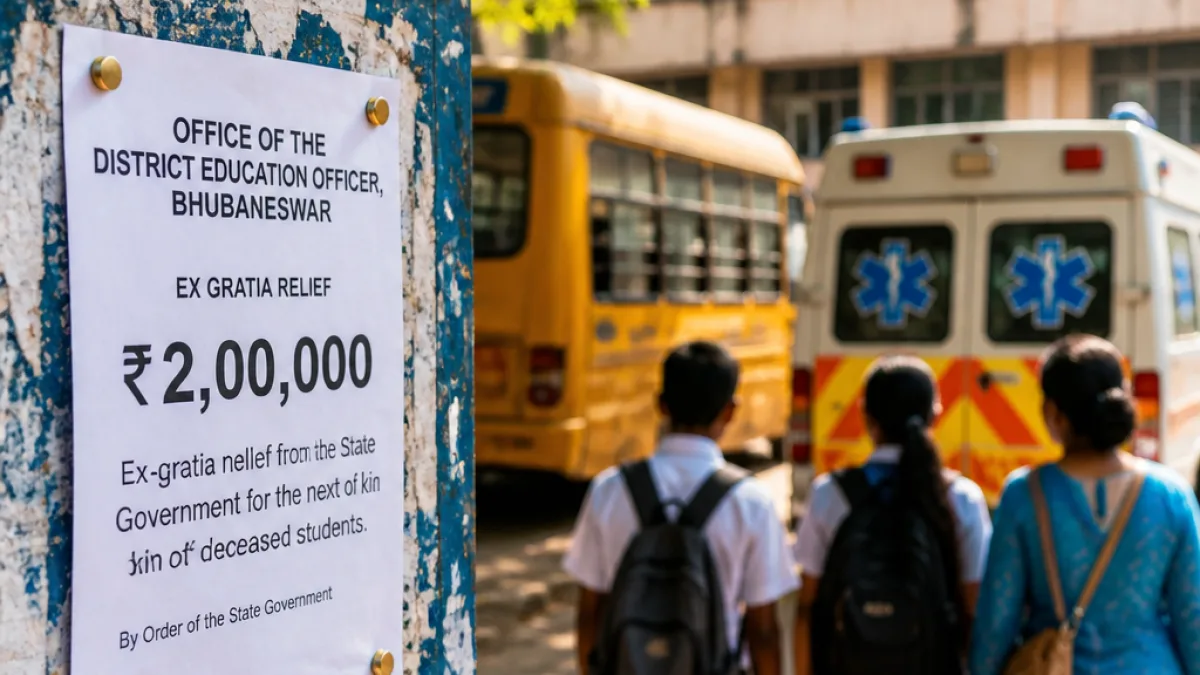
The Odisha government has notified a compensation package that will provide ₹2 lakh to the dependants of students who die or sustain permanent disabilities in accidents occurring in school or during travel to and from school, and during school-related activities. The assistance covers pupils from Sishu Vatika up to Class XII enrolled in government-run, aided schools and Odisha Adarsha Vidyalayas (OAVs), the School and Mass Education department said on Friday.
Scope and eligibility
Under the new measure, the one-time ex gratia payment of ₹2 lakh is intended to provide immediate financial relief to families when an accident causes death or permanent disability. The notification specifies that the scheme applies to incidents that take place within school premises, during sanctioned school programmes, or while students are commuting between home and school.
The state has prescribed a clear order of precedence for disbursal: priority will be given to the mother, if alive; in her absence the father; and thereafter to a guardian nominated by the district collector.
Medical support and additional assistance
Besides the principal ex gratia, the state will fund certain medical and transfer-related expenses for seriously injured pupils. Students who require advanced medical treatment outside their home district may receive up to ₹30,000 to meet transfer costs. Where a pupil is hospitalised for more than three days at a district headquarters hospital, up to ₹10,000 will be available to cover transport-related expenditures.
The department has also clarified that eligible students must receive free treatment at government hospitals and may simultaneously access benefits available under other welfare schemes such as Ayushman Bharat, the Chief Minister’s Relief Fund and assistance from the Red Cross, when relevant.
Sanction and disbursal process
Authority to sanction the ex gratia payment has been decentralised to enable prompt action. The district collector, district education officer (DEO), block education officer (BEO) and the headmaster or principal of the institution are empowered to approve claims. Once sanctioned, the payment must be credited to the guardian’s bank account within 24 hours, according to the notification.
| Assistance type | Amount |
|---|---|
| Death or permanent disability (one-time) | ₹2,00,000 |
| Transfer for advanced treatment outside district | Up to ₹30,000 |
| Transport allowance (hospitalisation >3 days) | Up to ₹10,000 |
Administrative intent and purpose
Officials framing the scheme cited the heavy financial burden that sudden accidents impose on families and the disruptions caused to a child’s education. The notification emphasises expedited financial help and streamlined approval to reduce hardship in crisis moments.
Practical steps for schools and families
While the scheme aims to offer financial relief when tragedy strikes, school authorities and parents can take practical measures to reduce risks and ensure readiness for emergencies. Recommended precautions include:
- Conducting regular safety audits of school buildings, playgrounds and transport arrangements.
- Ensuring all school buses and vehicles are roadworthy, insured and driven by licensed drivers.
- Maintaining up-to-date emergency contact information and consent forms for each pupil.
- Providing basic first-aid kits and training staff in emergency response and stabilisation of injured children.
- Running periodic mock drills for fire, earthquake and evacuation to familiarise students and staff with procedures.
Schools that brief parents on these measures and keep records of safety checks can both reduce incidents and speed administrative action when accidents occur.
Implementation challenges
Decentralised sanctioning and the 24-hour disbursal target may ease access to funds, but local officials will need clear procedures and documentation templates to avoid delays. The notification does not specify detailed documentary requirements in the public text; district administrations will therefore have to publish checklists so affected families know how to apply quickly.
For remote areas of the state where banking access and documentation can be a barrier, the district machinery’s role in identifying guardians and fast-tracking transfers will be particularly important.
The state’s move brings financial assurance to families facing the worst outcomes of school accidents while also highlighting the need for robust prevention and preparedness at the school level. Parents and school managers should treat the policy as a backstop and intensify efforts to bolster safety and emergency response on campus.
Reporting from Bhubaneswar.