The National Green Tribunal (NGT) has asked the Haryana chief secretary to file an affidavit disclosing the decisions and measures taken towards the Haryana Tree Preservation Act, 2026, in response to allegations of large‑scale tree felling and questionable compensatory plantation practices in Gurugram between November 2024 and November 2025.
Tribunal flags regulatory vacuum in non‑forest areas
The direction came during a hearing on a petition that alleged trees were felled in Gurugram without proper permission and that compensatory plantings were perfunctory. The tribunal observed that there is no effective mechanism to regulate tree felling on private land not covered by the Punjab Land Preservation Act, creating a gap in protection for trees in non‑forest areas.
NGT Chairperson Justice Prakash Shrivastava criticised the state authorities’ handling of the issue, saying their conduct was affecting the larger National Capital Region. The bench questioned whether project proponents were exerting undue influence or whether administrative weaknesses were to blame.
“Your authorities are not listening to the needs of the environment. Either project proponents are too strong or authorities are weak. Your conduct is affecting the national capital region,”
During the hearing, the tribunal also scrutinised the reliance on landowners and farmers for compensatory plantations, expressing concern about the long‑term survival and maintenance of such trees.
Expert member Dr Afroz Ahmad noted the absence of assurances that seedlings planted as compensation would survive or be maintained beyond the initial years.
“There is no guarantee farmers will keep those plantations after five years once they mature into fully grown trees,”
Forest department figures and earlier directions
According to a forest department report submitted to the tribunal on August 10, approximately 12,587 trees were felled in the period under review, while permissions were sought for the felling of 17,852 trees in 389 applications. The disparity between felled trees and permissions sought was a focus of the tribunal’s queries.
| Metric | Figure |
|---|---|
| Trees felled (Nov 2024–Nov 2025) | 12,587 |
| Permissions sought | 389 applications for 17,852 trees |
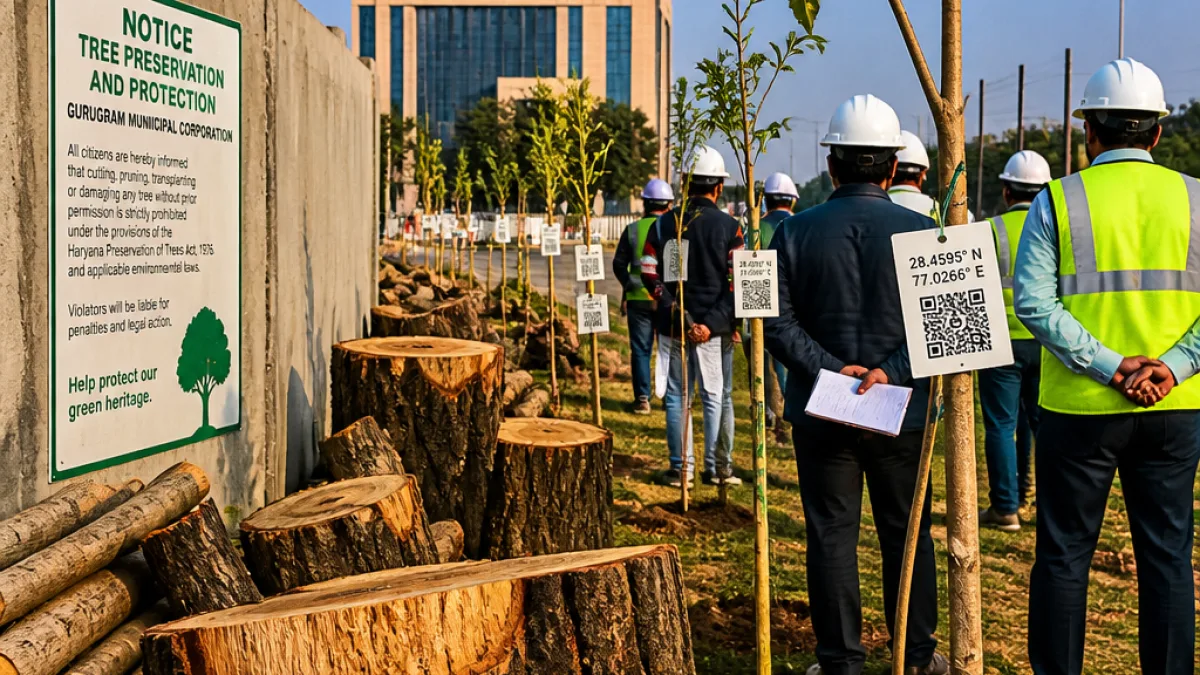
The tribunal referred to its earlier April directions, when it asked Surender Dangi, Divisional Forest Officer (DFO), Gurugram, to appear because a status report on compensatory plantations failed to provide essential verification details — geographical coordinates, video recordings, serial‑wise numbering and survival rates for planted saplings.
At the current hearing, Dangi told the bench that the department carries out periodic inspections of compensatory afforestation sites. The department said it has, following previous directions, collected site‑wise geo‑tagged video recordings of plantations and issued notices to agencies that obtained permissions to fell more than 10 trees but did not carry out compensatory plantations.
Petition and local accountability
The petition was filed by Gurugram environmental activist Vaishali Rana, who accused authorities of permitting tree felling without adequate oversight and imposing only nominal fines for violations. The NGT’s demand for an affidavit from the state chief secretary aims to make the government’s actions and timelines for the proposed legislation publicly accountable.
Environmental experts and the tribunal flagged that relying on private landholders for compensatory planting is an insecure model unless backed by enforceable maintenance obligations, monitoring and penalties for non‑compliance. The bench’s insistence on detailed records — geo‑tagged evidence, survival data and unique identifiers for planted saplings — reflects an enforcement approach that prioritises verifiable outcomes over paper filings.
What the tribunal has sought and next steps
- The NGT has directed the Haryana chief secretary to file an affidavit outlining steps taken towards enacting the Haryana Tree Preservation Act, 2026.
- The tribunal has emphasised the need for verifiable records for compensatory plantations: geo‑coordinates, video proof, serial numbering and survival rates.
- The DFO has reported geo‑tagged video evidence collection and notices to agencies failing to meet compensatory obligations.
The NGT’s order compels the state to clarify both legislative timelines and administrative measures. For residents and developers in the region, the tribunal’s attention signals heightened scrutiny over permissions for tree felling and stronger expectations for documented, durable compensatory planting. How quickly the state submits the affidavit and what it contains will determine the immediate course of further hearings and enforcement actions.