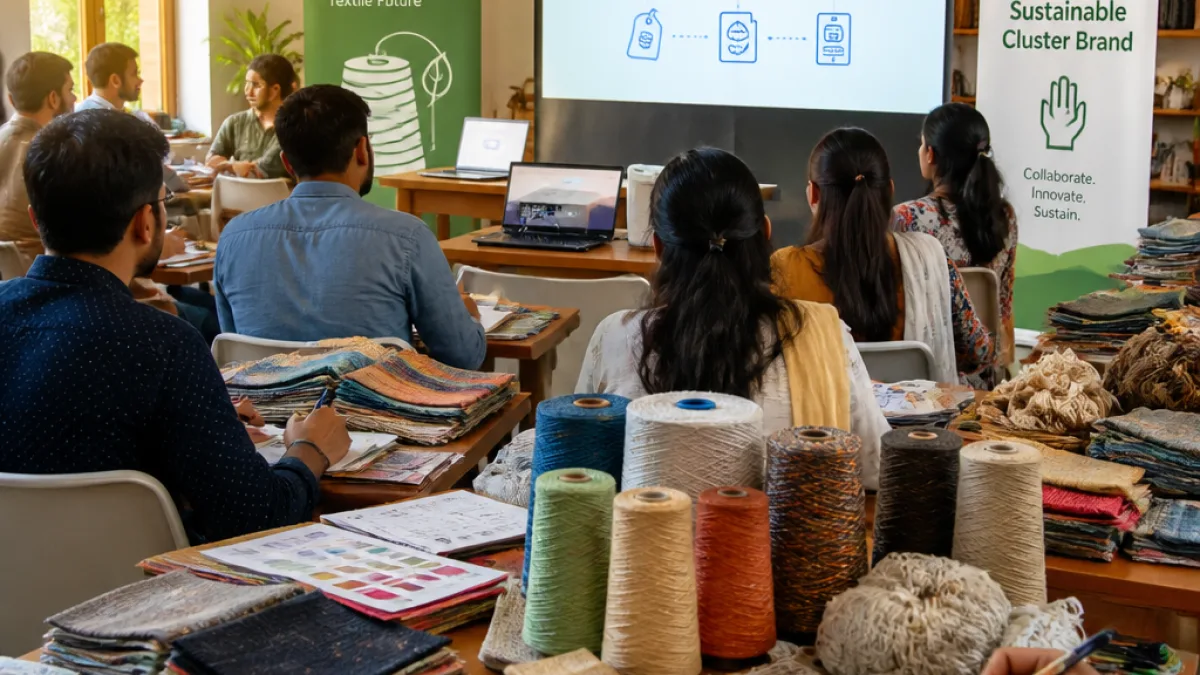
Panipat recyclers briefed on EU rules and Sustainable Cluster Brand
A focused workshop held in Panipat under the EU SWITCH-Asia – Green Threads Project brought together over 60 MSMEs, exporters and other stakeholders from the city’s recycled textile cluster to discuss adoption of a Sustainable Cluster Brand (SCB) and preparedness for emerging European Union sustainability regulations.
The session was organised by the Foundation for MSME Clusters (FMC) in collaboration with consortium partners Global Fashion Agenda (GFA) and Small Industries Development Bank of India (SIDBI), with participation from the Center for Responsible Businesses (CRB) and Conserve India. The workshop aimed to build a common understanding among local firms on the proposed SCB criteria and to sensitise participants to regulatory changes that affect exports to major markets, notably the EU.
Abhishek Naga, Deputy General Manager, Energy & Environment, FMC, opened the session and underlined the need for MSMEs to adapt to global sustainability standards to retain and expand market share. The presentation stressed that proactive compliance would help firms remain competitive as buyers tighten procurement standards.
"MSMEs must proactively adapt to evolving global sustainability standards to enhance their competitiveness in international markets," said Abhishek Naga, according to the workshop report.
Context: EU market size and India’s current share
Speakers highlighted the scale of opportunity and the scale of regulatory change. The workshop report cited EU apparel imports in 2024 at EUR 180.5 billion, of which EUR 79.2 billion came from developing countries. India’s apparel exports to the EU were reported at about EUR 4.1 billion, rising to nearly EUR 7.0 billion when textiles, apparel and home textiles are combined.
The session included an overview of several regulatory instruments that exporters must consider, including the EU Labelling Regulation, recaps of the Ecodesign for Sustainable Products Regulation (ESPR) and related measures such as digital traceability tools and the Digital Product Passport (DPP).
Key takeaways for Panipat firms
- Adopt common SCB criteria: Agreement on cluster-level sustainability criteria could help smaller units meet buyer expectations without each firm bearing the full cost of compliance separately.
- Prepare for digital requirements: The Digital Product Passport was identified as an emerging requirement that will demand better data capture across the supply chain.
- Understand labelling and ecodesign rules: Exporters need to track product composition, lifecycle impacts and disclosure obligations under EU labelling and ecodesign frameworks.
Senior Impact Manager Harshitha Venati of Global Fashion Agenda presented key insights on the EU Labelling Regulation during the session, framing the labelling requirements within broader industry shifts toward product-level transparency. The workshop also revisited earlier modules on ESPR and Extended Producer Responsibility, signalling an incremental but widening set of obligations for exporters.
Why this matters locally
Panipat’s textile ecosystem includes many micro, small and medium enterprises that supply yarn, fabric, processing and finished goods. The workshop organisers emphasised that cluster-level alignment on sustainability standards and access to technical assistance could reduce the compliance burden and protect jobs by maintaining access to the EU market.
| Metric | Figure (2024) |
|---|---|
| EU apparel imports | EUR 180.5 billion |
| From developing countries | EUR 79.2 billion |
| India's apparel exports to EU | EUR 4.1 billion |
| India (textiles, apparel, home textiles) to EU | Nearly EUR 7.0 billion |
Organisers said the workshop was intended as a step towards consensus on SCB adoption and to identify next steps for technical support. The report indicates further capacity-building activities under the Green Threads Project are planned to help Panipat firms comply with evolving buyer and regulatory demands.
For Panipat exporters and small units, the immediate implications are practical: increased administrative and data-management requirements, potential changes in product design and materials, and the need to coordinate at the cluster level to share costs and technical expertise.