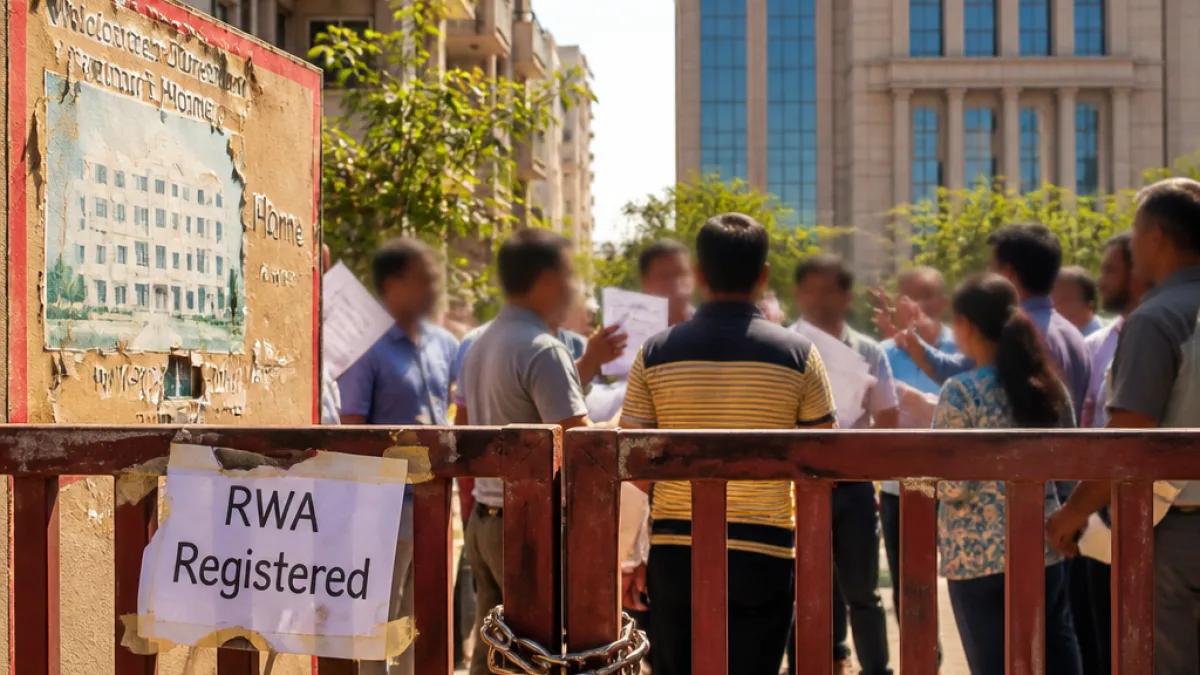
Long-running fights over RWA membership grip Gurugram societies
Apartment owners in several Gurugram gated communities are locked in protracted disputes over membership of Resident Welfare Associations (RWAs) and Apartment Owners’ Associations (AOAs), with some alleging that builders and management committees have manipulated registrations to exclude owners, ThePrint reported.
Residents described prolonged interactions with builders and repeated visits to government offices after discovering, to their surprise, that an RWA had already been registered without their knowledge. One resident identified in coverage as Rishi said what started as an expectation that an RWA would be formed quickly turned into a continuing legal and administrative battle spanning several years.
Legal experts point to an unclear practical overlap between multiple statutes and regulatory frameworks. Advocate Sanjay Lal was quoted as saying that the difficulty in becoming an RWA member in Gurugram is not just administrative but arises from how Haryana has allowed apartment ownership laws, society laws, RERA provisions and builder-controlled maintenance arrangements to coexist without a clear statutory framework.
“In Gurugram, the difficulty many apartment owners face in becoming members of an RWA or AOA is not merely an administrative problem. It is largely a consequence of the way Haryana has allowed apartment ownership laws, society laws, RERA provisions and builder-controlled maintenance arrangements to overlap, without a clear statutory framework,” said Advocate Sanjay Lal, according to the reporting.
The legal basis for registration is primarily the Haryana Registration and Regulation of Societies Act, 2012 (HRRS Act, 2012), which envisages RWAs/AOAs as bodies that grant apartment owners a formal role in community management. Yet, on the ground, disputes among builders, existing RWAs and individual residents have made the process contested and opaque.
- Several residents reported that an RWA had been registered in their society in 2023 without broader awareness of owners.
- In at least one case, the founding RWA committee reportedly resigned in 2025 after disputes over membership and control.
- Residents say resolving membership denial has required repeated complaints to builders and multiple visits to the District Registrar’s office.
ThePrint's coverage records specific examples of owners alleging they were prevented from becoming formal members despite owning flats and paying maintenance, leading to what residents describe as a denial of a basic participatory right in community management. One resident, Rishi, said his attempts to obtain a membership certificate involved a four-year struggle of complaints, confrontations and administrative visits.
Officials responsible for registration and membership disputes remain the formal route for redress, but residents say the process has not been quick or transparent. The article notes that the overlapping legal frameworks allow scope for builders and vested groups to influence formation and composition of resident bodies, which in turn affects control over maintenance, common facilities and decision-making in gated complexes.
| Item | Reported detail |
|---|---|
| Governing statute | Haryana Registration and Regulation of Societies Act, 2012 |
| Reported registered RWA | 2023 (in one cited case) |
| Reported resignation of founders | 2025 (in one cited case) |
Residents and legal practitioners interviewed in the coverage urged greater procedural transparency from builders and more proactive supervision by registration authorities to ensure that apartment owners are informed and able to exercise their statutory rights.
For Gurugram homeowners, the dispute has immediate consequences: membership of an RWA determines who can contest management, access accounts and participate in decisions affecting maintenance charges, repairs and common-area governance. Where membership is contested or opaque, accountability can weaken and conflicts over funds and services may escalate.
ThePrint's report underscores the need for clarity in how multiple regulations intersect in practice. It also highlights recurring requests from residents that authorities ensure public notice and consultation during formation and registration of RWAs/AOAs so that ownership rights do not remain theoretical but translate into real participation.