
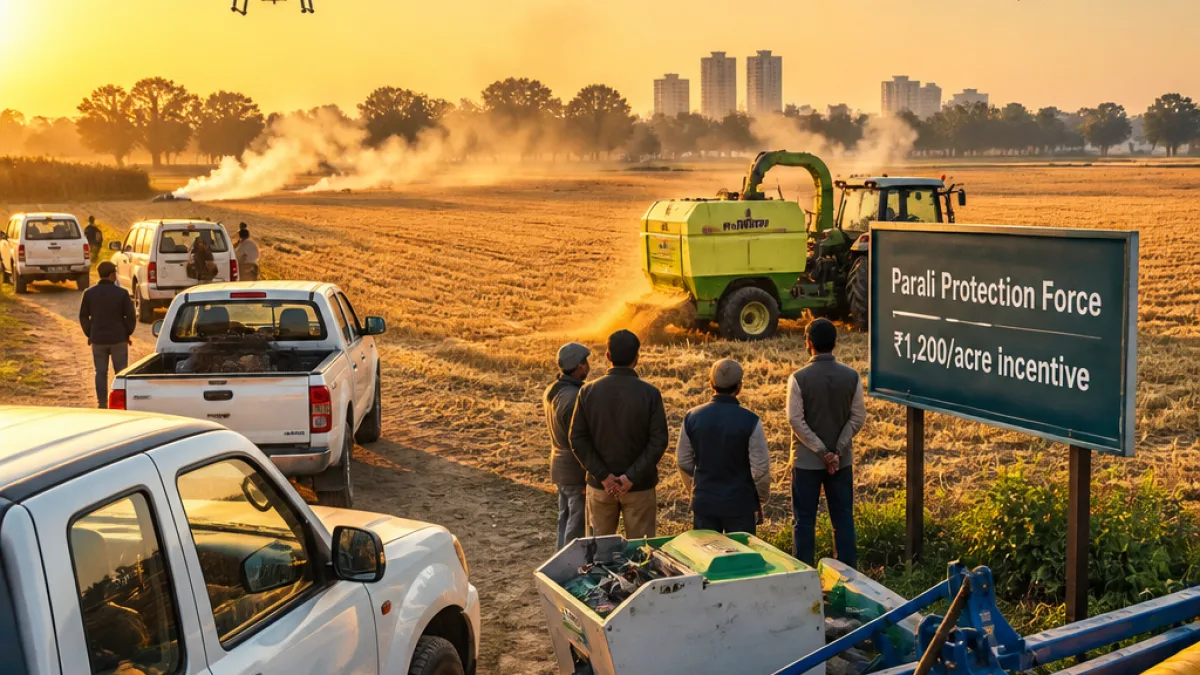
Haryana has unveiled a strengthened enforcement and incentive package to combat paddy stubble burning ahead of the forthcoming harvest season, officials said on Thursday. The plan combines a dedicated field force, intensified patrolling and drone surveillance with financial incentives and greater availability of crop‑residue machinery.
New enforcement architecture
The state will constitute a “Parali Protection Force” that will function at both district and block levels. The multi‑departmental teams will include police personnel, officials from the Agriculture Department, district administrative officers, and designated nodal and cluster officers, along with representatives of other stakeholder departments.
The force’s remit is to closely monitor farm‑fire incidents and take prompt action where stubble burning is detected. The enforcement protocol prescribes three measures in every verified case: registration of a First Information Report (FIR), issuance of a challan and making a “red entry” in the farmer’s land records. Environmental compensation will also be levied and recovered from violators.
Surveillance and timing
Haryana plans to step up late‑evening patrolling during the burning season and move towards systematic drone surveillance. In line with directions from the Commission for Air Quality Management (CAQM), the state is working with DRIISHYA to deploy drones for monitoring stubble‑burning incidents.
Officials have been instructed to synchronise enforcement and machinery movement with the paddy harvesting calendar. Harvesting is expected to start in the north‑eastern districts and move west and south as the season progresses.
| Phase | Districts (approx. start) |
|---|---|
| Early September | Yamunanagar, Ambala, Karnal, Kurukshetra |
| Late October | Sirsa, Fatehabad, Hisar, Jind |
Incentives and machinery sharing
To provide alternatives to burning, the state is offering an incentive of ₹1,200 per acre for optimal use of crop‑residue management machinery. Alongside the incentive, Haryana is providing subsidies for farmers purchasing machines such as balers and rakers.
Recognising variable harvest times across districts, the government will move balers and other equipment between districts according to local schedules. District officials have been asked to coordinate with baler owners in neighbouring states and adjoining Haryana districts to ensure sufficient machinery is available when required.
What the plan aims to achieve
- Reduce incidents of paddy straw burning through active patrolling and rapid response.
- Detect and deter offenders using FIRs, challans and land‑record penalties.
- Encourage adoption of on‑farm and collective mechanised solutions via incentives and shared machinery pools.
- Use technology — notably drones — to identify and document violations for enforcement.
Officials said the enforcement measures would be pursued alongside outreach to farmers on alternatives to burning and the logistics of using shared machinery. The state’s combined approach seeks to balance punitive steps with support measures, aiming to cut emissions that contribute to poor air quality in the region.
Operational coordination
Implementation will require coordination between several agencies: law and order units for patrol and FIRs, agriculture teams for machinery deployment and farmer outreach, and technical partners for drone operations. The CAQM’s oversight and the engagement of DRIISHYA for aerial monitoring underline the technological emphasis in the new plan.
Authorities will also monitor the flow of machines across borders and request cooperation from adjoining states when needed, particularly to access additional balers during peak harvesting in parts of Haryana.
As harvesting begins in September in parts of the state, officials said the combined enforcement‑incentive strategy is intended to deliver immediate deterrence while expanding practical, lower‑cost alternatives for farmers who traditionally resort to burning crop residue.












