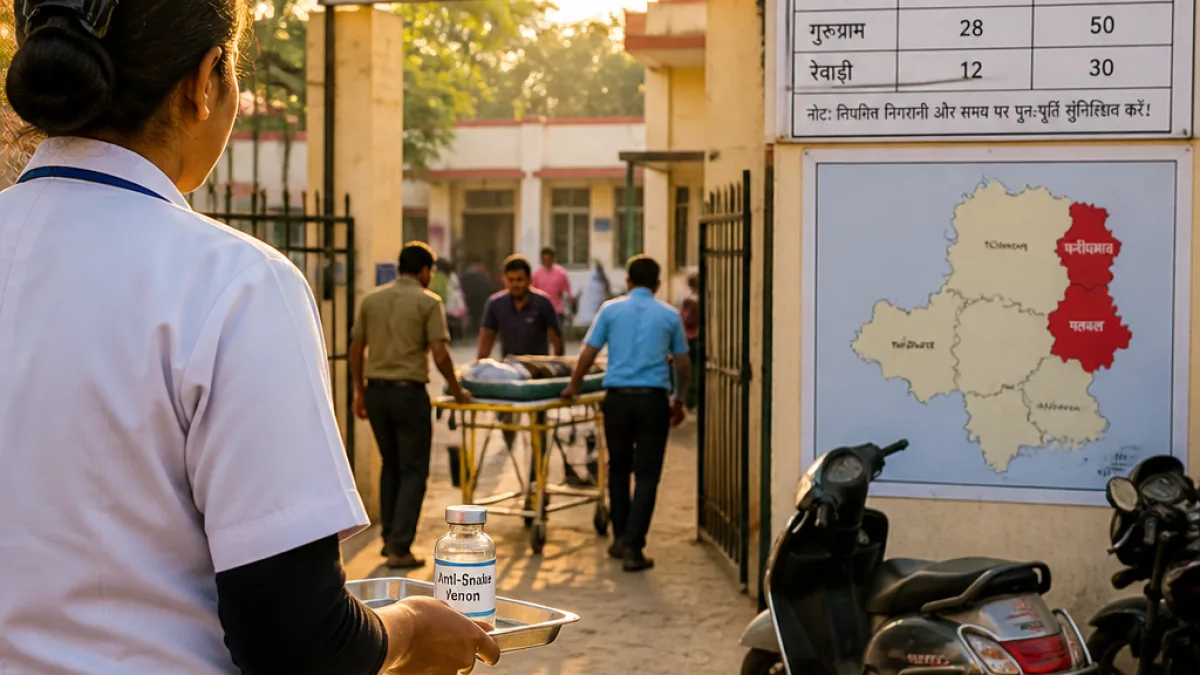
Chandigarh: Prompt administration of anti‑snake venom (ASV) has saved nearly 473 snakebite victims in Haryana so far this year, the state health department said on Friday. Officials said the highest number of cases were recorded in Jhajjar and Ambala districts.
ASV availability and stock monitoring
Additional Chief Secretary, Health and Family Welfare, Dr Sumita Misra, said ASV is provided free of cost at all primary health centres (PHCs), community health centres (CHCs) and civil hospitals across the state. Health department officials said stocks are monitored continuously to prevent shortages and ensure immediate treatment during emergencies.
Five‑year treatment figures
According to the health department, a total of 1,526 snakebite victims were treated in Haryana over the last five years. Officials highlighted improved public response, with more victims being taken straight to hospitals instead of seeking faith healers or traditional remedies, which can delay life‑saving care.
| Period | Snakebite victims treated |
|---|---|
| Last five years | 1,526 |
| This year (to date) | 473 saved following ASV administration |
Clinical and public advice emphasised
Health officials reiterated basic first‑aid measures to reduce harm while arranging transport to a health facility. They urged that the victim be kept calm, movement restricted, and the affected limb kept still and at or below heart level. Rings, watches, bangles or tight clothing should be removed because swelling may develop.
- Gently wash the bite area with clean water; do not cut or suction the wound.
- Avoid tight tourniquets, applying ice, chilli, oil or pastes, and do not give alcohol or intoxicants.
- If safe, a photograph of the snake taken from a distance may help clinicians, but people should not try to catch or kill the snake.
- Inform trained snake rescuers or the forest department instead of attempting capture.
Officials warned against tying a tight rope or tourniquet, cutting the wound, sucking out venom, applying ice, chilli, oil or traditional pastes, or giving alcohol or intoxicants to the victim. It also warned against wasting time on faith healing.
Case example underlines importance of quick care
The department cited the example of a 20‑year‑old woman from Palwal who was bitten while working in a field. She was rushed to hospital, given ASV immediately and discharged after recovery, illustrating the positive outcomes possible when victims reach medical care quickly.
Why timely treatment matters
Snake envenoming can progress rapidly and cause haemotoxic, neurotoxic or local tissue damage depending on the species and quantity of venom injected. ASV remains the only specific antidote for systemic envenoming; delays in receiving it can increase the risk of complications and death. The health department's emphasis on ASV availability and stock monitoring aims to reduce preventable mortality and morbidity from snakebites across Haryana.
What residents should know
Residents in rural and peri‑urban areas — where human‑snake encounters are more common — were advised to:
- Keep pathways and courtyards clear, use footwear when walking in fields or thick vegetation, particularly after sunset and before dawn.
- Ensure families know the location of the nearest PHC, CHC or civil hospital that stocks ASV.
- Transport the victim to hospital promptly rather than relying on unverified traditional remedies.
The health department said it will continue public education on preventive measures and first‑aid, and maintain ASV supplies at government health facilities. No additional figures or district‑wise breakdown beyond Jhajjar and Ambala were provided in the briefing.