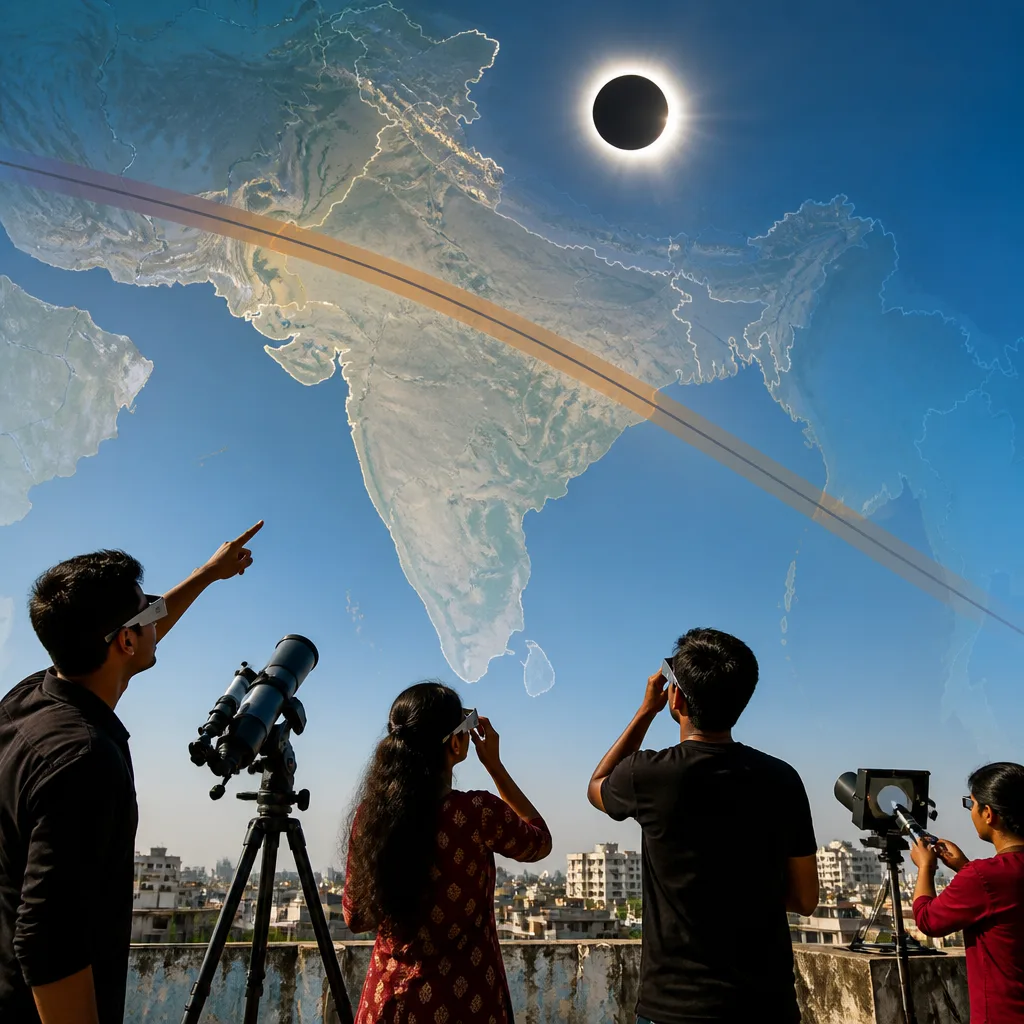
Millions of skywatchers in Europe, Greenland and parts of the North Atlantic witnessed a total solar eclipse on 12 August 2026, while India remained outside the path of totality. Astronomical projections now show the next total solar eclipse that will pass over Indian territory is due on 20 March 2034, when the Moon’s shadow will sweep across parts of South Asia.
What happened on 12 August 2026
The 12 August event unfolded as the Moon moved directly between Earth and the Sun, briefly blocking the Sun’s bright disk for observers within the narrow path of totality. The spectacle drew photographers, scientists and casual skywatchers to locations across Greenland, Iceland, northern Russia, Spain and a small section of Portugal. In central parts of the eclipse track, totality lasted up to about two minutes and 18 seconds, according to observational reports.
In western Europe, the eclipse coincided with sunset in some areas, producing dramatic skies as the partially obscured Sun descended below the horizon. Observers within the path experienced the Moon’s silhouette entirely covering the Sun, permitting a view of the faint solar corona — the Sun’s outer atmosphere that is normally hidden by the brightness of the solar disk.
Why India missed the 2026 eclipse — and when it will see totality
The geometry of solar eclipses makes visibility highly location-specific. For the 2026 event, India lay outside the Moon’s shadow path and experienced night-time conditions while the eclipse occurred. Eclipse projections now indicate that the 20 March 2034 eclipse will cross North Africa, the Middle East and into South Asia, with the shadow traversing parts of India, Pakistan, Afghanistan, Iran, Saudi Arabia and Egypt before continuing eastward.
When the Moon completely covers the solar disk during totality, the faint corona becomes visible and the sky darkens as if it were twilight. For India, the 2034 event is expected to be one of the most significant astronomical events of the decade for observers and scientists in the region.
Opportunities for science and public engagement
Total solar eclipses offer both public spectacle and scientific value. During the brief moments of totality, ground- and space-based instruments can study the corona’s structure and dynamics, investigate solar wind origins, and measure magnetic field signatures that are otherwise obscured. For educators and outreach teams, eclipses provide a chance to engage large audiences with astronomy and observational safety messages.
- Date of recent eclipse: 12 August 2026 — visible across parts of Europe and the North Atlantic.
- Next totality over India: 20 March 2034 — path projected to cross South Asia.
- Scientific gains: corona observations, transient phenomena study, outreach and public interest in astronomy.
Practical guidance and cautions
Authorities and astronomy groups typically stress the importance of safe viewing: never look directly at the Sun without certified solar filters or eclipse spectacles during partial phases. Only during the brief span of totality, when the Sun is wholly obscured, is it safe to view the eclipse with the naked eye. Observers planning for 2034 should follow guidance from professional societies and check official eclipse-path projections well in advance to identify prime viewing locations.
"the move of his life."
The recent European event also produced viral images and moments from the public viewing crowds. As with past eclipses, a mix of scientific observation and popular culture accompanied the astronomical spectacle.
| Event | Date | Visibility |
|---|---|---|
| Total solar eclipse | 12 August 2026 | Parts of Europe, Greenland, North Atlantic (not India) |
| Next totality visible in India | 20 March 2034 | Projected path crosses South Asia |
For scientists and enthusiasts in India, the 2034 eclipse offers time to prepare instruments, plan public outreach, and coordinate cross-border observational campaigns where the path passes multiple countries. Accurate prediction of eclipse tracks comes from established astronomical calculations; still, local weather conditions will ultimately determine viewing quality at any given site.
As the 2034 date approaches, observatories, astronomy clubs and educational institutions are likely to intensify preparations so the event can be both a scientific opportunity and a safe, well-managed public experience.