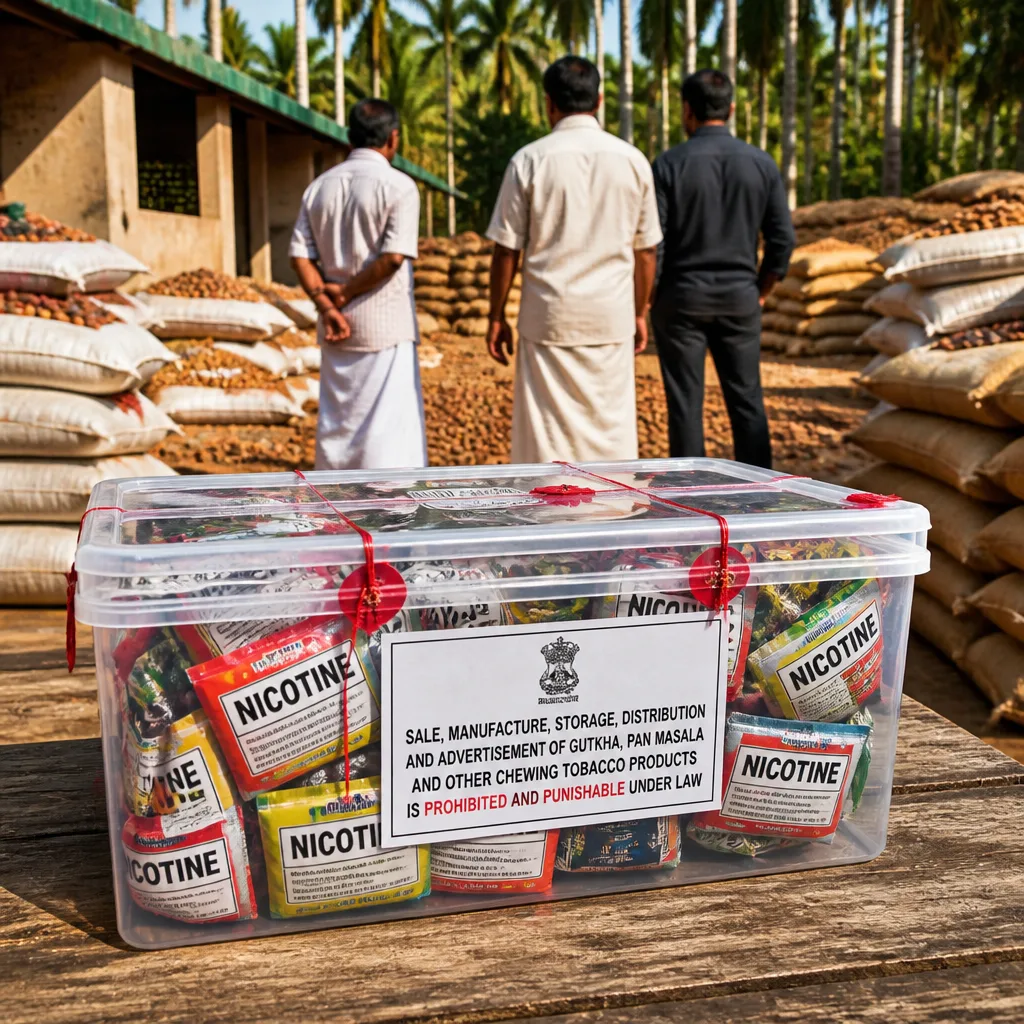
Bengaluru: Karnataka's Health Minister U.T. Khader on Saturday clarified that the state has not withdrawn its order on gutka, but has moved to specifically prohibit nicotine‑containing gutka and pan masala in the interest of public health. He emphasised the decision will not adversely affect arecanut growers and traders.
Government intent and farmers' concerns
Answering reports that the ban had been reversed, Khader told reporters in Bengaluru that the directive targets the presence of nicotine in pan masala products and is intended to protect public health. He said the state administration will continue to support arecanut cultivation, trade and farming communities and insisted there is no ban on arecanut itself.
"The order is only against nicotine in pan masala. There is no ban on arecanut. Our department and the government will continue to provide complete support and encouragement to arecanut growers, farmers and traders," the minister said.
Why the government says growers will not suffer
Khader argued that the move need not cause losses to those engaged in arecanut production. Drawing on the government's earlier experience when a previous gutka ban was introduced, he suggested the market may even see a rise in arecanut prices rather than a fall.
- Order scope: prohibition directed at nicotine in pan masala and gutka products.
- Agricultural impact: no restriction on arecanut cultivation or sale, according to the Health Minister.
- Government reassurance: continued support and encouragement to arecanut farmers and traders.
Khader also told the media that Indian arecanut is reportedly not the main source for manufacturers of gutka, who, he said, often source arecanut from neighbouring countries. He urged patience, saying stakeholders should observe the market over the coming months to judge impact.
Political context and public health priority
The minister recalled that when the state had earlier moved to ban gutka, similar anxieties had been raised about arecanut prices and the welfare of farmers. On that occasion, he said, the predicted downturn did not materialise and prices subsequently increased after three months. He said Chief Minister D.K. Shivakumar had supported the decision and insisted that public health considerations must remain paramount while ensuring farmers' livelihoods are protected.
Implications for tobacco control and next steps
The order targets nicotine as an additive in chewable tobacco preparations and pan masala. Public‑health experts regard nicotine‑containing preparations as addictive and associated with long‑term harms to oral and systemic health. Measures restricting nicotine in such products are part of broader tobacco‑control strategies recommended by national and international bodies such as the Ministry of Health and Family Welfare and the World Health Organization, which advise countries to reduce availability and attractiveness of addictive tobacco products.
Karnataka's approach appears to try to balance public‑health objectives with economic concerns of agricultural communities. The minister asked stakeholders to wait for market adjustments over a three‑month period, as done earlier, before drawing conclusions on impact.
What consumers and growers should know
Consumers should note that a prohibition on nicotine in specific products means formulations that include nicotine are subject to enforcement action. Growers and traders of arecanut, the minister said, should continue regular cultivation and trade activities; the government intends to provide necessary assistance to mitigate any transitional challenges.
As with any public‑health measure, individuals with questions about tobacco use or dependence are advised to consult qualified healthcare providers. Agencies such as the Indian Council of Medical Research (ICMR) and the National Tobacco Control Programme provide guidance on cessation services and harm reduction. Readers seeking help for nicotine dependence should contact local health facilities or certified cessation centres rather than relying on unverified remedies.
The state government’s notification and its detailed implementation instructions will determine enforcement on the ground and any regulatory impact on manufacturers and retailers. Stakeholders will be watching the official orders and subsequent clarifications from the state administration in Bengaluru.