
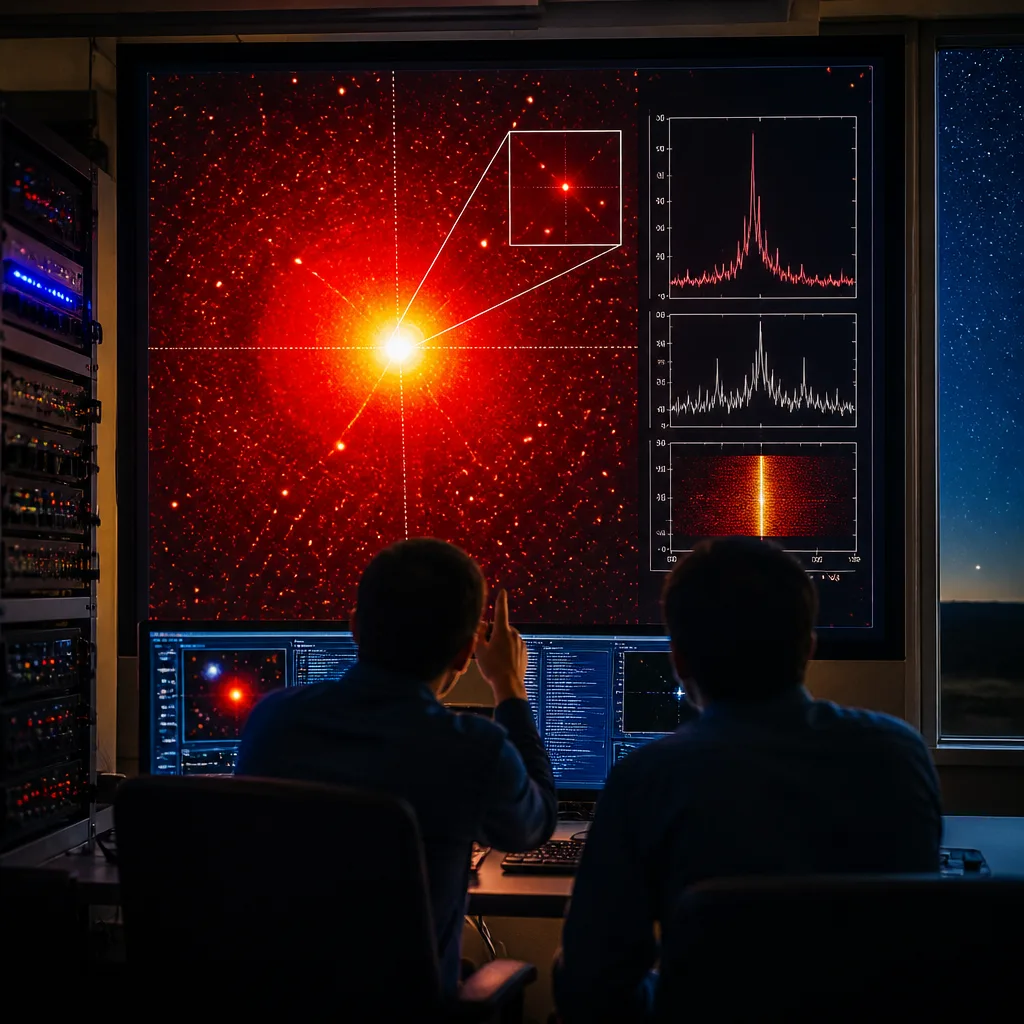
Astronomers analysing data from NASA’s James Webb Space Telescope (JWST) report discovery of an extraordinarily bright object from the early Universe that does not match any previously known class of astrophysical body. The object, identified in a JWST survey for the Universe’s earliest galaxies and published in Nature, has been proposed as a new type of entity: a "black hole star", a supermassive black hole embedded in a star‑like envelope of primordial gas.
What the discovery shows
The source, labelled MoM‑BH‑1* by the research team, was detected as an intense red point in JWST images taken at wavelengths that probe the epoch a few hundred million years after the Big Bang. Analysis indicates the object shines with a luminosity comparable to the combined output of about 100 billion Suns and has spectral features inconsistent with ordinary stellar populations and known galaxy templates.
Lead author Rohan Naidu of the Massachusetts Institute of Technology is quoted in the paper describing the inferred central mass:
"We think there is a central black hole that is 100,000 times as massive as the Sun. Around this black hole, there would be a very extended envelope of gas that looks like a star the size of the Solar System."
Detailed spectroscopy showed an unusually deep Balmer break, a discontinuity in the spectrum associated with hydrogen, which the authors say could not be reproduced by ordinary stellar populations. The object’s light is also dominated by hydrogen and helium with very little evidence of heavier elements, consistent with primordial composition expected soon after cosmic reionisation.
How researchers reached this interpretation
The team combined JWST imaging and spectroscopic data with computer simulations to test different physical models. Conventional explanations — an individual star, a stellar cluster, or a regular galaxy hosting an accreting black hole — failed to reproduce the observed luminosity, spectral shape and inferred lack of heavy elements. Simulations in which a massive black hole sits at the centre of an extended, dense hydrogen envelope matched the data more closely, leading the authors to propose the "black hole star" scenario.
- Observed epoch: a few hundred million years after the Big Bang.
- Luminosity: ~100 billion Suns.
- Central black hole mass (inferred): ~100,000 Solar masses.
- Structure: extended hydrogen/helium envelope comparable in size to the Solar System.
- Composition: almost exclusively hydrogen and helium, with negligible heavy elements.
The authors caution that the interpretation remains tentative. The term "black hole star" describes an accreting black hole enveloped within a star‑like gas shroud that reprocesses emitted radiation, producing stellar‑like spectral signatures despite being powered by gravitational accretion rather than nuclear fusion. Further JWST observations and theoretical work will be required to confirm whether MoM‑BH‑1* represents a new class of object or an unusual extreme of a known category.
Context and implications
If confirmed, the discovery has several implications for models of early structure formation. It may provide a natural explanation for the numerous ultra‑red, ultra‑bright compact sources JWST has found in deep fields — sometimes referred to as the era’s "little red dots" — and could offer a pathway to forming early supermassive black holes observed at high redshift.
The apparent absence of heavy elements points to formation from primordial gas. The envelope’s size — comparable to the dimensions of the Solar System — underscores how different early cosmic objects could be from modern stellar systems. The mechanism that builds such an extended gaseous cocoon around a growing black hole, and the subsequent evolution of the system, are active areas for follow‑up study.
| Property | Inferred value |
|---|---|
| Luminosity | ~100 billion Suns |
| Central mass | ~100,000 Solar masses |
| Composition | Hydrogen and helium dominated |
| Apparent size | Comparable to Solar System |
The finding demonstrates JWST’s capacity to reveal unexpected phenomena in the first billion years, but authors emphasise caution: the Nature paper presents models that match current data, not a unique solution. Future JWST spectroscopy with higher signal‑to‑noise and observations at other wavelengths, together with improved simulations, will be needed to test the black hole star hypothesis and to determine how common such objects may have been in the infant Universe.