High‑altitude evacuation near Nun Kun tests helicopter limits
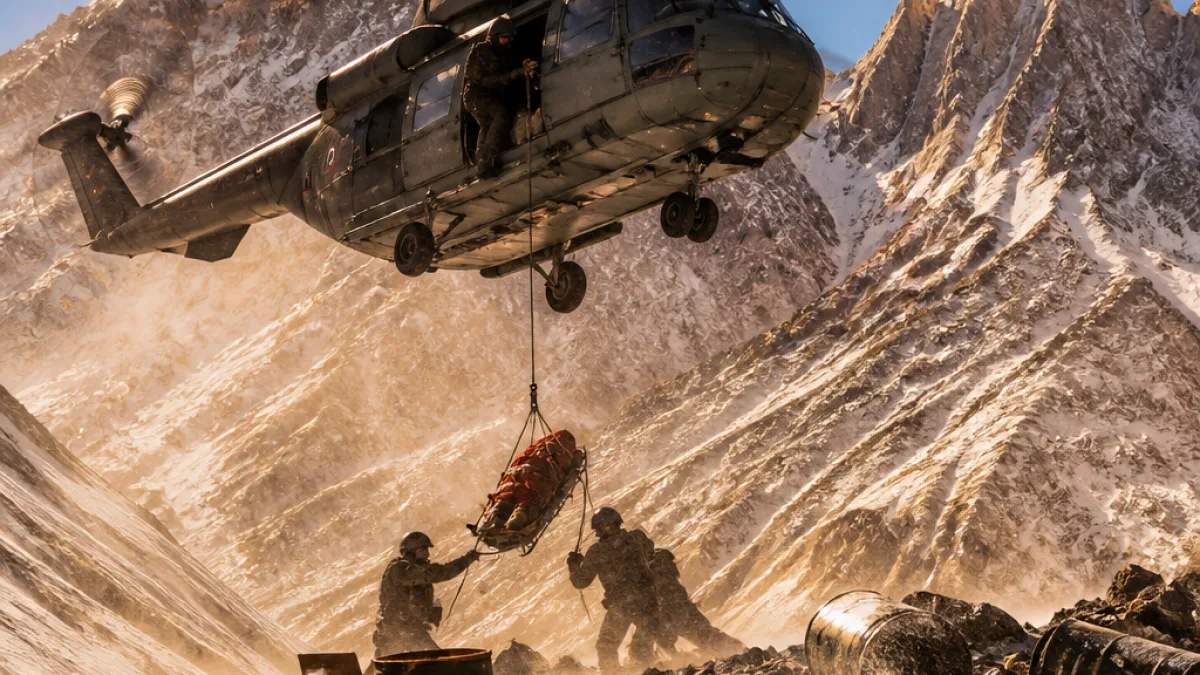
Indian Army aviation crews on Saturday carried out a precision rescue to evacuate a patient from a steep mountainside at an altitude of 18,600 feet near the Nun Kun mountain range in Ladakh, official video and media reports said. The operation, undertaken in rapidly fading daylight and strong winds, left no space for a conventional helicopter touchdown and required technical flying and mission management, according to the footage circulated by news agency ANI.
High‑altitude helicopter operations face unique limitations because reduced air density diminishes engine performance and rotor lift, curbing the aircraft’s available payload. To address those constraints during the Ladakh mission, the aviation crew removed non‑essential equipment from the helicopter and carried only the minimum fuel required while ensuring enough to complete the sortie, the report added.
"In a daring rescue mission at 18,600 ft near Nun Kun, Indian Army Aviation pilots evacuated a casualty from an extremely challenging slope with no landing space and strong winds," ANI wrote alongside the shared video.
The rescue video posted on social media shows the helicopter holding a hover close to the slope while crew members conducted the casualty evacuation. The short clip has since been widely shared and prompted strong public reactions, drawing attention to the technical demands of mountain rescues in the Union Territory.
Why such rescues are especially difficult
Aircraft performance at very high altitudes is affected in two main ways, both of which were cited in the published account of the mission:
- Engine power loss: Thinner air contains less oxygen, reducing the power output of turbine engines and affecting climb capability.
- Rotor lift reduction: Lower air density provides less aerodynamic lift per rotor revolution, limiting the helicopter’s payload margin.
These factors force crews to make operational trade‑offs: lightening the aircraft by offloading non‑essential gear, carrying reduced fuel to lower weight and planning to operate within narrow "landing windows" when daylight and weather temporarily permit safer flight and hover operations.
Operational choices and risks
The cited account states the mission was executed during the "last available landing window of the day," underscoring the time pressure such sorties often entail. Time‑limited daylight, rapidly changing mountain weather and strong, gusting winds increase risk for aircrews and complicate casualty recovery.
While the public video highlights the dramatic element of the extraction, it also illustrates routine procedures used by trained army aviation crews in the high Himalaya: precise hover control, coordinated winching or fast‑rope techniques where landing is impossible, and careful fuel and weight management to preserve a safe margin for the return flight.
Local impact and public reaction
The successful evacuation has been widely circulated on social platforms, with the shared ANI post generating a wave of responses praising the professionalism of the armed forces. The footage has renewed discussion about the challenges of emergency medical access in remote high‑altitude zones of Ladakh and the role of military aviation in supplementing civil rescue capability.
Local authorities and disaster management agencies in mountainous regions frequently stress the importance of rapid aerial response capabilities, given the limited road access and long ground transit times for many high‑altitude settlements and trekking routes.
| Item | Detail |
|---|---|
| Altitude | 18,600 feet (near Nun Kun range) |
| Operational constraints | Strong winds, steep slope, no landing space, reduced air density |
| Mitigation measures | Removal of non‑essential equipment, limited fuel load, last landing window |
Wider context
Ladakh’s high mountain environment places a premium on trained military and specialised civilian rescue teams. Helicopter sorties of this nature are complex and require crews who are experienced in mountain flying, fine hover control and quick decision‑making under pressure.
While the immediate outcome in this incident appears to be a successful evacuation, the event also highlights ongoing needs for medical evacuation planning, strengthened local rescue capacity and public awareness about the hazards of high‑altitude travel in the Himalayan region.
The Army video and the accompanying ANI post form the primary publicly available account of the operation. No further operational details, including the patient’s identity or condition, were provided in the materials released with the footage.
The rescue adds to a sequence of documented high‑altitude operations in the region and underlines the technical skill and logistical planning required when life‑saving help must reach remote slopes where conventional landings are impossible.