The Ladakh administration on Friday cleared rules to regularise long‑standing "nautor" land holdings, a move that paves the way for thousands of occupants to obtain proprietary rights over barren or waste land they have cultivated or occupied for generations, officials said.
Key features of the regularisation framework
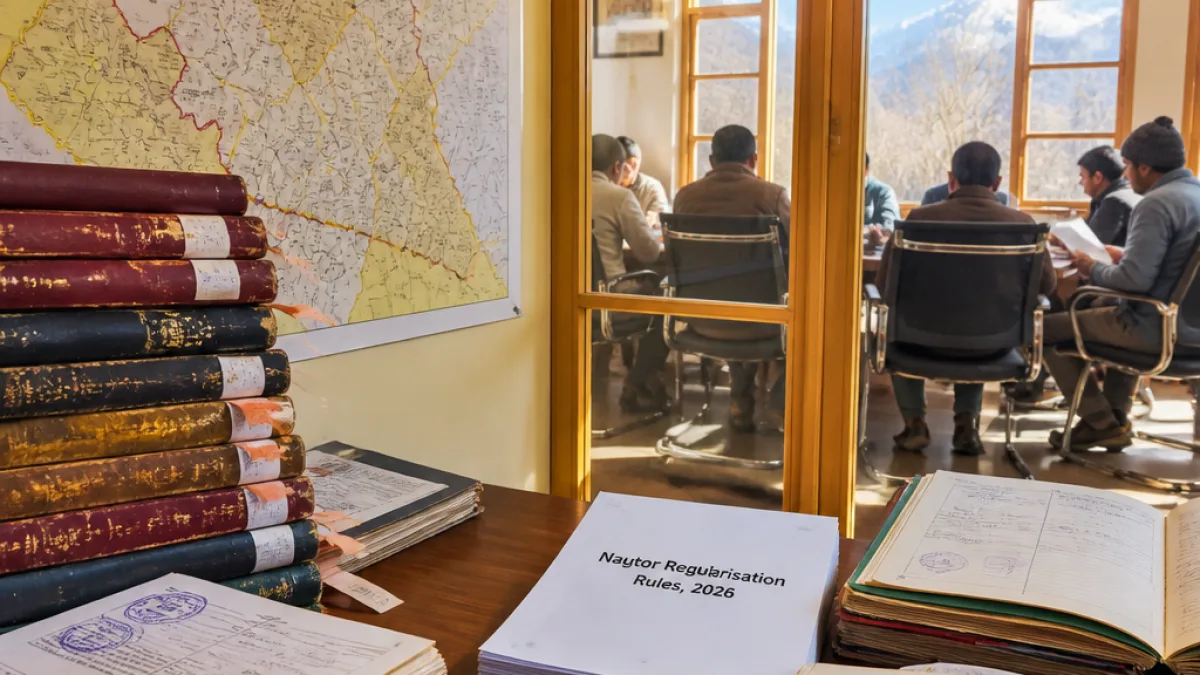
The Nautor Regularisation Rules, 2026 provide a one‑time mechanism to convert occupancy of government‑owned barren land into proprietary title for eligible persons. An official spokesperson said the rules apply to holdings occupied before 27 October 2020 — the date when the Jammu and Kashmir Tenancy Act, 1980 was repealed — and set a threshold of up to 10 acres that can be regularised as proprietorship.
“These rules seek to strike a balance between protecting the legitimate interests of genuine nautor landholders and safeguarding public and Council land from encroachment and unauthorised claims,” Lieutenant Governor Vinai Kumar Saxena said.
The rules also allow nautor land beyond the 10‑acre limit to be allotted on a leasehold basis, and vest the authority to process and grant such allotments with the Ladakh Autonomous Hill Development Councils (LAHDCs) across all seven districts, the spokesperson added.
Background and scale of the issue
Under revenue records, more than 60,000 acres in Ladakh are recorded as nautor holdings — state land historically allotted for cultivation or other productive use. For decades, families in remote pockets converted otherwise barren tracts into arable plots under customary arrangements; however, legal title often remained with the government, leaving occupants without full proprietary rights.
Local leaders and residents have for years pressed for a statutory mechanism to recognise these de facto holdings. The new rules aim to formalise long‑standing arrangements while setting a clear cut‑off date so that only historical occupancies are considered eligible.
How the rules will operate locally
The rules transfer administrative responsibility for allotments to the LAHDCs. Officials said this aligns with existing provisions of the Ladakh Autonomous Hill Development Councils Act, 1997, which assigns land‑related executive powers to the district councils.
- Cut‑off date: Possession prior to 27 October 2020 only.
- Eligible area: Proprietary rights up to 10 acres per occupant; excess may be leased.
- Authority: LAHDCs in all seven districts empowered to process applications and grant titles or leaseholds.
Officials emphasised that possession after the cut‑off date will not be eligible for regularisation, signalling an attempt to prevent recent encroachments from being legitimised retroactively.
Administration's stated goals and safeguards
According to the government statement, the rules are designed to balance two objectives: secure the legitimate interests of those who have invested labour into transforming barren land and protect public and Council land from unauthorised claims.
The LAHDCs will be required to verify claims against revenue records and local evidence of cultivation or occupation. The statement cited Section 42 of the LAHDC Act, 1997 — under which land within a district stands transferred to the Council — and Section 23 clause (i) as the statutory basis for delegating allotment powers to the Councils.
Practical implications for farmers and occupants
If implemented smoothly, the exercise could provide occupants with secure land titles that enable better access to credit, investment in soil improvement and irrigation, and inter‑generational transfer of assets. Regularisation may also simplify dispute resolution and reduce litigation on land ownership in rural pockets.
However, the government will need clear procedures and adequate staff at the district level to examine claims, verify historical occupancy and guard against fraudulent applications. The cut‑off date will be a critical benchmark in disputes where documentary evidence is scant.
Next steps and timeline
The government has not yet released a detailed timeline for the roll‑out of application procedures, fees, or verification protocols. District LAHDCs will be the implementing agencies and are expected to issue further circulars specifying application formats and supporting documents required from claimants.
| Provision | Details |
|---|---|
| Cut‑off date | Possession before 27 October 2020 |
| Proprietary limit | Up to 10 acres per occupant |
| Authority | LAHDCs in all seven districts |
Officials said the rules aim to bring transparency and uniformity to a sensitive issue that carries deep social and economic significance in Ladakh. Further details are expected from the LAHDC secretariats in coming weeks.