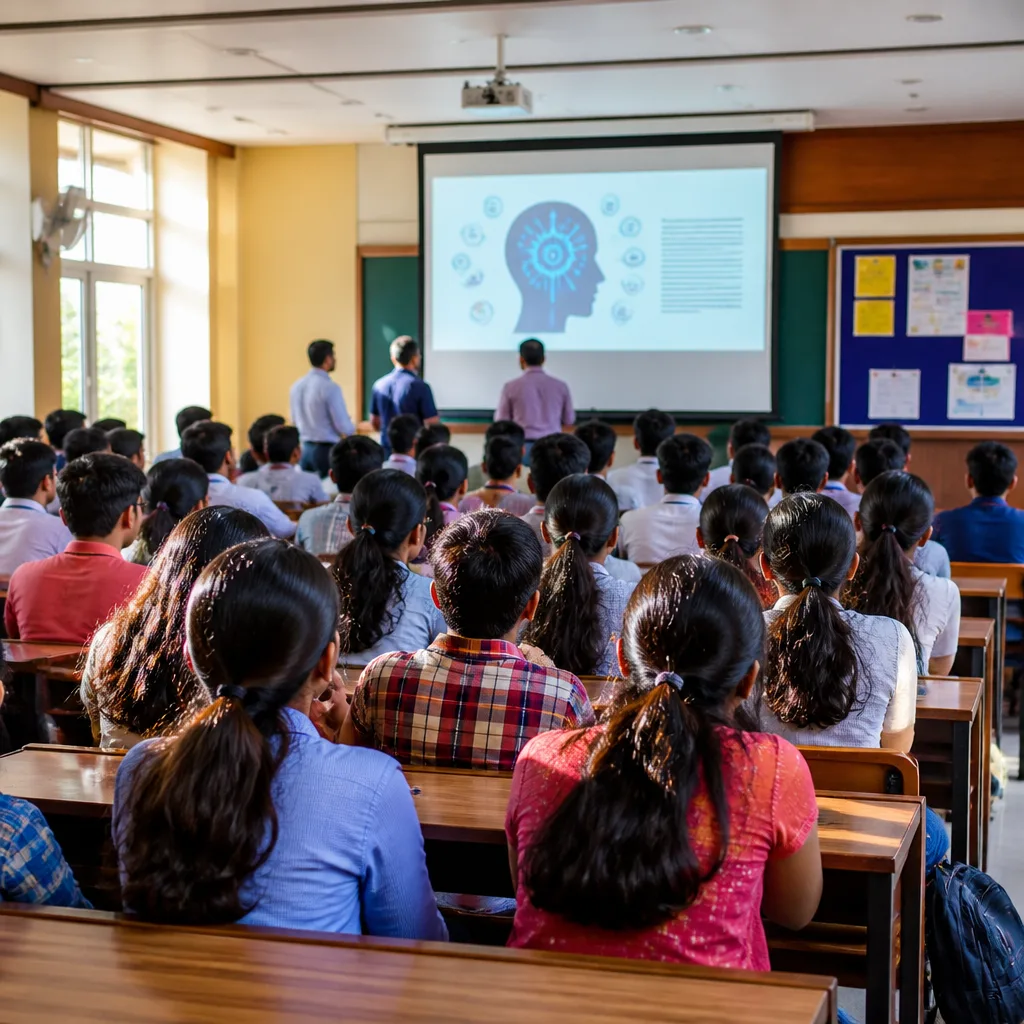
India’s rapid expansion of artificial intelligence courses at colleges and universities is colliding with a shortage of teachers qualified to deliver advanced AI and machine-learning instruction, prompting academics to call for urgent upskilling, recruitment of specialised talent and deeper industry–academia partnerships.
Demand outpaces supply of advanced AI educators
“The biggest issue is that demand has grown much faster than the supply of people who can teach AI and machine learning at an advanced level,” said Prof. (Dr.) Sanjay Kumar, Vice-Chancellor of Rayat Bahra University, Mohali, according to News18. The comment underscores a widening gap as institutions expand AI curricula to meet student and employer demand.
Experts who spoke to News18 said the problem is not an absolute absence of teachers, but a shortage of personnel capable of bridging deep research knowledge, engineering skills and real-world deployment.
“India’s AI faculty challenge is not simply a shortage of teachers; it is a shortage of professionals who can bridge research, technology, and real-world deployment.” — Nishant Narang, Associate Professor, BITS Pilani (Off-campus, Delhi)
What faculty need
Both Prof. Kumar and Nishant Narang emphasise that effective AI teaching requires a strong foundation across several disciplines. They list the core competencies as:
- Mathematics and statistics — for understanding underlying models and guarantees.
- Algorithms and programming — for building and optimising systems.
- Knowledge of generative AI and large language models (LLMs) — to teach current multimodal and foundation-model approaches.
They noted that the rapid pace of change in AI means syllabuses cannot stay static for years; curricula and teacher skills must evolve continually to remain relevant.
Proposed responses
News18 reports that academics recommend a mix of short- and long-term measures to address the faculty shortfall. These include:
- Upskilling existing computer-science teachers through targeted training and sabbaticals in industry labs.
- Attracting specialised talent by offering competitive packages and clearer academic career pathways for AI researchers.
- Deepening industry–academia partnerships so faculty and students gain exposure to deployed systems and real-world data.
Prof. Kumar suggested that while institutions may not currently have many teachers with advanced AI expertise, there exists “a large base of capable Computer Science teachers,” and that these educators could form a significant part of the solution if provided with appropriate reskilling opportunities.
Academic standards and hiring questions
The expansion of AI programmes is also complicating the question of who qualifies to be an AI faculty member. As courses move beyond traditional computer-science topics into machine learning, deep learning and multimodal AI systems, universities must refine hiring criteria to ensure instructors can teach both theoretical foundations and applied, system-level engineering.
| Challenge | Suggested action |
|---|---|
| Rapidly changing curriculum | Regular curriculum review and industry-informed course updates |
| Shortage of advanced AI teachers | Upskilling programmes and incentives to attract researchers |
| Gap between theory and deployment | Stronger industry–academia partnerships and internships |
Academics told News18 that successfully tackling these issues will require concerted action by universities, regulatory bodies and industry partners. Training existing faculty in advanced AI topics may be the fastest route to increasing classroom capacity in the near term, while incentives to bring specialists into academia will be needed for longer-term research and teaching strength.
As AI education expands across India, the balance between rapidly scaling programmes and maintaining teaching quality will be critical. Institutions that invest in continual teacher development and forge practical ties with industry could avoid pitfalls of poorly staffed programmes and help produce graduates ready for research and deployment roles in an increasingly AI-driven economy.