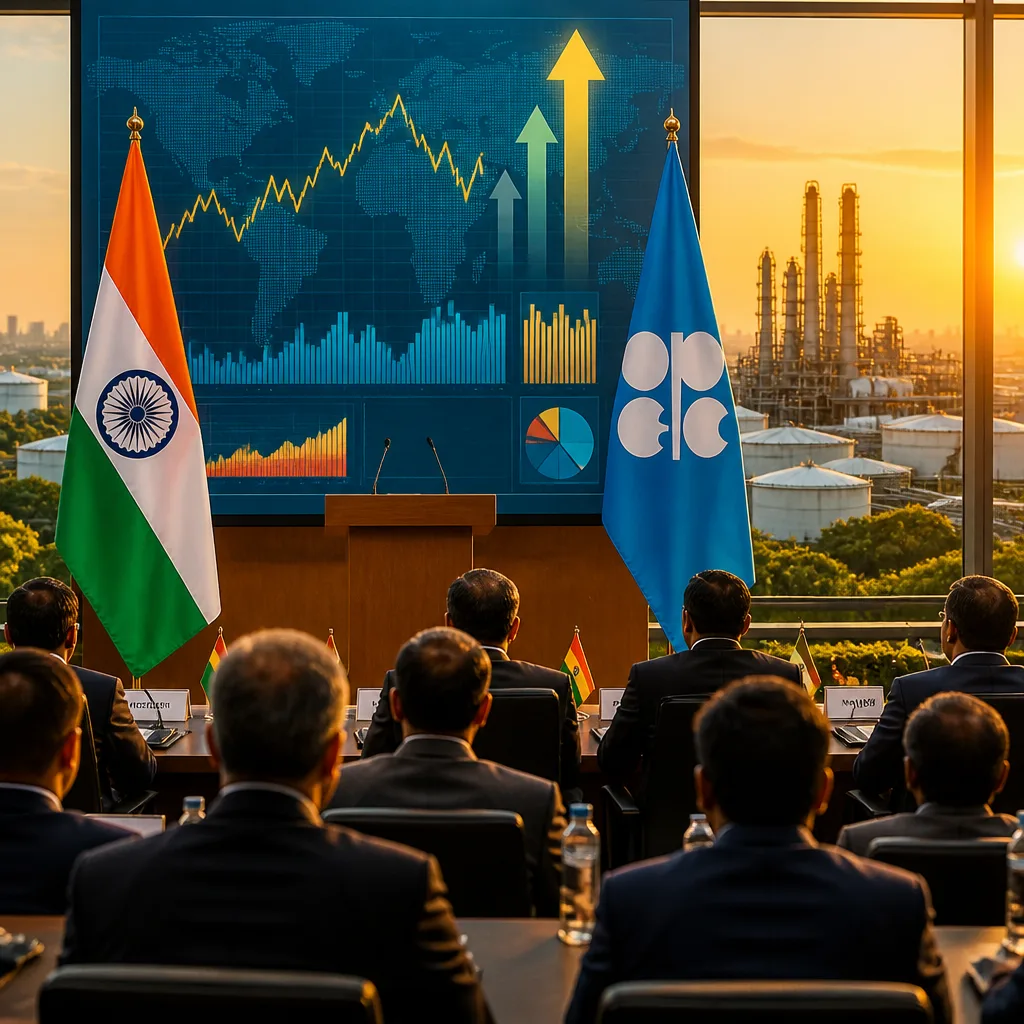
New Delhi: India and the Organisation of the Petroleum Exporting Countries (OPEC) have resolved to intensify cooperation to bolster oil-market stability and secure reliable supplies, the two sides said after the Seventh High-Level Meeting of the OPEC–India Energy Dialogue held in New Delhi on Tuesday.
Meeting led by Puri and OPEC secretary-general
The session was co-chaired by Union Petroleum and Natural Gas Minister Hardeep Singh Puri and OPEC Secretary-General Haitham Al Ghais. Delegates reviewed near-, medium- and long-term energy outlooks and emphasised the need for timely investment in the oil industry to meet growing demand.
“As one of the fastest-growing major economies
According to the meeting communique reported by the organisers, discussions centred on market stability, energy security and cooperation on investment planning. The dialogue comes against a backdrop of heightened geopolitical tensions, supply-chain uncertainty and price volatility that have affected global energy markets.
Numbers underline Asia’s dependence on OPEC crude
The report cited OPEC export data for 2025 showing members shipped an average of 19.85 million barrels per day (bpd) of crude globally, of which 14.79 million bpd were exported to Asia. The figures underline OPEC’s continuing importance to energy security in the region and for demand centres such as India.
| Metric | 2025 figure |
|---|---|
| OPEC crude exports (global) | 19.85 million bpd |
| OPEC crude exports to Asia | 14.79 million bpd |
Delegates also noted that OPEC+ continued to apply market monitoring and production management frameworks in 2026, aimed at responding to changing conditions and reducing abrupt supply shocks.
What this means for India and consumers
- For policymakers: closer contact with OPEC could help New Delhi secure more predictable crude flows, easing fuel procurement planning for refiners.
- For industry: clearer signals on investment needs and coordination between producer and consumer markets may support refinery scheduling and import diversification strategies.
- For end consumers: while direct price effects depend on many global factors, improved supply coordination could reduce the risk of sharp short-term disruptions that translate into sudden retail fuel price spikes.
At the meeting, Indian and OPEC representatives emphasised the complementary nature of their engagement. Puri underlined the mutual benefit of cooperation as India’s energy requirements grow alongside broader global demand. The dialogue reaffirmed a shared interest in ensuring that investment in oil production and infrastructure keeps pace with anticipated needs.
Officials also discussed the ongoing challenges posed by geopolitical risks and supply-chain fragility, factors that have complicated market planning in recent years. In this context, the OPEC–India channel is being used to exchange assessments and coordinate on measures that can enhance predictability.
While the communique did not set out binding commitments on volumes or contracts, it highlighted the role of sustained dialogue and monitoring mechanisms—practices that OPEC+ has continued to employ in 2026—to manage market balance.
For businesses, the renewed engagement signals an environment where coordination between a major energy consumer and primary producers could ease some planning uncertainties. For the wider public, the immediate impact will be indirect: more stable wholesale markets can, over time, reduce the likelihood of sudden retail price shocks, though prices will continue to be driven by global supply–demand dynamics and geopolitical developments.
The OPEC–India Energy Dialogue, now in its seventh high-level iteration, illustrates New Delhi’s strategy of maintaining open channels with major producer groups while seeking diversified supply sources and investment flows to meet expanding energy demand.