
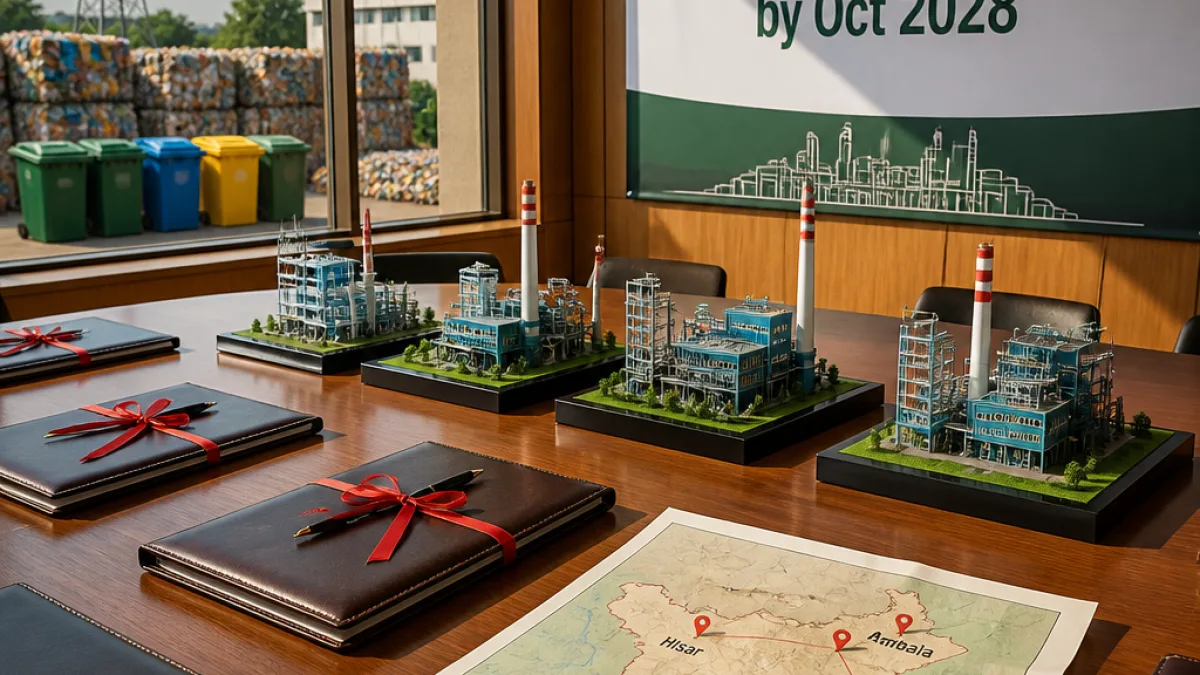
Haryana has signed memoranda of understanding (MoUs) for four integrated waste-to-energy facilities to be built in the Hisar, Ambala, Faridabad and Gurugram clusters, officials said. The plants together are expected to handle 5,000 tonnes of municipal solid waste a day and produce about 50 MW of electricity when fully commissioned by October 2028.
Funding structure and implementing agency
The projects will be developed by Oil Green Energy Limited, a wholly owned subsidiary of Oil India Limited, under agreements signed at a ceremony in Nuh. According to the state release, the schemes will receive assistance from the Union Ministry of Housing and Urban Affairs’ Urban Challenge Fund.
The financial share of the projects has been set as follows: the Centre will cover 25% of the total capital cost, while the state government and the relevant urban local bodies will jointly provide another 25%. Oil Green Energy Limited will meet the remaining 50% of the investment.
Officials underline waste-management urgency
“These agreements marked a major step towards making the cities of the state cleaner, healthier and more modern,” the Chief Minister said at the event in Nuh.
Chief Minister Nayab Singh Saini framed the move as part of a larger effort to modernise urban waste handling in the face of growing municipalisation and rising refuse volumes. The state noted the projects will be carried out in compliance with the Solid Waste Management Rules, 2026, issued by the Government of India.
Union Minister Rao Inderjit Singh urged prompt action by Oil India officials and asked the state to take strict measures for waste disposal from urban centres such as Gurugram. He specifically pointed to the long-standing problem at Bandhwari in Gurugram, calling for work to begin immediately so the substantial mounds of dumped solid waste there can be removed.
What the plants will do and where
Officials say the facilities will use scientific processing to convert municipal solid waste into energy, reducing reliance on open dumping and unscientific disposal. The four clusters named will serve multiple urban local bodies in their catchment areas, with a combined processing capacity of 5,000 tonnes per day and anticipated generation of roughly 50 MW of power.
| Cluster | Function |
|---|---|
| Hisar | Integrated waste processing and energy generation |
| Ambala | Integrated waste processing and energy generation |
| Faridabad | Integrated waste processing and energy generation |
| Gurugram | Integrated waste processing and energy generation |
Environmental and local implications
For Haryana’s rapidly expanding towns and cities, the projects are intended to address two linked problems: the accumulation of municipal waste and the need for distributed clean power. If the plants operate as planned, they could reduce volumes going to landfills and informal dumpsites, lower greenhouse-gas emissions from open burning and decomposition, and produce baseload electricity that may feed local grids or municipal services.
However, for such benefits to materialise, several conditions must be met: sustained segregation of waste at source, reliable door-to-door collection, proper pre-processing (removal of inert and hazardous components), and continued compliance with emissions and ash-disposal norms. The state has said the projects will adhere to the Central government’s 2026 rules, which set standards for processing, emission control and residual handling.
What to watch next
- Timelines and milestones from Oil Green Energy Limited on detailed project reports, technology choice and procurement schedule.
- Arrangements for municipal-level waste segregation and collection that will feed the plants.
- Clear plans for ash and residue management, air-emission controls and monitoring to ensure environmental compliance.
The state has set an operational target of October 2028 for all four plants. Officials at the signing said the partnership with a public sector energy firm and central funding support aim to fast-track construction and avoid recurring open-dump problems in key urban areas, particularly Gurugram, where the Bandhwari site has drawn sustained attention for years.












