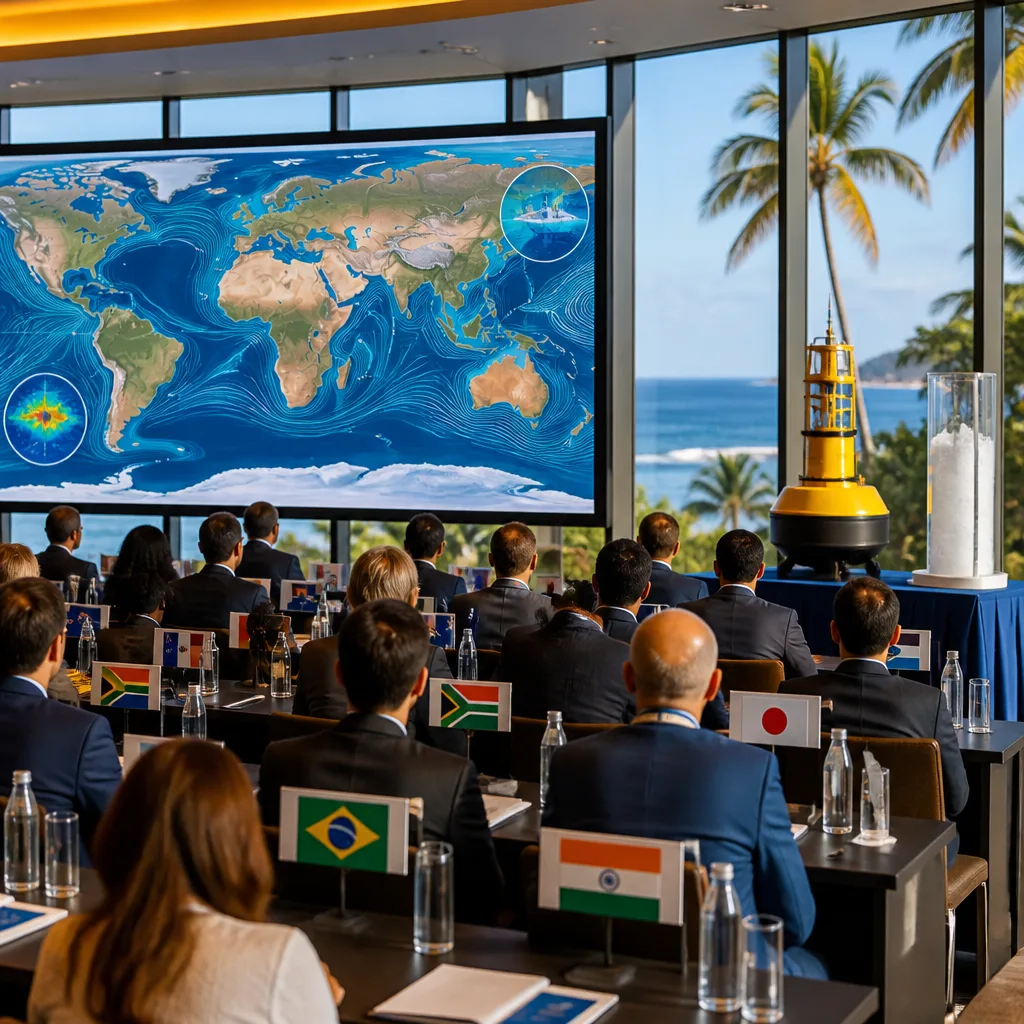
Panaji, Aug 12: A three‑day meeting of the BRICS Working Group on Oceanic and Polar Science and Technology (OPST) began in Goa on Wednesday with Indian research agencies hosting delegates who will review ongoing programmes and negotiate future collaborative activities in ocean and polar research.
India hosts multilateral science talks
The National Centre for Polar and Ocean Research (NCPOR), operating under the Ministry of Earth Sciences, is hosting the event at its South Goa campus as part of India’s BRICS Presidency for 2026. Delegations from Brazil, China, Egypt, Indonesia, Russia, South Africa, the United Arab Emirates and India are participating, officials said.
Dr Thamban Meloth, director of NCPOR and the working‑group chair for 2026, opened the meeting and welcomed participants. The inaugural session also featured a keynote lecture on “India’s Blue Economy Initiatives” delivered by Dr M. Rajeevan, vice‑chancellor of Atria University and former secretary of the Ministry of Earth Sciences.
Agenda: cooperation, shared infrastructure, capacity building
According to the organisers, the working group will examine national programmes currently underway in member countries and identify areas where joint efforts would bring scientific and operational advantage. Sessions are scheduled to cover proposals for bilateral, trilateral and multilateral cooperation, prioritisation of common research themes, and mechanisms for shared use of research infrastructure.
- Joint research: Deliberations will focus on collaborative ocean exploration and polar studies.
- Capacity building: The meeting aims to design exchanges, training and scientific visits to raise technical capabilities across member institutions.
- Infrastructure sharing: Discussions include access to and joint use of research vessels, polar stations and observational platforms.
Officials described the forum as an opportunity to strengthen institutional linkages, promote scientific exchanges and agree on priority areas that reflect mutual interests across the BRICS membership and invited partners. The OPST working group was originally established in 2018 to facilitate scientific cooperation, knowledge exchange and collaborative activities among member countries.
History and continuity
The working group has met seven times prior to this session, with India hosting the third meeting in 2020 during its earlier BRICS Presidency, the organisers noted. The present meeting seeks to build on that continuity by converting discussions into specific proposals for joint projects, funding mechanisms and timelines.
| Item | Focus |
|---|---|
| Joint expeditions | Ocean exploration and Arctic/Antarctic research |
| Data sharing | Observational datasets, oceanographic and polar records |
| Capacity building | Training, exchanges, shared use of laboratories and ships |
Officials emphasised that the meeting provides a platform for member states to translate high‑level statements into concrete scientific programmes, including potential joint calls for proposals and coordinated field campaigns.
Dr Meloth, as chair, is expected to steer technical sessions that will prioritize areas of common interest and solicit proposals from member delegations. The meeting will also consider mechanisms to facilitate sustained cooperation beyond ad hoc projects, such as institutional partnerships and shared governance arrangements for common facilities.
India’s Ministry of Earth Sciences and the Department of Science and Technology have officials and institute directors attending the sessions, reflecting a whole‑of‑government interest in leveraging BRICS collaboration to support national priorities in the blue economy, climate research and polar logistics.
Delegates are set to present national capabilities and ongoing programmes, and to explore opportunities for trilateral and multilateral projects that could include joint cruises, shared polar logistics and collaborative modelling efforts aimed at improving understanding of ocean dynamics and polar processes.
Observers noted that strengthening scientific ties through working groups such as OPST can accelerate capacity building in developing member states and create efficiencies by pooling expensive infrastructure and expertise for costly polar and deep‑ocean research.
The three‑day meeting will conclude with recommendations and an action plan to guide collaborative activities under India’s BRICS Presidency for the remainder of 2026, organisers said.