
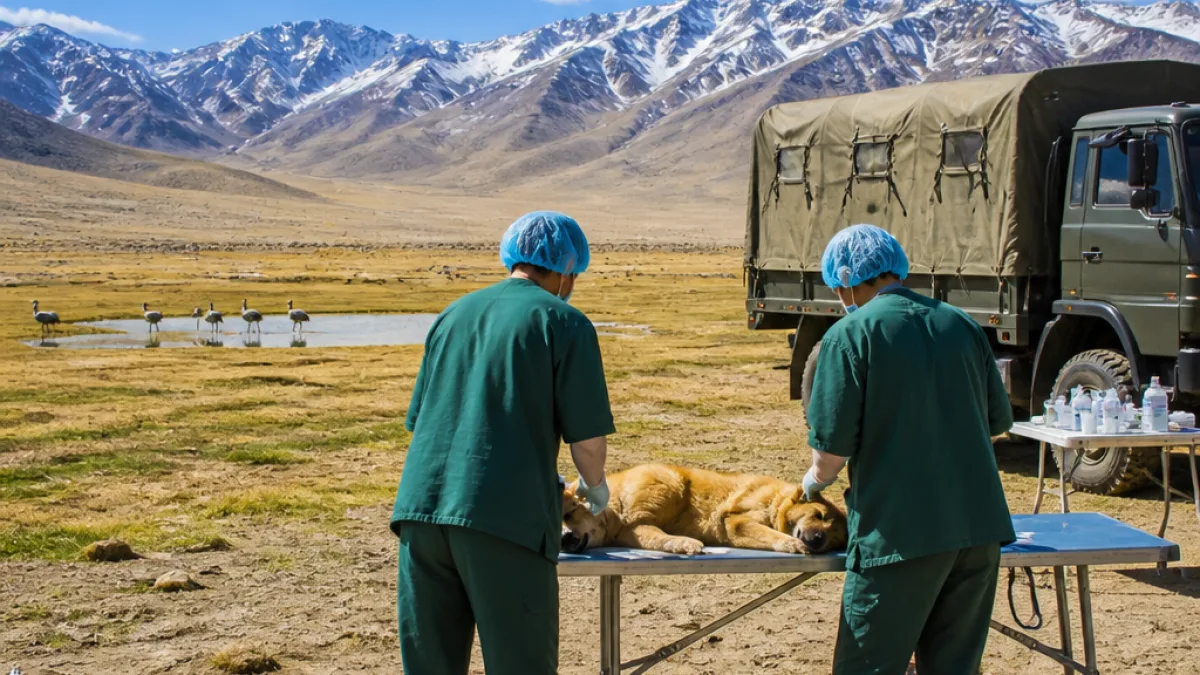
Leh, Aug 12: The Bombay Natural History Society (BNHS) has sterilised more than 2,950 free‑ranging dogs in Ladakh as part of a conservation effort aimed at protecting the region's black‑necked cranes, the organisation said on Wednesday.
Partnerships and timeline
BNHS launched the intervention in 2022 in collaboration with the Indian Army, the Union Territory's Animal Husbandry Department and the Department of Forest, Ecology & Environment, according to a BNHS release. The programme involves sterilisation and management of free‑roaming dogs that have been identified as a growing threat to crane breeding success across Ladakh's alpine wetlands.
Why dogs are a conservation concern
Free‑ranging dogs have been documented preying on black‑necked crane eggs and chicks, disturbing nesting birds and otherwise altering breeding behaviour, BNHS said. The group described dogs as a significant factor reducing reproductive success for the species at several breeding sites in the union territory.
- Black‑necked cranes are listed as vulnerable globally, with an estimated world population of 11,000–12,000, most found on the Tibetan Plateau.
- Fewer than 100 black‑necked cranes are known to survive in India, the BNHS release stated.
- Key breeding areas in Ladakh include the Changthang Cold Desert Wildlife Sanctuary—particularly the wetlands of Hanle, Tso Kar, Nyoma and adjacent marshes—as well as an extended population in the Suru Valley.
Drivers of rising dog populations
BNHS highlighted that the rising number of free‑ranging dogs in many parts of Ladakh is closely linked to readily available anthropogenic food subsidies. Unmanaged food waste and kitchen refuse from settlements and tourist activities act as a steady food source, allowing dog numbers to increase and remain near critical wetland habitats.
The group also flagged wider pressures on the cranes, including expanding human settlements near wetlands, growth in linear infrastructure and tourism, habitat degradation and the effects of climate change—factors that together heighten the vulnerability of the species.
Conservation response and local involvement
BNHS said that local communities, monasteries and conservation organisations in Changthang often work together to safeguard breeding wetlands. The sterilisation drive complements on‑ground protection efforts aimed at reducing disturbances during nesting and enhancing the cranes' chances of successful breeding.
| Intervention | Reported figure / area |
|---|---|
| Dogs sterilised (since 2022) | 2,950+ |
| Global population estimate (black‑necked crane) | 11,000–12,000 |
| Estimated number in India | Fewer than 100 |
Practical implications for residents and visitors
BNHS underlined the role of waste management and responsible tourism in reducing food sources that sustain free‑ranging dog populations. Effective garbage disposal, restrictions on feeding stray animals near wetlands, and community‑level coordination with animal‑welfare and forest authorities are measures that can lower human‑linked subsidies that support larger dog populations.
Authorities' involvement, including the Animal Husbandry Department and forest officials, is expected to ensure that sterilisation is paired with broader management practices, such as monitoring of dog movements around sensitive nesting sites and public awareness drives during the breeding season.
Outlook
Conservationists say sustained, multi‑agency action is needed to reduce threats to the black‑necked crane, whose arrival each year has cultural importance for Ladakhi communities. While the BNHS sterilisation programme aims to lower immediate predation pressures, long‑term protection will also require addressing habitat loss, tourism impacts and climate‑related changes to wetland ecosystems.
BNHS and partner agencies have not published a comprehensive timeline for future sterilisation targets in Ladakh, but the organisation's reported figure of over 2,950 animals treated since 2022 represents a significant operational footprint in the region.