Festival opens with call to balance livelihoods and ecosystem protection
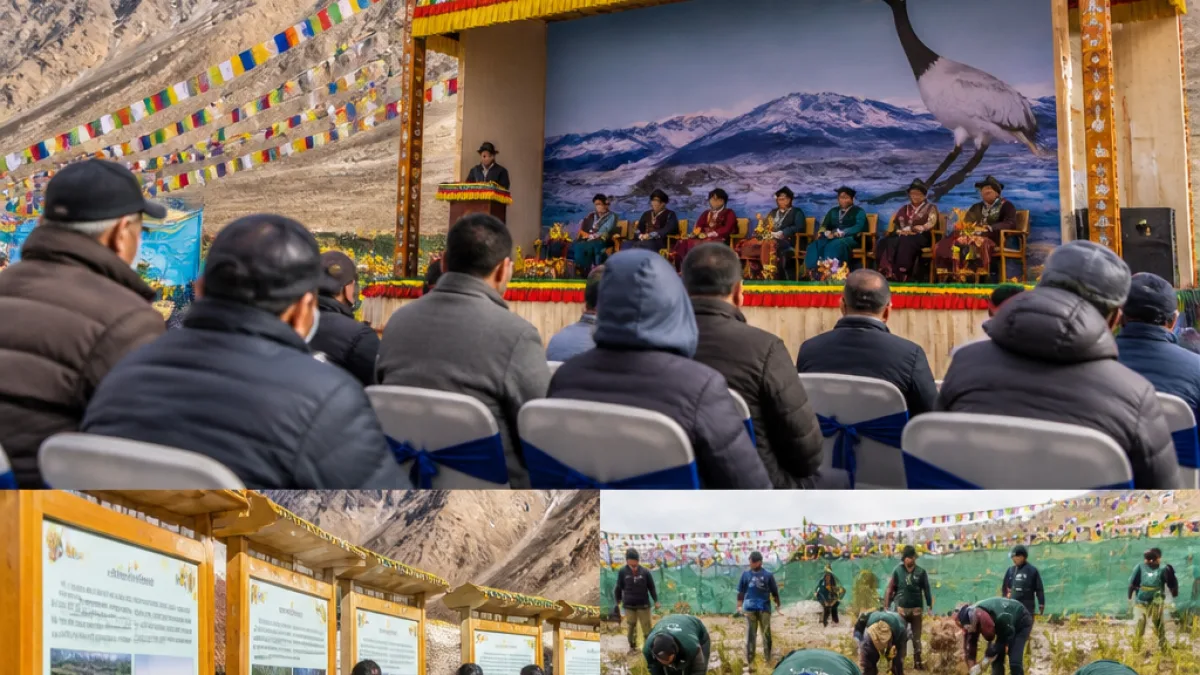
Leh, Ladakh — The Union Territory on Tuesday hosted the inaugural Black‑Necked Crane Festival, the first national event dedicated to the conservation of the alpine crane that breeds in India only in Ladakh. Lieutenant Governor Vinai Kumar Saxena inaugurated the festival, which brought together conservationists, researchers and wildlife experts from India and neighbouring countries.
Organisers said participants included representatives from Bhutan and Nepal, reflecting the bird’s transboundary range across parts of South and East Asia. The Black‑Necked Crane is one of the world’s few high‑altitude crane species and is estimated to number about 16,000 across India, Bhutan, China and Nepal.
Wetlands and breeding grounds central to protection measures
Addressing the gathering, Saxena stressed that conserving the Black‑Necked Crane is inseparable from safeguarding Ladakh’s wetlands, grasslands and other high‑altitude habitats. He argued that these landscapes not only provide nesting and feeding sites for the bird but also underpin biodiversity, water regulation and pastoral livelihoods in the region.
"More value from nature, with less pressure on nature,"
The Lieutenant Governor reiterated his call for policies and practices that generate economic benefits from nature while reducing environmental strain. He urged greater collaboration between local communities and scientific institutions, saying traditional ecological knowledge should be integrated with modern conservation science.
Symbolic recognition and regional importance
The UT Administration has declared the Black‑Necked Crane as the State Bird of Ladakh, a move officials presented as recognition of both the species’ ecological role and its cultural significance. The bird is locally regarded as a symbol of peace and is entwined with the cultural landscape of high‑altitude communities.
Officials at the festival highlighted key wetland areas such as Tso Kar and Hanle as important breeding landscapes. Those sites, along with other high‑altitude marshes, were described as focal points for monitoring, habitat protection and community‑based stewardship.
Conservation priorities and community role
Speakers and experts underlined several immediate priorities discussed at the festival:
- Securing and restoring wetland habitats that support nesting and foraging.
- Developing community‑led monitoring and protection mechanisms that offer alternate livelihoods while limiting disturbance.
- Promoting cross‑border scientific collaboration to study migration, population trends and threats.
Officials emphasised that pastoral communities and nomadic herders are to be treated as partners and custodians in conservation, not merely recipients of top‑down programmes. Integrating local practices into management plans was put forward as essential to durable protection of both species and livelihoods.
Regional and scientific collaboration
Delegates at the festival included researchers working on alpine wetland ecology and migratory bird conservation. The event provided a platform to exchange field observations, share monitoring methodologies and discuss coordinated action across national boundaries where the crane occurs.
Experts noted that because the Black‑Necked Crane nests in some of the highest and most challenging environments on earth, conservation measures must adapt to the climatic and logistical constraints of high‑altitude ecosystems.
Practical implications for tourism and policy
Speakers also flagged the need to align tourism promotion with habitat conservation. The Lieutenant Governor’s emphasis on obtaining "more value from nature, with less pressure on nature" was presented as a guiding principle for future tourism and development planning in Ladakh.
| Aspect | Implication |
|---|---|
| Breeding sites | Require protection from disturbance during nesting season |
| Local communities | Partners in stewardship and beneficiaries of sustainable livelihoods |
| Cross‑border range | Necessitates international scientific cooperation |
Festival organisers said follow‑up actions will focus on mapping critical habitats, setting up long‑term monitoring and working with local councils to frame guidelines for tourism and land use near sensitive wetlands. The UT Administration’s declaration of the species as the State Bird is expected to support stricter protection measures in official land‑use and conservation planning.
The event marks the first concerted public festival in India devoted to the Black‑Necked Crane and is intended to raise public awareness in Ladakh and beyond about the species’ conservation needs and the broader health of high‑altitude ecosystems that sustain both wildlife and human communities.