
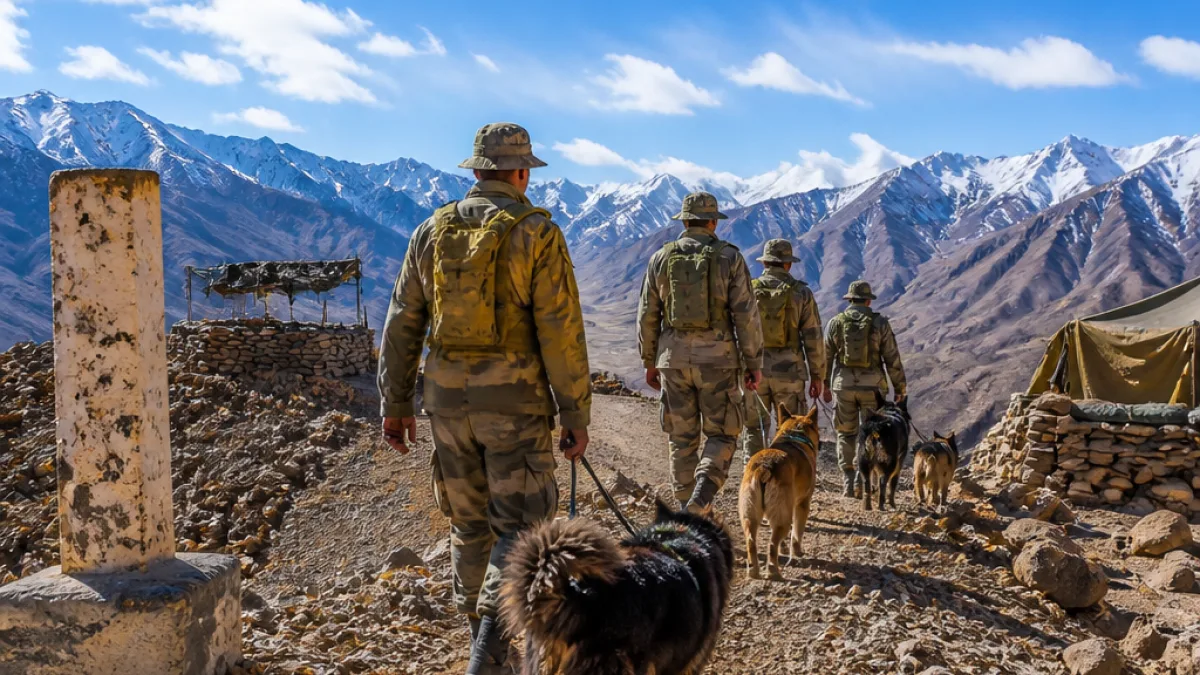
The Indian Army and the Indo-Tibetan Border Police (ITBP) have deployed trained canines — including indigenous Himalayan breeds and assault dogs — to strengthen surveillance and operational capability along the Line of Actual Control (LAC) in Ladakh, security sources said.
Roles and breeds deployed
According to officials in the security establishment, the animals being used range from native Himalayan breeds such as Bakharwal and Tibetan Mastiff to proven assault breeds like the Belgian Malinois. Traditional foreign breeds used by the Army — the German Shepherd, Labrador Retriever and the Great Swiss Mountain Dog — continue to be part of the force pool.
“The native dogs of Ladakh have been trained by the army to alert sentries in case of any possible intrusion amid the ongoing border standoff with the Chinese People’s Liberation Army in Ladakh,” a security official attached to the Union home ministry said.
Sources said the ITBP has also deployed assault dogs at sensitive forward bases to assist patrol teams and, where necessary, to pin down adversary personnel in case of an attack on patrols.
Operational use and training
Officials said the canines are engaged in a spectrum of tasks including explosive and mine detection, tracking, surveillance and forward-area security. They are increasingly being used for high-altitude border guarding and surveillance operations that began in larger numbers since last year, the sources added.
All defence service dogs are trained at the Remount and Veterinary Corps (RVC) Centre and College in Meerut, the sources noted. The Army has, over recent years, expanded training to include Himalayan breeds, considered better adapted to cold, thin-air conditions on the high plateau.
Why Himalayan breeds?
Security officials said the indigenous canines possess natural physiological advantages for the harsh climate of Ladakh, including thicker coats and acclimatisation to low-oxygen, sub-zero conditions. The shift complements the continued use of foreign breeds that have been part of Indian military canine units for decades.
Force posture and Chinese deployments
Sources in the ITBP said Chinese forces along the LAC have also employed Molosser-type dogs — a heavy-boned, powerful group of breeds — for high-altitude vigil. Separately, intelligence and open reports have indicated that the PLA has experimented with robotic quadrupeds for surveillance and patrolling in difficult mountainous terrain.
Officials framed the canine deployments as one element in layered frontier security, which includes sensors, observation posts, human patrols and engineering works. Canines, they said, provide rapid detection and first-response capability in situations such as intrusions, ambushes, explosive threats, tracking and search-and-rescue and avalanche response.
Practical considerations for high-altitude use
Deployment of dogs at high altitude involves logistical and veterinary considerations: acclimatisation time, specialised nutrition, medical care and transport. Present training at the RVC covers acclimatisation and specialised high-altitude conditioning, sources said, but did not provide quantitative details on strength or exact locations of deployment.
- Primary duties: surveillance, explosive/mine detection, tracking, search and rescue.
- Breeds mentioned: Bakharwal, Tibetan Mastiff, Belgian Malinois, German Shepherd, Labrador Retriever, Great Swiss Mountain Dog, Molosser (reported on PLA side).
- Training hub: Remount and Veterinary Corps Centre and College, Meerut.
Context and constraints
The deployment comes against the background of an extended standoff between Indian and Chinese troops in parts of eastern Ladakh. Officials emphasised that the use of canines does not replace other surveillance assets but augments patrol and base-defence capabilities where terrain and weather can limit technology or human endurance.
While sources provided general descriptions of employment and breeds, they did not disclose numbers, precise forward locations or operational details, citing security considerations. The information was attributed to security and ITBP officials and internal sources within the defence establishment.
| Aspect | Detail |
|---|---|
| Training centre | Remount and Veterinary Corps Centre and College, Meerut |
| Local breeds | Bakharwal, Tibetan Mastiff |
| Assault/working breeds | Belgian Malinois, German Shepherd, Great Swiss Mountain Dog, Labrador Retriever |
| Reported PLA assets | Molosser-type dogs; robotic quadrupeds reported in open-source accounts |
Officials stressed that canine teams are a well-established capability in Indian security forces, routinely used in Jammu and Kashmir and other challenging environments. Their employment in Ladakh highlights adaptation of established practices to the particular demands of high-altitude frontier security.













