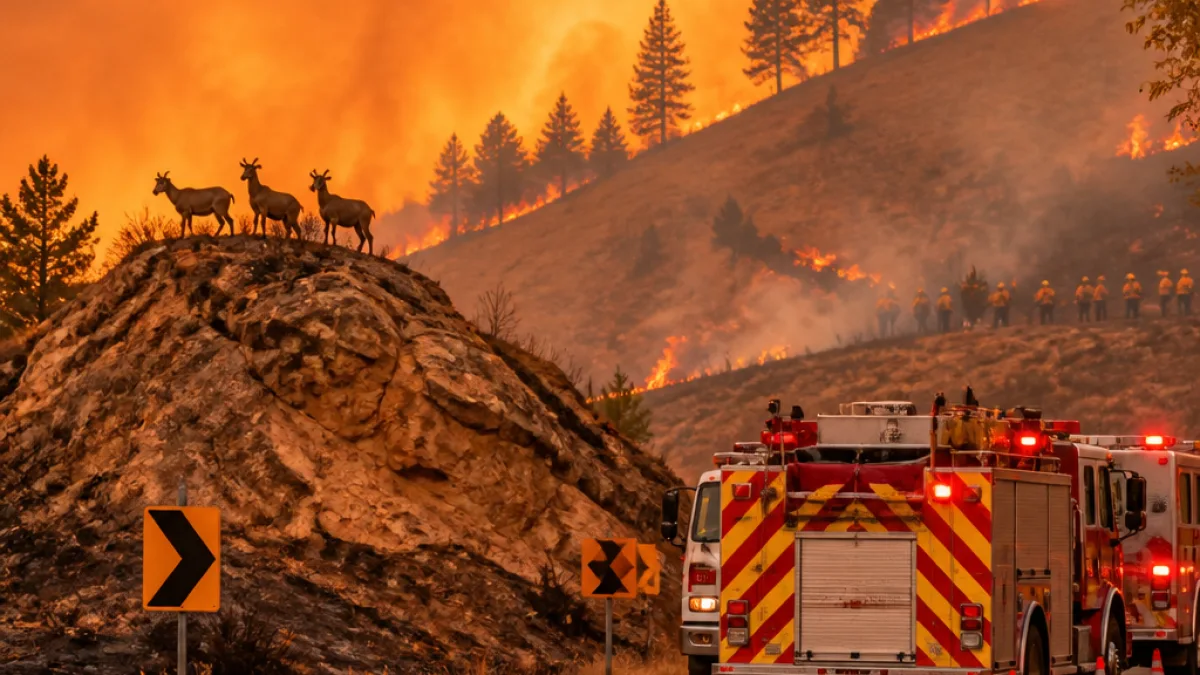
SUMMERLAND, B.C. — The fate of a small group of mountain goats long seen along Highway 97 near Summerland remains uncertain as firefighters battle a large blaze that prompted evacuations and road closures.
Local icons, unknown status
Residents and wildlife watchers have for years recognised the goats as an iconic part of the landscape because of their frequent visibility from the highway. With Highway 97 closed and the community evacuated, there are unconfirmed reports about whether any of the animals survived the fast-moving flames.
The Peachland Watershed Protection Alliance posted on social media that Peachland Fire and Rescue personnel had observed an unspecified number of animals, though the post later removed the department reference and provided no additional details. The society declined to make available the person who reportedly saw the goats, and the fire chief in Peachland, Ian Cummings, said he had no information about the animals’ status.
How goats respond to fire
Dr. Michael Noonan, who studied mountain-goat responses during the 2003 Cathedral Park fires, warned that the species’ natural escape strategies may put them at risk in a rapidly advancing wildfire.
“They respond, when it is an immediate threat,”
Noonan said the animals do not always react to an approaching fire until flames are close, which can be dangerous when a blaze moves quickly. His research found that goats typically flee toward higher ground — their usual refuge.
That instinct can backfire during fires, he said, because heading uphill or toward cliffs may trap animals as flames and heat follow the same upward trajectory. Conversely, goats already above the tree line face a lower immediate threat from crown or forest fires.
Why steep terrain can be perilous
Experts point out a mismatch between the goats’ anti-predator behaviour and wildfire dynamics. Moving toward steep cliffs or higher elevations is an effective strategy against predators, but when fire advances uphill it can cut off escape routes and concentrate the animals in hazardous pockets.
- Common goat behaviour: Seek higher ground and steep cliffs.
- Wildfire behaviour: Flames often move upslope, increasing danger for animals moving uphill.
- Relative safety: Being above the tree line reduces exposure to forest fires.
What is known and what remains unclear
At this stage, there is no confirmed tally of how many goats inhabited the area before the fire or whether individuals survived. The small number of animals in southern B.C., compared with other parts of the province, heightens concern about local population impacts, but precise figures were not available.
| Observed behaviour | Fire-related risk |
|---|---|
| Move uphill toward cliffs | May become trapped as fire moves upslope |
| Remain above tree line | Lower immediate exposure to forest fire |
Community connection and concern
For many travellers and locals, the goats have been a familiar sight on the roadside and a small but meaningful connection to the natural world. That visibility has made their possible losses more poignant for nearby communities watching the fire’s progress.
Officials and local groups have so far offered limited public updates on wildlife impacts, focusing on evacuation and suppression efforts. Conservation and watershed organisations that monitor the area have been active in communicating other aspects of the emergency but have not been able to provide confirmatory sightings that would clarify the goats’ status.
What comes next
As containment and assessment efforts continue, wildlife specialists will need time to survey burned slopes once it is safe to access the area. Past research indicates that post-fire monitoring is important to understand direct mortality, displacement and longer-term habitat impacts for species with small, locally dispersed populations.
Until on-the-ground surveys or verified sightings are reported by officials or qualified observers, the fate of the Summerland-area goats will remain unresolved — a reminder of how quickly wildfire can imperil both human communities and the animals that share their landscape.
Mei-Ling Wong reports from British Columbia for WE NEWS.