
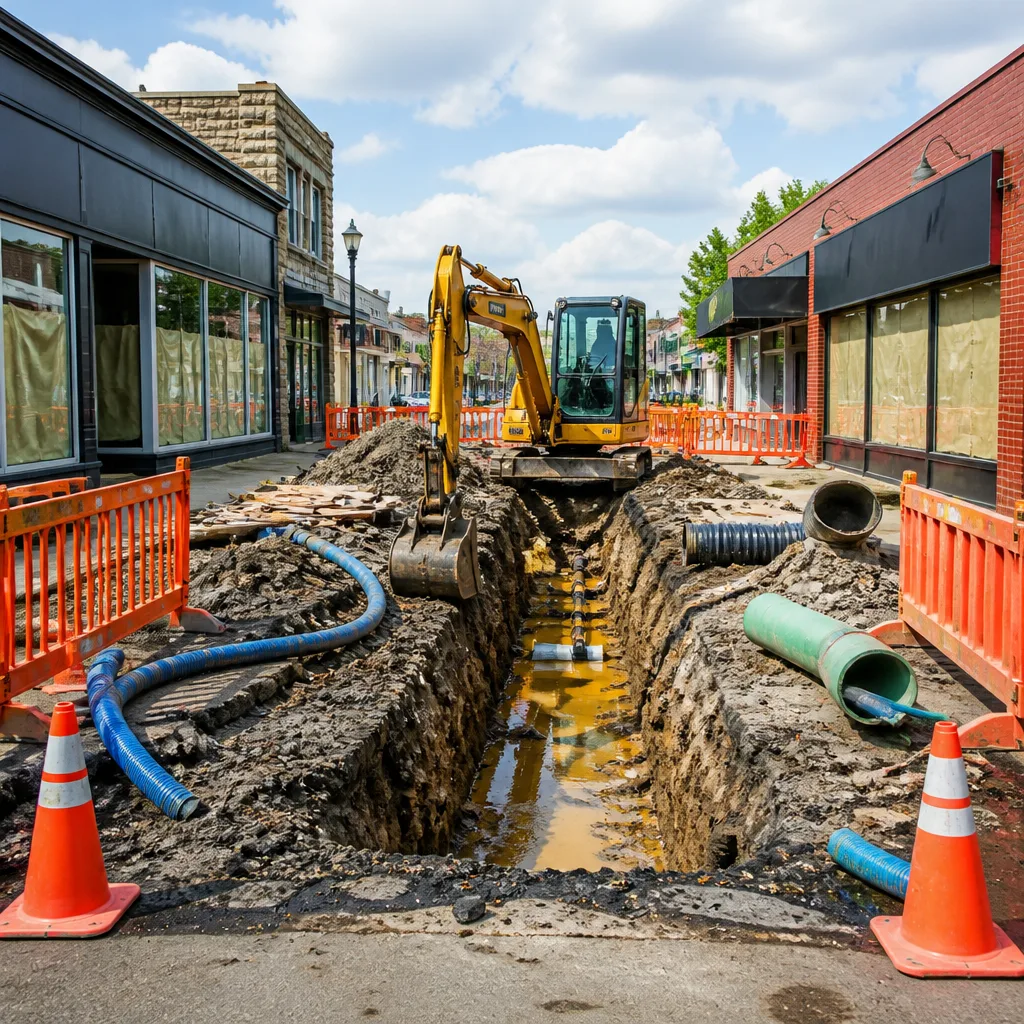
Several businesses in Calgary's Bowness neighbourhood were forced to close as municipal crews worked to excavate the road and repair a failing water main, the Calgary Herald reports. The affected stretch runs between 62nd and 63rd Street N.W., where operators were still closed late Monday morning while repairs were under way.
Immediate commercial impact
The closures illustrate how a single below‑ground fault can ripple through a local economy. For the businesses directly affected, the interruption can mean lost sales, frustrated customers and added operational costs — from calling in staff to arranging clean‑up and dealing with suppliers.
- Location: Between 62nd and 63rd Street N.W., Bowness, Calgary.
- Status: Multiple businesses closed while crews excavated roadway and repaired the water main.
- Response: City crews on site performing excavation and repairs.
Why these incidents matter to business readers
Water‑main breaks are not purely an operational nuisance. They can trigger broader consequences that matter to investors, insurers and municipal planners alike. For small and medium‑sized enterprises, even a half‑day closure during a busy period can shave off a meaningful portion of weekly revenue. For surrounding commercial corridors, repeated service interruptions can alter foot traffic patterns and customer behaviour, compounding the economic hit.
Municipal crews responding to such failures face competing priorities: urgent repairs to restore services and minimise damage, alongside longer‑term decisions about when and where to replace aging infrastructure. The costs of reactive work — emergency excavation, temporary traffic control and rushed material procurement — typically exceed the staged expense of planned rehabilitation.
What businesses can and cannot expect
When a water main fails and a public thoroughfare is dug up for repairs, businesses have a limited set of immediate options. They can temporarily close, shift operations online where feasible, or try to operate in reduced capacity. Some may have contingency plans or insurance coverage for interruption; others do not. The fragmentary reporting available does not disclose which of these applied in Bowness.
From a municipal standpoint, rapid deployment of crews aims to restore service and reopen roads as quickly as safety allows. But repair timelines vary with the nature of the fault, ground conditions and whether surrounding utilities are affected. That uncertainty can prolong closures and complicate compensation or relief arrangements for impacted businesses.
| Item | Known detail |
|---|---|
| Neighbourhood | Bowness, Calgary |
| Block affected | Between 62nd and 63rd Street N.W. |
| Operational impact | Several businesses closed late Monday morning |
| Municipal action | City crews excavating roadway to repair below‑ground infrastructure |
Without further reporting on the specific businesses affected, the duration of the closures or any municipal statements about compensation or mitigation, the precise economic toll in Bowness cannot be quantified from the available account. Nevertheless, the episode is a useful prompt for business owners to revisit contingency plans and for policymakers to consider the trade‑offs between reactive repairs and systematic infrastructure renewal.
For small‑business operators in neighbourhood commercial strips, routine maintenance of public utilities is more than a technical matter: it is a determinant of daily revenue. Municipalities, meanwhile, must balance budgets while keeping water, sewer and road networks resilient enough to prevent recurring interruptions that erode local commerce.
Further details on the Bowness incident may emerge as city officials and impacted businesses comment. For now, the visible scene — crews excavating a road while storefronts remain shuttered — is a tangible reminder of how municipal infrastructure touches the bottom line for neighbourhood economies.