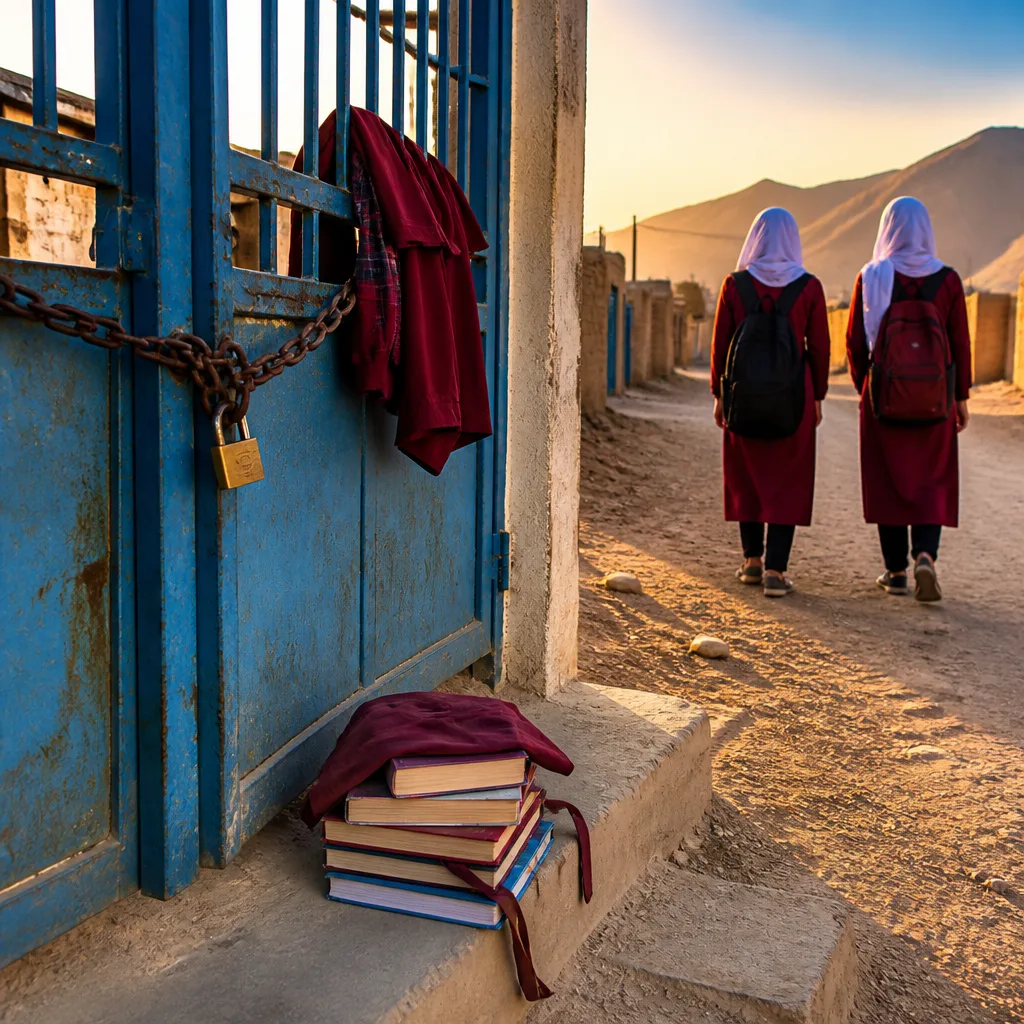
About 2.4 million girls in Afghanistan have been denied access to secondary education since the Taliban returned to power in 2021, UNESCO warned, a setback that erases much of two decades of gains and could widen to almost 4 million by 2030 if the current prohibitions continue.
Scope of the exclusion
The United Nations' education agency said the number of girls barred from secondary schooling has increased by roughly 200,000 in the past year. The ban on secondary schooling for girls began in March 2022, and by December of the same year women were also excluded from universities, measures the Taliban initially described as temporary.
"Five years is not a temporary interruption in a child’s education. It is clearly almost an entire secondary school cycle."
The quote, from Hoda Jaberian, UNESCO’s programme coordinator for education in emergencies, underscores how prolonged exclusion translates into a lost generation of learners. UNESCO noted that Afghanistan is now the only country in the world where girls and women are formally banned from both secondary and higher education.
Reversal of two decades of progress
UNESCO highlighted that Afghanistan had made significant improvements in girls’ education prior to 2021. Where only a small fraction of girls attended secondary school in 2001, by 2021 nearly one million girls were enrolled in secondary education — gains that have since been largely wiped out by the restrictions.
The agency warned that continued denial of schooling threatens not only individual futures but the country’s broader social and economic recovery, as education is central to preparing young people for citizenship and the workforce.
Wider restrictions and international response
The report places the educational bans within a broader pattern of curbs on women’s public life. Since the Taliban returned to power on Aug. 15, 2021, authorities have placed limits on employment, movement and access to public spaces for women and girls, including bans on parks, gyms and beauty salons in some areas. The United Nations has used the term "gender apartheid" to describe the cumulative system of restrictions.
Taliban leaders have framed the measures as consistent with their interpretation of Islamic law and Afghan culture and have characterised them as internal matters. International reaction has been to condemn the policies and to press for restored access, but UNESCO’s update makes clear that the restrictions have persisted and intensified in some areas.
- 2021: Nearly 1,000,000 girls enrolled in secondary education (UNESCO).
- 2022: Secondary schools closed to girls in March; universities closed to women in December.
- 2026: UNESCO reports roughly 2.4 million girls barred from secondary schooling; projection could reach about 4,000,000 by 2030 if bans continue.
The agency emphasised that five years without schooling amounts to almost the full span of secondary education for many children, meaning the interruption is not merely a pause but a structural breakdown in access to learning.
| Year | UNESCO figure |
|---|---|
| 2021 | Nearly 1,000,000 girls enrolled in secondary education |
| 2026 | Approximately 2.4 million girls now barred from secondary school |
| 2030 (projection) | Could reach nearly 4,000,000 barred if bans continue |
The human cost goes beyond lost classroom time. UNESCO and other observers say prolonged exclusion from education undermines career prospects, civic participation and health outcomes, and deepens economic dependency and inequality across communities already facing hardship.
What this means for students and educators
For girls and young women in Afghanistan, the immediate reality is one of interrupted development and curtailed opportunity. For families and educators, the bans pose urgent questions about how to sustain learning, protect rights and plan for a future that currently offers no clear path to higher studies for half the population.
International agencies continue to call for restoration of access and for measures to protect students and teachers. UNESCO’s public statements draw attention to the scale of the crisis and to the risk that years of investment in education could be undone if the prohibitions remain.
As the global community assesses humanitarian and policy responses, the fate of millions of Afghan girls remains uncertain. Restoring access to education is framed by advocates as both a moral imperative and a practical necessity for Afghanistan’s long-term stability.
— Reporting from international UNESCO materials; analysis for WE NEWS Education desk.