San Diego State University undergraduates studying child development are deepening their classroom learning by returning to in-person observations at College Park Preschool, a partnership that faculty say restores dimensions of children's behaviour and classroom context lost to pandemic-era video assignments.
From screens back to the classroom
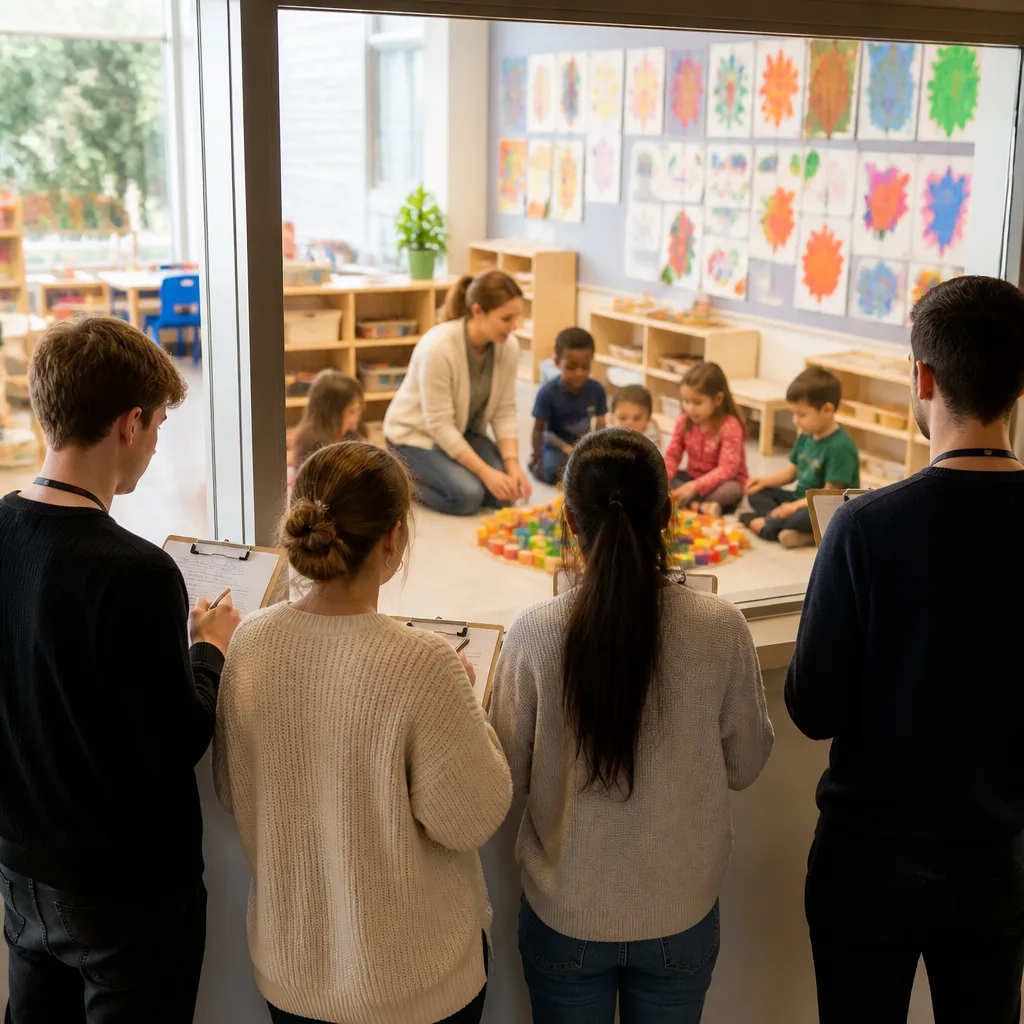
The collaboration between SDSU’s Department of Child and Family Development (CFD) and College Park Preschool began with lecturer Hsing-chen Tung, who teaches three sections of a CFD observation course. During the COVID-19 pandemic, the course shifted to video-based observation. Tung said the virtual format curtailed students’ ability to perceive the larger classroom environment and the role of caregivers.
“Students really need to take part in in-person observation, so they know what children are like,” Tung said. “When they get to see children in-person, they not only see the children, they see the environments, what caregivers are doing, the impact of the setting. They see everything. That's unlike with video, where they basically focus on the child.”
For many students, the change has been profound. Laurelei Vasquez, a CFD sophomore who works as a substitute teacher at College Park Preschool, described in-person observation as both moving and educational. She said courses teach what to look for in textbooks, but seeing children at play reveals spontaneous imagination and behaviour that cannot be fully captured on video.
“I really love their imaginations,” Vasquez said. “They're always doing something to make you laugh or make you giggle. I'm in a lot of classes at SDSU that are teaching me what I'm supposed to see from a textbook, but seeing it in person is a lot different — and it's a lot more moving and educational.”
What students gain
Faculty involved in the partnership highlight several concrete benefits of returning to in-person observation:
- Contextual understanding: Students observe how physical space, materials and routines shape children’s interactions.
- Caregiver interaction: In-person settings let students watch how teachers and aides scaffold learning and respond to behaviour.
- Rich, spontaneous data: Live observation reveals unplanned moments of creativity and social negotiation that videos may miss.
Those gains reflect a wider pedagogical aim: to help future early-childhood professionals translate textbook concepts into practice. Students who substitute or assist at College Park Preschool can compare theories from class with real-time development and classroom management strategies.
Course design and student experience
Tung’s observation course requires students to examine children’s behaviour; the in-person partnership arose from a desire to restore the course’s original intent after pandemic restrictions limited that possibility. The return to live observation is presented as an evolution of curriculum, not merely an extra activity.
For students like Vasquez, the opportunity is also a stepping-stone to career clarity. Hands-on experience helps undergraduates imagine themselves in roles such as classroom teachers, early-intervention specialists or family support workers, and gives them a more nuanced sense of the challenges and rewards of working with young children.
Simple contrasts, clear outcomes
| Observation mode | What students see |
|---|---|
| Video-based (pandemic) | Focused primarily on the child; limited view of environment and caregiver actions |
| In-person (current partnership) | Whole setting: child, environment, caregiver interactions and contextual influences |
The partnership also signals a broader post-pandemic trend in teacher education: programmes are increasingly emphasising direct, supervised practice to complement classroom theory. While online tools remain useful — for review, reflection and certain types of analysis — SDSU faculty argue that some learning outcomes are best achieved face to face.
As universities and colleges across North America reassess practicum models and field placements, the SDSU–College Park arrangement offers a concrete example of how campus partnerships with local early-learning centres can enrich undergraduate training while providing additional support to community preschools.
For students preparing to work with young children, the return to in-person observation provides not only practical skills but an emotional literacy: the capacity to recognise and respond to children’s play, curiosity and resilience in real time.