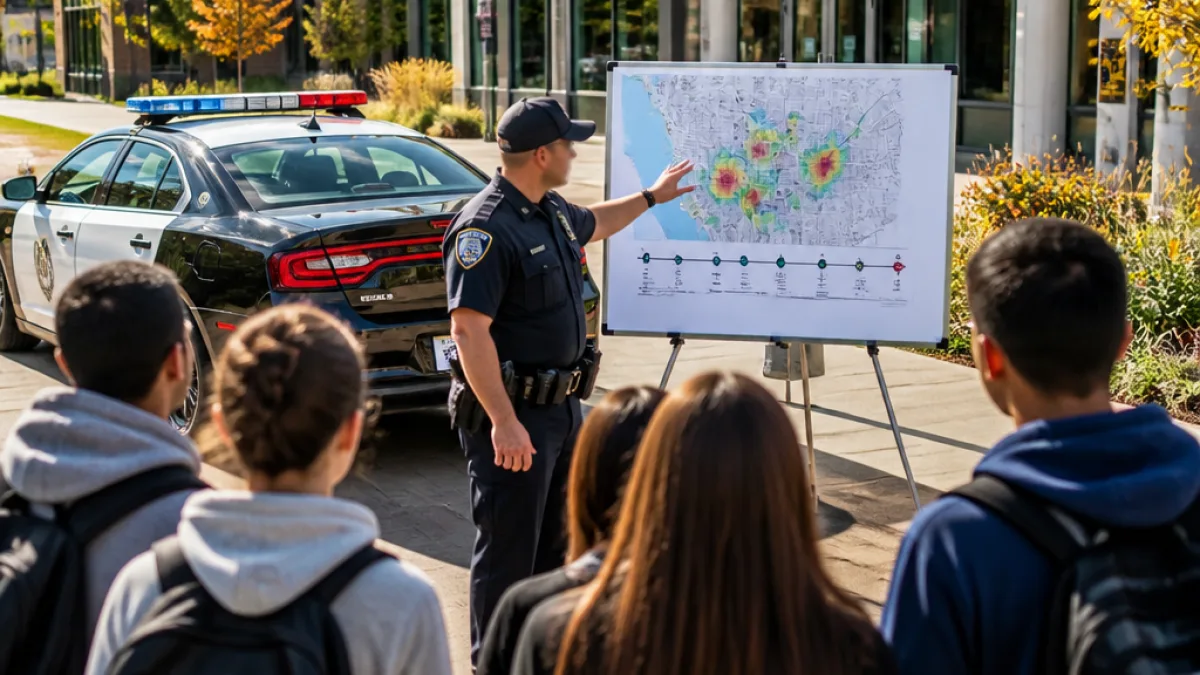
Barrie police have been asked to develop a formal timeline and methodology for analysing how the arrival of Lakehead University students will affect downtown crime and activity, a change that city leaders say warrants careful, unbiased monitoring.
New campuses, new questions for policing
The Barrie Police Service Board made the request this week after the downtown launch of two Lakehead University locations. The campuses — one on Ross Street and the other at the former downtown bus terminal on Maple Avenue — welcomed their first group of students in early September.
Lakehead’s Barrie STEM Hub opened its doors on Sept. 8, with approximately 250 students starting studies at the Ross Street site. University officials say they expect the combined downtown enrolment to grow to about 800 students within the first five years.
Board chair Craig Ferguson asked police Chief Rich Johnston to craft a plan that would identify any change in downtown patterns attributable to the new student population. The request focuses on capturing impacts “from a population perspective, but also time of day that they are involved in their studies or in the community, living and studying in the community.”
“I am curious if you can find a way to flag, without biasing your data, just what is the impact of having those students and residents in the core,”
The board’s request underscores an ongoing conversation in Barrie about safety and the city’s downtown environment. In recent years the municipal police force has expanded officer numbers and patrols downtown and along the waterfront, particularly during the summer months, describing the increase as an “enhanced downtown presence.”
Academic growth and downtown dynamics
Lakehead’s downtown programs are concentrated in electrical engineering and computer science, at both undergraduate and graduate levels. Chris Glover, associate vice-president of administration for Lakehead’s Simcoe County campuses, described the first year as “really healthy” with the initial cohort and reiterated institutional plans to expand enrolment to roughly 800 students in the first five years.
That projected growth presents several practical questions for city planners, businesses and police:
- How will the increased daytime population change foot traffic and commercial demand in the core?
- Will the temporal pattern of activity — classes, study hours and student social life — shift peak times for calls for service?
- How can police isolate student-related data without introducing bias into crime trends?
The police board asked that methodology be designed to flag impacts without biasing the data, signalling an interest in robust, evidence-based decision-making. Chief Johnston was tasked specifically with developing the timeline and analytical approach, though the board did not provide detailed specifications at the meeting.
Implications for downtown residents and businesses
For downtown residents and shop owners, the presence of a growing student population can mean increased economic activity but also shifts in local services and amenities. The police focus on data-driven assessment aims to inform where and how resources — including patrols and community policing initiatives — should be deployed.
City leaders and law enforcement will need to balance a desire for safety with the realities of a denser, busier downtown. Any analytical framework will have to account for seasonal variation in downtown activity, pre-existing trends, and the natural fluctuation of university calendars.
As Lakehead’s campuses continue to ramp up enrolment, the city’s public safety apparatus and downtown stakeholders will be watching the data closely. The board’s direction to police seeks to ensure early, measurable insight into how the campuses change the downtown environment, with an emphasis on neutral, transparent analysis.
| Item | Figure / Detail |
|---|---|
| Initial cohort | Approximately 250 students (Ross Street start, Sept. 8) |
| Projected five-year enrolment | About 800 students |
| Campus locations | Ross Street and Maple Avenue (former bus terminal) |
| Program areas | Electrical engineering and computer science (undergraduate and graduate) |