After an almost two‑month closure, a portion of Highway 1 through British Columbia’s Fraser Canyon has partially reopened, offering immediate relief to businesses that depend on the Trans‑Canada corridor for customers and freight.
Closure began July 7 amid wildfire threat
Provincial authorities closed the stretch on July 7 as the Brunswick wildfire complex burned near Boston Bar. There was a brief reopening in July that was later reversed, and the road remained closed for most of the weeks that followed. On Wednesday, the province deemed conditions safe enough for a partial reopening.
The prolonged closure disrupted local supply chains, cut off tourist traffic and left small businesses with perishable stock and mounting bills. Farmers, festival organisers and accommodation providers described varying degrees of financial pain and logistical headaches.
Farmers face wasted harvests and unpaid wages
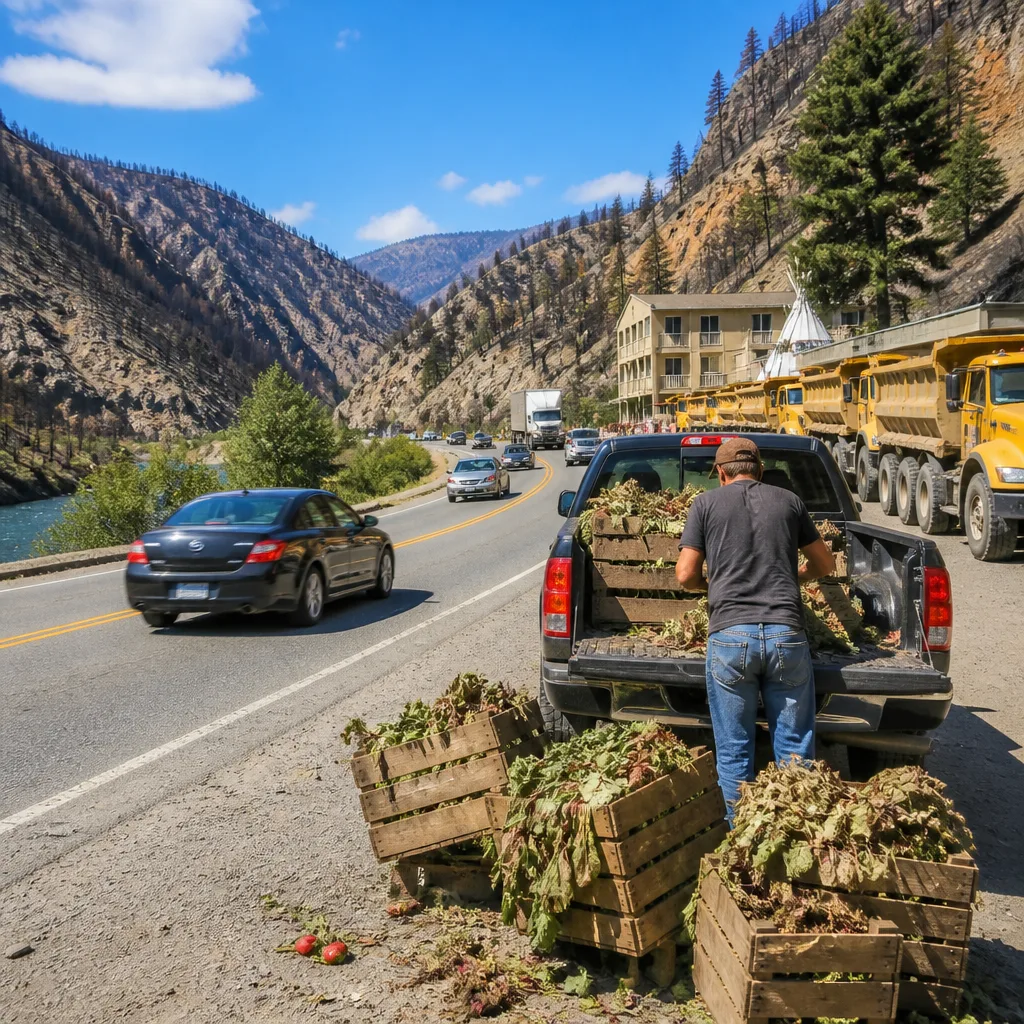
Operators of small farms in the canyon said they lost product that could not be marketed during the closure. Jewel Rice, co‑owner of Hilltop Gardens Farm near Spences Bridge, said the family was forced to discard large quantities of fruit.
“Three thousand pounds of cherries went to the chickens … a minimum of $450 a pound,”
Rice said the highway shutdown limited customers to local traffic only, keeping regular buyers away and squeezing the farm’s cashflow. She told CBC that with diminished revenue over the closure period she could not pay workers and could only hold product for so long.
Some businesses benefited, others suffered
Not all operators fared the same. The report notes that one local lodging business, the Bates Motel, managed to remain profitable because of an influx of long‑term construction workers. That illustrates a split in economic impact: firms tied to construction and infrastructure response saw increased demand, while those dependent on transient tourists and through traffic suffered losses.
- Duration: Closure began July 7, with partial reopening announced mid to late August.
- Impacted sectors: Agriculture (perishable produce), tourism and festivals, local retail and hospitality.
- Winners/losers: Some accommodation providers saw steady business from construction crews; farms and event organisers faced sharp revenue declines.
What reopening means — and what remains uncertain
The partial reopening restores an essential east–west artery for western Canada, easing the movement of goods and visitors. For farmers, even a partial flow of traffic can mean access to markets and the ability to move remaining harvests toward buyers. For festival organisers and vendors, the reopening allows planning to resume and ticket sales to reach audiences previously cut off by the closure.
But reopening does not erase losses already incurred. Perishable crops discarded or downgraded cannot be recovered, and shortfalls in revenue and unpaid wages will weigh on household and business finances for the remainder of the season. The long‑term economic toll for the affected communities will depend on the duration of remaining fire activity, consumer confidence among travellers, and how quickly freight and tourism volumes return to normal.
| Item | Reported detail |
|---|---|
| Closure start | July 7 |
| Primary cause | Brunswick wildfire complex near Boston Bar |
| Example loss | 3,000 lb of cherries discarded (owner's account) |
For regional policymakers and businesses, the immediate priority will be restoring reliable transport links and supporting affected producers and service providers. Recovery measures could include targeted financial assistance, marketing efforts to draw visitors back to the canyon, and logistical support for moving remaining agricultural product to market.
The partial reopening is an important first step, but business owners say rebuilding revenues and offsetting losses will take time and continued attention from provincial agencies and industry partners.