
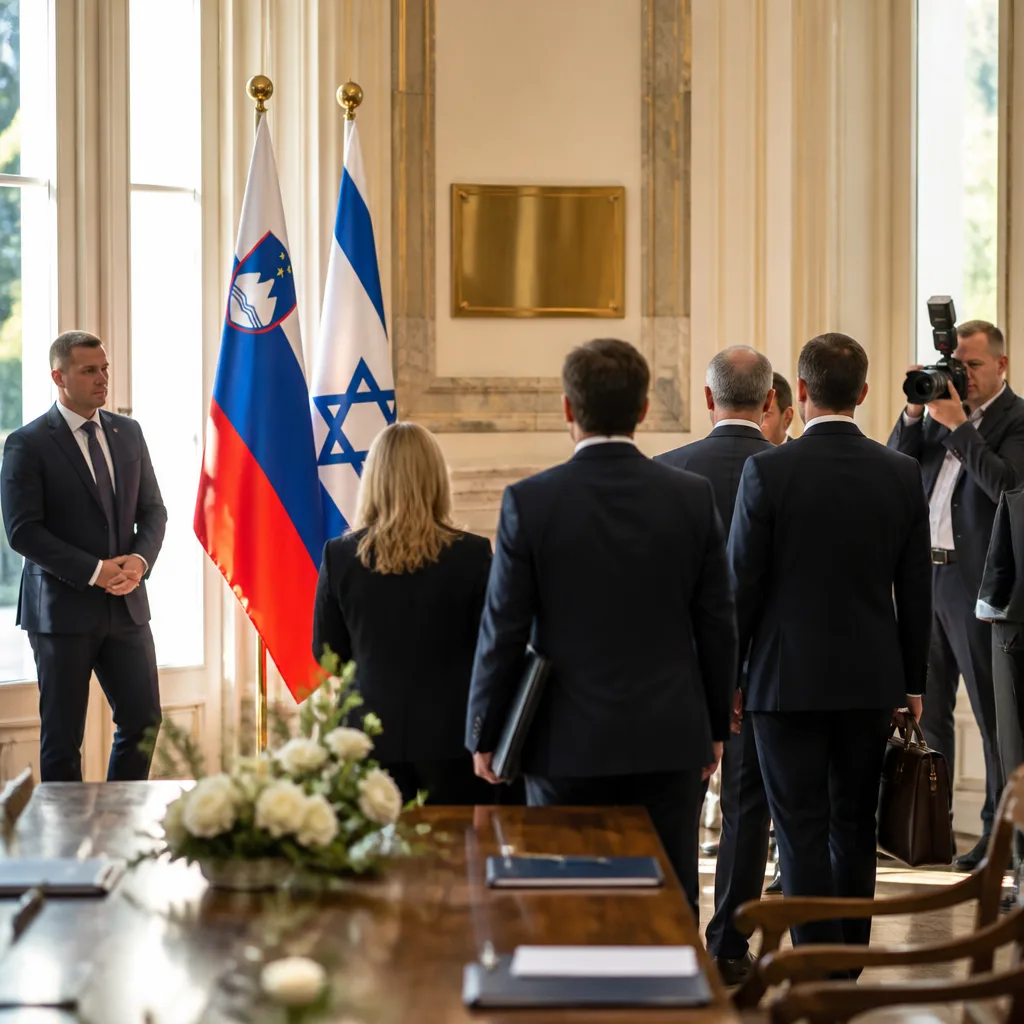
A senior delegation from the World Jewish Congress (WJC) met with Slovenian Prime Minister Janez Janša and senior members of his government in Ljubljana on 17 September 2026, marking the first major international Jewish visit since Israel opened its first resident embassy in Slovenia and appointed Ruth Cohen-Dar as the country’s inaugural resident ambassador.
Diplomatic reset and community security
The visit, led by senior WJC figures, underlines the organisation’s interest in repairing and deepening ties between Slovenia, Israel and Jewish communities worldwide. The delegation included Sara Friedman (CEO, WJC Israel and North America), Hadassa Getsztain (Chair, WJC Israel), Maya Samokovlija (Executive Director, Community Relations) and Ernest Herzog (Executive Director of Operations and Head of Combating Antisemitism, Intelligence and Security).
According to the WJC report of the visit, the delegation represents Jewish communities in more than 100 countries and said its presence in Ljubljana reflected its commitment to engaging governments willing to strengthen relations with Israel, confront antisemitism and build partnerships with local Jewish communities.
Context: from 2024 walkout to a new opening
The WJC underlined that the current visit contrasts sharply with a mission to Slovenia in April 2024, when senior members of the previous Slovenian government declined to meet Jewish leaders. During that earlier visit, WJC representatives left a meeting with Slovenia’s delegation to the International Holocaust Remembrance Alliance (IHRA) after a senior Slovenian official reportedly sought to hold the global Jewish community accountable for the war in Gaza. The WJC said that conduct would fall under the IHRA Working Definition of Antisemitism; Slovenia itself adopted that definition in 2018.
The organisation’s return now follows two notable changes: the opening of Israel’s first resident embassy in Ljubljana and a shift in national leadership. The timing of the WJC delegation — immediately after the embassy opening and the ambassadorial appointment — signalled to the organisation both an opportunity and a test of Slovenia’s readiness to respond to concerns about antisemitism and to pursue closer bilateral ties.
- Key attendees: WJC delegation leaders included Sara Friedman, Hadassa Getsztain, Maya Samokovlija and Ernest Herzog.
- Diplomatic milestone: Ruth Cohen-Dar named Israel’s first resident ambassador to Slovenia.
- Historical friction: WJC walked out of a 2024 IHRA meeting with Slovenian officials after contentious remarks.
Why the visit matters for South Africa and beyond
While this meeting is bilateral in form, it touches on broader international themes of minority security, the responsibilities of governments to counter antisemitism, and the ways in which diplomatic openings can reshape regional relationships. For South African readers, the development offers a lens on how European states are recalibrating their relations with Israel and responding to civil-society concerns about hate speech and community protection. It also demonstrates how multilateral instruments such as the IHRA working definition continue to frame debates about acceptable public and official discourse regarding Israel and Jewish communities.
The WJC’s emphasis on both Israel relations and the safety and dignity of local Jewish communities reflects a long-standing organisational stance that those interests are intertwined. The delegation’s visit therefore serves as both a diplomatic outreach to Ljubljana’s government and an on-the-ground assessment of the space for Jewish communal life in Slovenia under its present leadership.
| Delegation member | Role |
|---|---|
| Sara Friedman | CEO, WJC Israel and North America |
| Hadassa Getsztain | Chair, WJC Israel |
| Maya Samokovlija | Executive Director, Community Relations |
| Ernest Herzog | Executive Director of Operations; Head of Combating Antisemitism, Intelligence and Security |
The meeting is likely to be watched closely by Jewish communities in Europe and internationally, and will inform future engagement between the WJC and Ljubljana. It also establishes a benchmark for how the new diplomatic relationship between Slovenia and Israel will address both bilateral cooperation and the protection of minority communities.









