
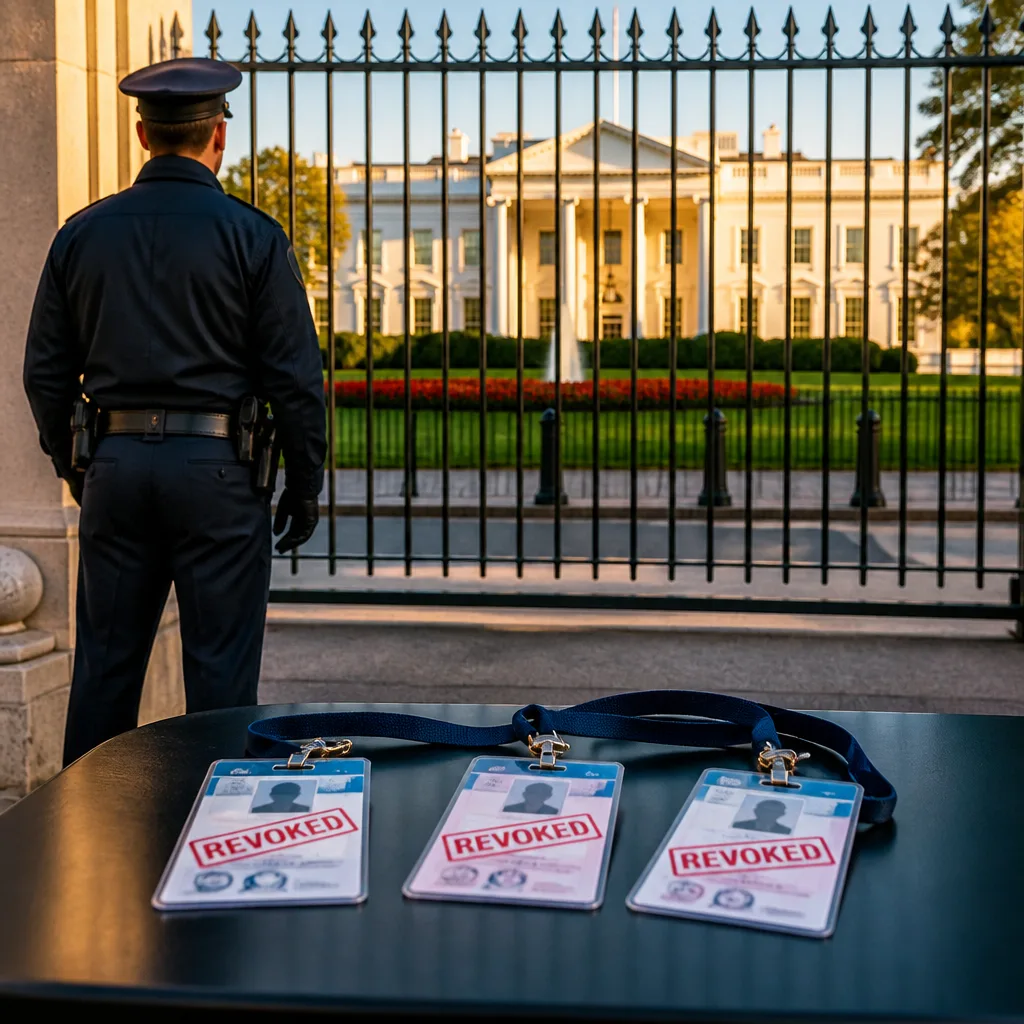
Reporters from CNN, MS NOW and Politico were denied entry to the White House on Saturday, a day after President Donald Trump announced he would bar the outlets over coverage he described as "fake news", the Associated Press reported.
Immediate action at the White House
Two correspondents for the cable networks — Betsy Klein of CNN and Akayla Gardner of MS NOW — were turned away at the gate while the Politico reporter, Cheyenne Haslett, had her White House badge taken away, the AP said. The three outlets issued statements saying they would defend their rights and continue to cover the presidency.
"We will not be deflected from our duty to hold the government and other public bodies to account," CNN said, according to the AP report.
The removals came after the president said on Friday that he was banning the three organisations because of reporting he found objectionable. Media organisations and press freedom advocates view the step as an escalation of long‑running tensions between the Trump administration and certain newsrooms.
What was said and what happens next
Politico's editor‑in‑chief, Jonathan Greenberger, said his organisation would stand by its reporter and "vigorously defend our First Amendment rights," the AP reported. MS NOW also said it would take "any and all steps necessary to defend our First Amendment rights and the essential role of independent journalism in our democracy."
The actions are part of a broader pattern in the president's second term, the AP noted, in which the administration has pursued legal and administrative measures seen as limiting scrutiny by outlets it disfavors. Individual reporters have also been publicly criticised by the president in briefings and on social media.
Context and consequences
Lawyers and constitutional scholars will almost certainly assess whether the move runs afoul of First Amendment protections. The AP story frames the episode as another test of free‑speech guarantees in the United States; domestic litigation and political pushback have in previous years shaped how far executive branch officials can restrict access to government spaces or facilities.
- Who was affected: CNN, MS NOW and Politico correspondents covering the White House.
- Immediate consequences: Denied entry for two cable network reporters; Politico reporter had badge confiscated.
- Stated justification: The president said the outlets published "fake news" and announced bans on Friday.
For governments and journalists outside the United States, the episode will be watched closely as an indicator of how political pressure can translate into operational restrictions. Access to briefings, on‑the‑record questioning of officials and the ability to report from inside official premises are practical tools for accountability; curbs on those tools alter the balance between executive power and public scrutiny.
| Party | Action taken |
|---|---|
| CNN | Reporter turned away at gate |
| MS NOW | Reporter turned away at gate |
| Politico | Badge confiscated |
Whether the affected organisations will pursue legal remedies, appeal through credentialing processes, or rely on public pressure and industry coalitions remains to be seen. In the past such disputes have been resolved through a mix of court challenges, negotiations with the White House communications office, and interventions by press organisations.
For readers in South Africa, the episode is a reminder that press freedoms can be contested even in established democracies. The mechanics of access to government—who gets in, who asks the questions, and who reports on the answers—determine how effectively citizens can hold power to account. In Washington, as the AP reported, the decision to bar outlets is shaping up to be one of the more consequential skirmishes in an ongoing confrontation between the presidency and the media.












