
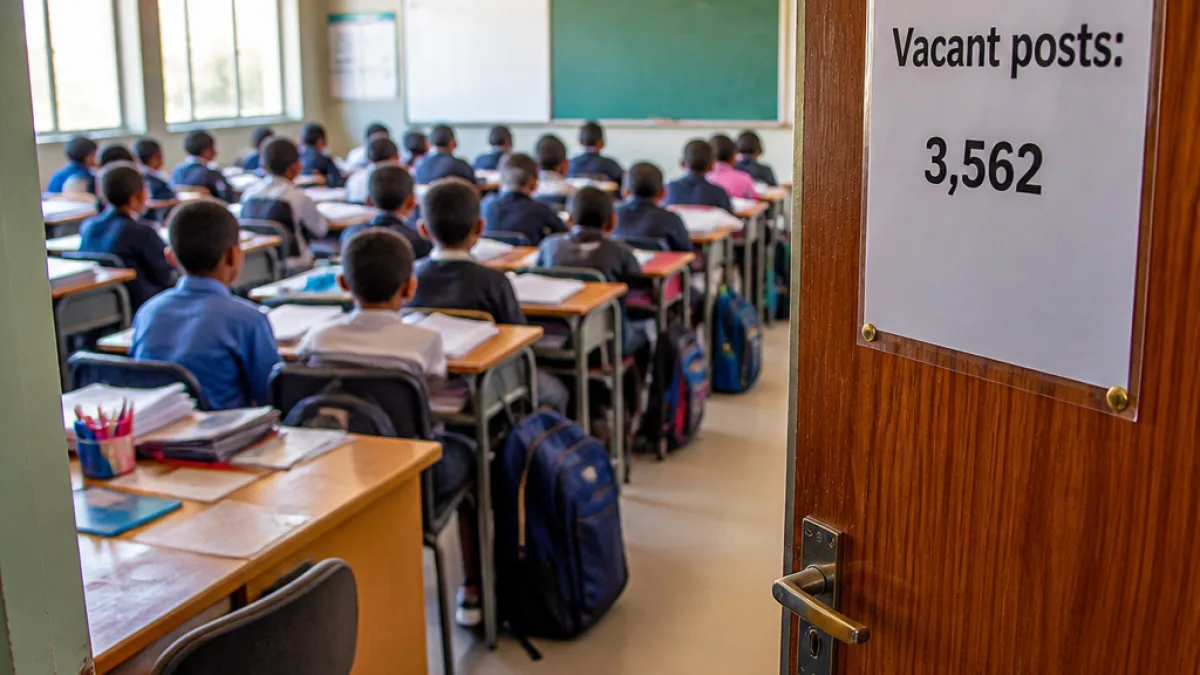
South Africa has 27 092 vacant teaching posts in public schools, placing further strain on classrooms already coping with high pupil numbers, the Basic Education Minister Siviwe Gwarube reported in a written parliamentary reply on figures current to 30 June 2026. The Western Cape accounted for 3 562 of those vacancies.
Vacancies by province
The Department of Basic Education provided a province-by-province breakdown that shows both coastal and interior provinces affected. The data include posts that have a system status described as “frozen” — though the department cautioned that the status does not always indicate deliberate budget-driven freezes.
| Province | Vacant posts |
|---|---|
| Eastern Cape | 5 730 |
| KwaZulu‑Natal | 4 700 |
| Gauteng | 3 994 |
| Western Cape | 3 562 |
| Limpopo | 3 097 |
| North West | 2 346 |
| Mpumalanga | 1 866 |
| Northern Cape | 1 521 |
| Free State | 276 |
The department also noted that 2 654 of the vacant posts carried a “frozen” status on 30 June 2026.
Pupil-to-educator ratios and classroom impact
The national educator vacancy rate stood at 7%, according to the parliamentary reply. That sits alongside elevated pupil-to-educator ratios reported in the Department of Basic Education’s School Realities 2025 report, published in February 2026. The national average was reported as 34 pupils for every state-paid educator in ordinary public schools.
Provincial ratios in the report highlighted pressure points: the Western Cape and Limpopo recorded the highest ratios at 35.7:1 each; Mpumalanga was at 35.6:1; the Eastern Cape at 34.2:1, and Gauteng at 32.7:1. The Department said the 2025 ratio figures are preliminary and based on provincial data uploaded by July 2025.
Teacher unions warned that such averages can conceal the realities in individual schools, where class sizes and workloads are often far higher than provincial or national means suggest. National Teachers' Union (Natu) president Sibusiso Malinga cautioned that classroom numbers were already unsustainable for many educators.
“The learner‑pupil ratio is practically impossible. You find that... we still have teachers teaching more than 70 learners in each and every classroom,” Malinga said.
What this means for the Western Cape
For the Western Cape, the headline figure of 3 562 vacancies sits against a provincial schooling system that includes some of the country’s highest-performing schools and large numbers of schools operating in informal settlement contexts. Unfilled posts can aggravate inequalities: schools in wealthier areas often attract applicants and offer private supplements or subject specialists, while those in under-resourced communities risk relying on temporary relief teachers, multi‑grade teaching or learners receiving less contact time.
Education unions in other provinces — notably KwaZulu‑Natal and the Eastern Cape, which recorded the highest vacancy counts — have also voiced concerns about the difficulty of finding substitute teachers and the administrative burden on school leaders when posts remain unfilled.
Department response and next steps
The Basic Education Department reiterated that the system status labelled “frozen” does not categorically mean posts were withheld due to budgetary constraints. It emphasised that provincial HR systems and data uploads influence how posts are coded.
Beyond clarifying the coding, the department and provincial education departments will be under pressure to show how they intend to recruit and retain educators. The parliamentary reply does not set out specific national recruitment targets or timelines tied to the vacancy numbers reported on 30 June 2026.
Practical implications for parents and schools
Parents concerned about large class sizes or the absence of subject specialists should raise these matters with their school governing bodies and the provincial education department. School governing bodies have the authority to highlight critical posts and to request interventions. Where substitute staffing is required, parents can also enquire about the use of district-provided relief teachers and how schools plan to mitigate loss of curriculum time.
- Key figures: 27 092 vacant posts nationally; 3 562 in the Western Cape; 2 654 posts flagged as frozen.
- Ratios: National average 34 pupils per state-paid educator; Western Cape 35.7:1 (School Realities 2025).
- Union concern: Instances of classes exceeding 70 learners have been reported by union representatives.
The vacancy numbers add urgency to long-standing debates in the Western Cape and nationally about teacher recruitment, incentives for teaching in underserved areas, and the administrative systems that record and manage educator posts. Education outcomes and learner experience this year will depend partly on how quickly provinces can fill critical vacancies and support teachers working in overpopulated classrooms.












