
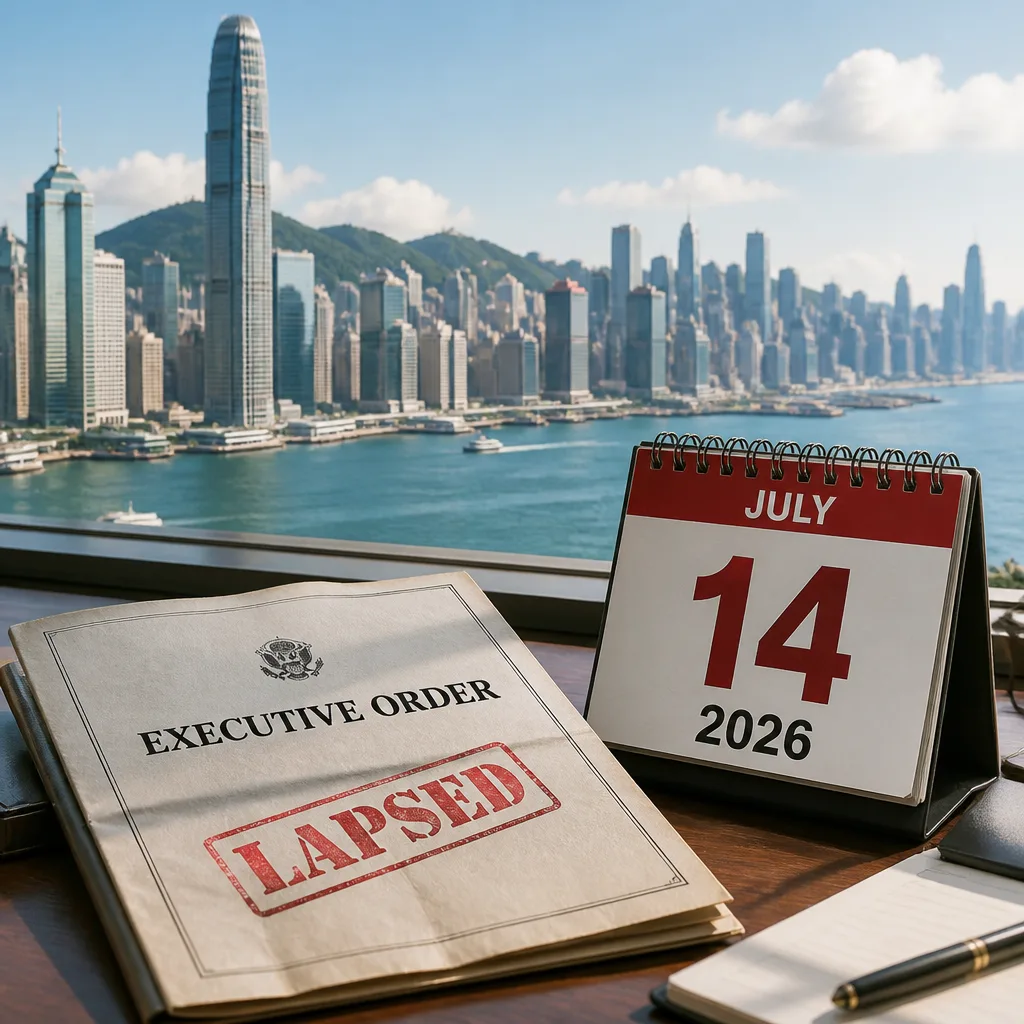
Washington allowed Executive Order 13936 to expire on 14 July 2026, the Australian Institute of International Affairs reported, ending a measure first adopted following the mass protests in Hong Kong and Beijing’s subsequent imposition of a national security law.
From emergency tool to symbolic gesture
The order, originally issued on 14 July 2020, suspended Hong Kong’s preferential treatment under US law, authorised sanctions on officials involved in the city’s crackdown and declared a national emergency related to threats to Hong Kong’s autonomy. It was supported by the Hong Kong Autonomy Act and the Hong Kong Human Rights and Democracy Act and had been renewed annually until this year.
According to reporting by the Australian Institute of International Affairs, US policymakers concluded that after more than half a decade of erosion in Hong Kong’s political space — including the passage of mainland-style security legislation and high-profile prosecutions — the executive order had become largely symbolic and no longer advanced Washington’s strategic objectives.
- Key events cited in the assessment: enactment of Article 23-style security measures; long prison sentences for pro-democracy activists; raids on independent publishers and bookstores.
- Financial integration: closer linkage between Hong Kong’s markets and the mainland via Greater Bay Area initiatives reduced the leverage of US financial sanctions.
- Sanctions effectiveness: research noted in the report finds that authoritarian regimes are often resilient to targeted economic pressure, particularly when the issue at stake is asserted sovereignty.
Why Washington retired the measure
Observers cited in the report argued the decision was pragmatic rather than conciliatory. After years of limited evidence that sanctions could alter Beijing’s approach to Hong Kong, US officials judged that the order no longer delivered meaningful leverage.
Renewal of the order had become a ritual that did not reverse the city’s political trajectory: prominent figures were prosecuted, independent civic organisations were curtailed, and Beijing pressed ahead with policies to bring Hong Kong closer to mainland governance structures. The report notes that these developments made the executive order a diminishing instrument in Washington’s toolbox.
Practical consequences and the diplomatic signal
Letting the order lapse risks being read as a softening of US pressure by some critics, especially since the move occurred alongside revived trade discussions with Beijing. But the institute’s analysis stresses that the lapse was unlikely to be a bargaining chip in talks: the order had limited capacity to compel changes in areas Beijing deems sovereign.
Policy-makers who favour targeted economic measures face a dilemma. The report highlights that sanctions against officials and financial controls are most effective when they exploit economic interdependence and when the target regime has domestic constraints or elite divisions. Where Beijing treats governance of Hong Kong as an internal matter and has tools to insulate itself, sanctions lose potency.
| Milestone | Date |
|---|---|
| Executive Order 13936 issued | 14 July 2020 |
| Order allowed to expire | 14 July 2026 |
For South Africa and other countries watching Sino-Western relations, the episode underscores how instruments of foreign policy can lose utility as the underlying realities change. Financial institutions recalibrated compliance costs; Hong Kong’s officials adjusted to sanctions; and Beijing deepened economic ties within the Greater Bay Area, all factors that diminished the executive order’s bite.
While the decision may prompt debate in capitals about the future of targeted measures, the institute’s analysis reinforces a central point: sanctions are limited when they confront issues that a target state frames as matters of sovereignty, and authoritarian systems can often absorb external pressure without changing core policy choices.
As governments reassess tools for influencing behaviour abroad, the US example will be watched for lessons on when to renew pressure, when to retire measures as symbolic, and how to design policy that can adapt to evolving political and economic integration.









