President Donald Trump was secretly transferred between aircraft during a trip to Turkey last month after US officials responded to an alleged threat from Iran, a US official told reporters, according to media reports.
Decoy operation and the presidential fleet
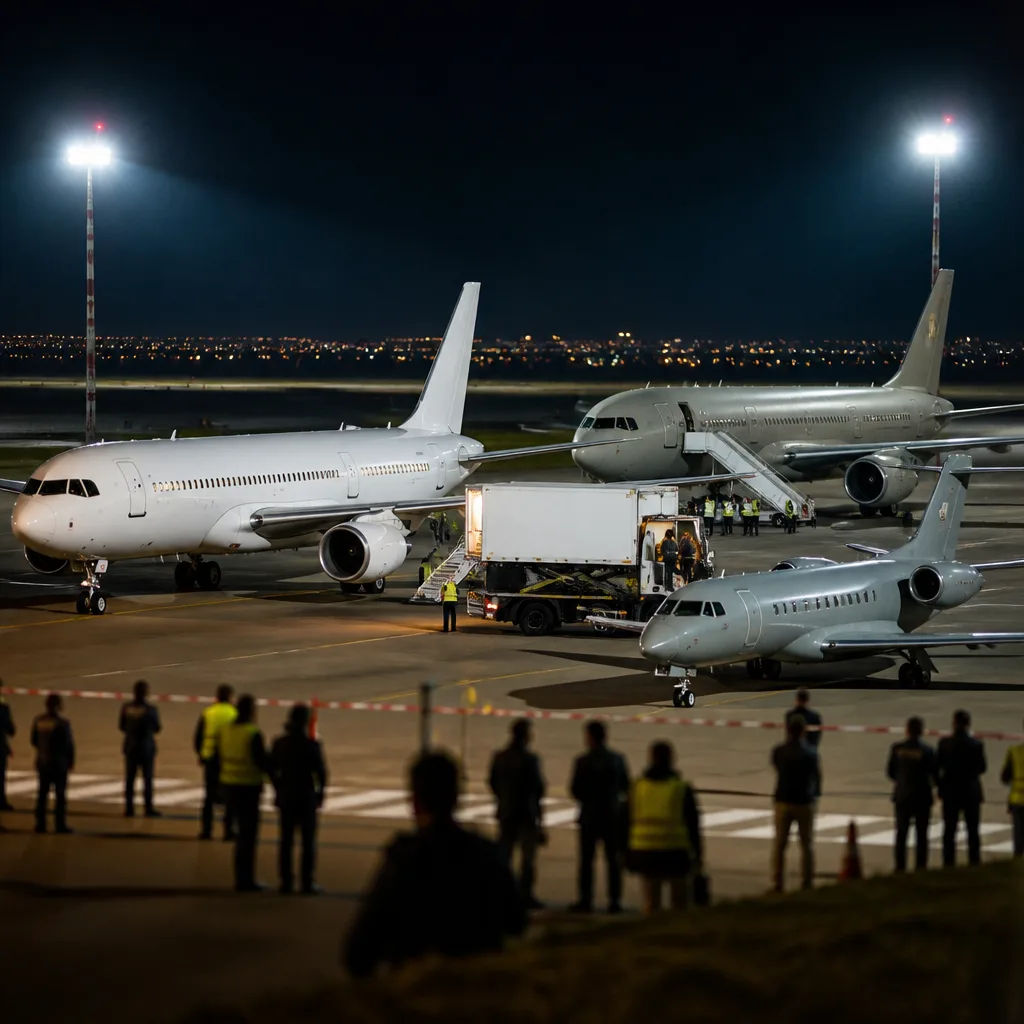
The complicated manoeuvre involved at least three aircraft: a new jet donated by Qatar that the president had publicly showcased, an older presidential plane described as functioning temporarily as Air Force One, and a smaller Air Force C-32A. The C-32A carried the president away from the older aircraft after he is reported to have exited the latter concealed inside a catering vehicle.
The three planes departed Turkey separately for the United Kingdom. Once in the UK, the president reportedly boarded the Qatar-donated jet to return to the United States.
| Aircraft | Role in operation |
|---|---|
| Qatar-donated jet | Originally used to fly to Turkey; later used for the president's return |
| Older presidential plane | Presented publicly as the outbound Air Force One; acted as a decoy |
| Air Force C-32A | Smaller aircraft that carried the president covertly from Turkey |
Security concerns and consequences for the press
Initial public discussion of the plane movements centred on the security capabilities of the Qatar-donated aircraft. The plane had been celebrated by the president but officials were reported to regard it as less secure until it could be retrofitted to fully meet Air Force One standards.
Media attention is likely to shift to the fact that reporters and some staff who travelled with the presidential pool may have been on a decoy aircraft without their knowledge. That raises questions about the informed consent of those travelling with the president and about risk management for non-security personnel assigned to cover presidential travel.
- Security rationale: US officials said the operation was prompted by an Iranian threat.
- Operational detail: The president reportedly disembarked the decoy aircraft via a catering vehicle.
- Press impact: Journalists and staff may have been unknowingly placed on a plane intended as a diversion.
“The new Air Force One is a state-of-the-art aircraft that has been fitted with high-level security protocols that ensure the safety of the President and his staff,” White House spokesperson Steven Cheung said, adding that officials use every tool at their disposal to address threats.
What this means politically
The revelations underline the lengths to which security teams will go to protect a sitting president when confronted with credible threats. They also reopen questions about the suitability of the Qatar-donated plane for presidential use and the potential political fallout from the optics of secrecy.
Politically, the episode places rival considerations in tension. On one hand, visible presidential assets such as a new jet can be a symbol of status and bilateral ties. On the other, security services must sometimes favour classified contingency measures that downplay or contradict public statements. Both choices create winners and losers: the public narrative of presidential competence and transparency may suffer, while security teams prioritise the president's immediate protection.
For journalists, there are procedural implications. The presidential travel pool is a small group that accompanies the president and provides shared coverage. If members of that pool were not informed about the decoy, there may be renewed demands for clearer briefing protocols and for review by those responsible for media safety during presidential travel.
At an international level, the episode touches on host-nation logistics and partnerships. The Qatar-donated aircraft played a visible role in the president's trip, but officials reportedly judged it needed retrofitting before matching the security features of other presidential aircraft — a technical and diplomatic detail that may attract scrutiny in Washington and among allies.
The White House comment reproduced above was provided in response to media reports. CNN and the Washington Post first reported elements of the story; a US official confirmed the account to those outlets, according to reporting.
The full implications — for security practice, press procedures and diplomatic messaging — are likely to be debated in the coming days as more details are reported and examined.