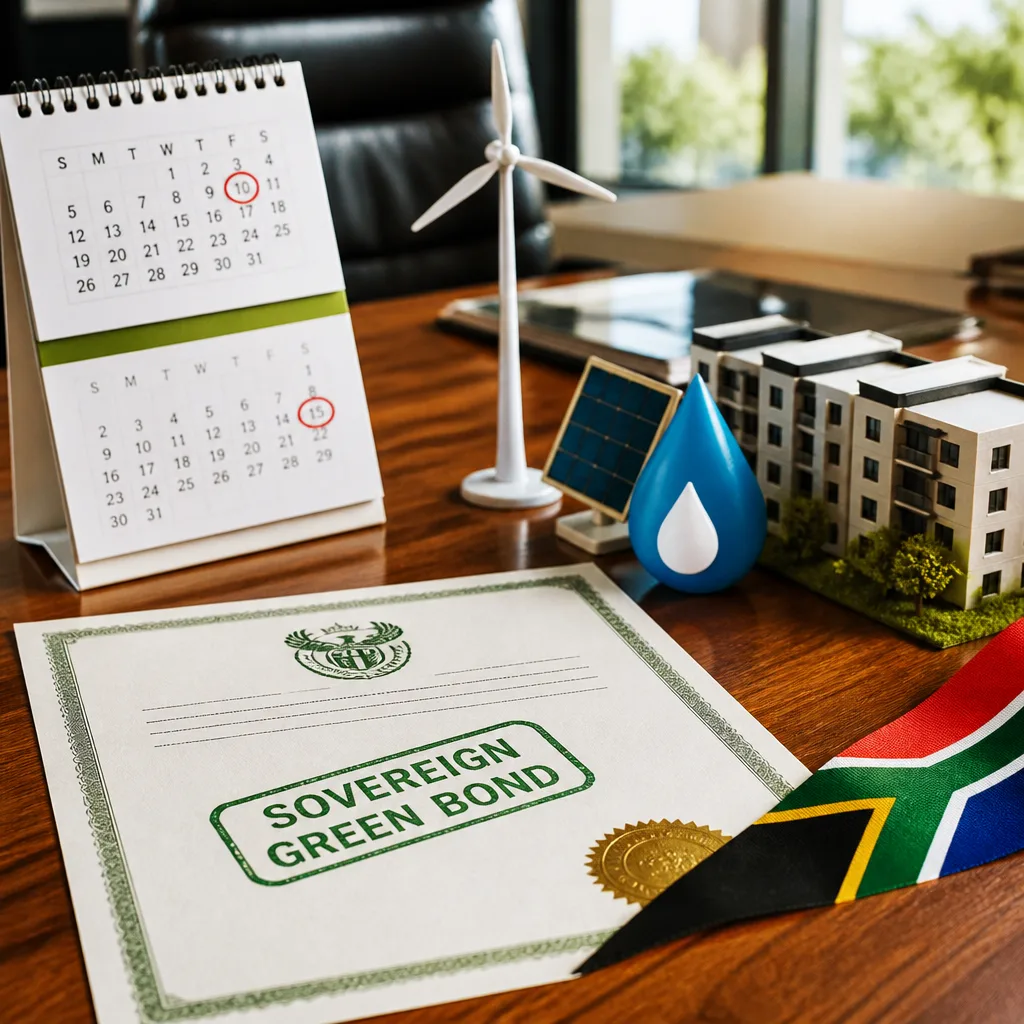
National Treasury is seeking to issue South Africa’s inaugural sovereign green bond within the current fiscal year as part of a plan to help finance the country’s climate transition and infrastructure pipeline.
The bond forms part of a broader sustainable-finance framework published by the Treasury in May. Officials say proceeds would be used for projects ranging from renewable energy and hydrogen manufacturing to water security, electricity transmission and municipal housing for low-income households.
Timing, amount and conditions
The Treasury’s chief director for liability management, Wanga Cibi, told reporters the department is working to identify eligible projects and will decide the timing and size of the first issuance within the mid-term budget statement process scheduled for October. The Treasury aims to issue the bond before the end of the fiscal year in March 2027, but said issuance could slip to the 2027-28 fiscal year if market conditions are unfavourable.
“Aspirationally, we would like to issue something within this fiscal year, so we’ve got from now until March 2027,” Cibi said. “If not, definitely in the 2027-28 fiscal year.”
Where the money will go
The Treasury’s framework lists both climate-related and socio-economic uses for green bond proceeds. Eligible areas include:
- Clean energy projects — hydropower, geothermal, bioenergy and renewables-related transmission and distribution;
- Low-carbon industry — hydrogen manufacturing and energy-efficient technologies for industry and households;
- Social and transition measures — reskilling and employment programmes for coal-sector workers, expanded access to healthcare and education, and low-income municipal housing;
- Water and energy security — investments in water infrastructure and electricity transmission networks.
Scale of the challenge
The framework sets out the finance required to meet South Africa’s commitments under international climate agreements. Between 2026 and 2035, the Treasury estimates about R250 billion will be needed for implementation measures and R3.47 trillion for mitigation strategies — a total financing requirement of roughly R3.7 trillion over the decade, or an average of R372 billion a year.
To bridge that gap, the Treasury aims to mobilise roughly R160 billion a year from international climate finance by 2030, with the remainder to be sourced from private lenders and public spending.
| Item | Estimated cost (2026–2035) |
|---|---|
| Implementation | R250 billion |
| Mitigation | R3.47 trillion |
| Total (2026–2035) | R3.7 trillion |
| Average per year | R372 billion |
Investor safeguards and market considerations
The Treasury says the framework embeds strict governance measures to meet international standards and reassure investors. It links the use of proceeds to nationally planned climate and infrastructure projects, and sets out reporting and transparency requirements for issuances.
Officials emphasised the mid-term budget statement in October will be a key moment for determining the size and timing of the debut issuance, which will also depend on prevailing market conditions and investor appetite for sovereign green debt.
Implications
A sovereign green bond would mark a new step in South Africa’s efforts to attract climate finance and crowd in private investment for the energy transition. If issued as planned, it could provide dedicated funding for projects that reduce greenhouse gas emissions and support the social transition away from coal-dependent communities.
However, the success of such an issuance will hinge on credible project pipelines, rigorous oversight, and market conditions. Treasury officials are continuing to refine the list of eligible projects and disclosure arrangements ahead of the October budget review.
Details remain subject to confirmation when the mid-term budget statement is published and as further technical work on eligible projects is completed.