
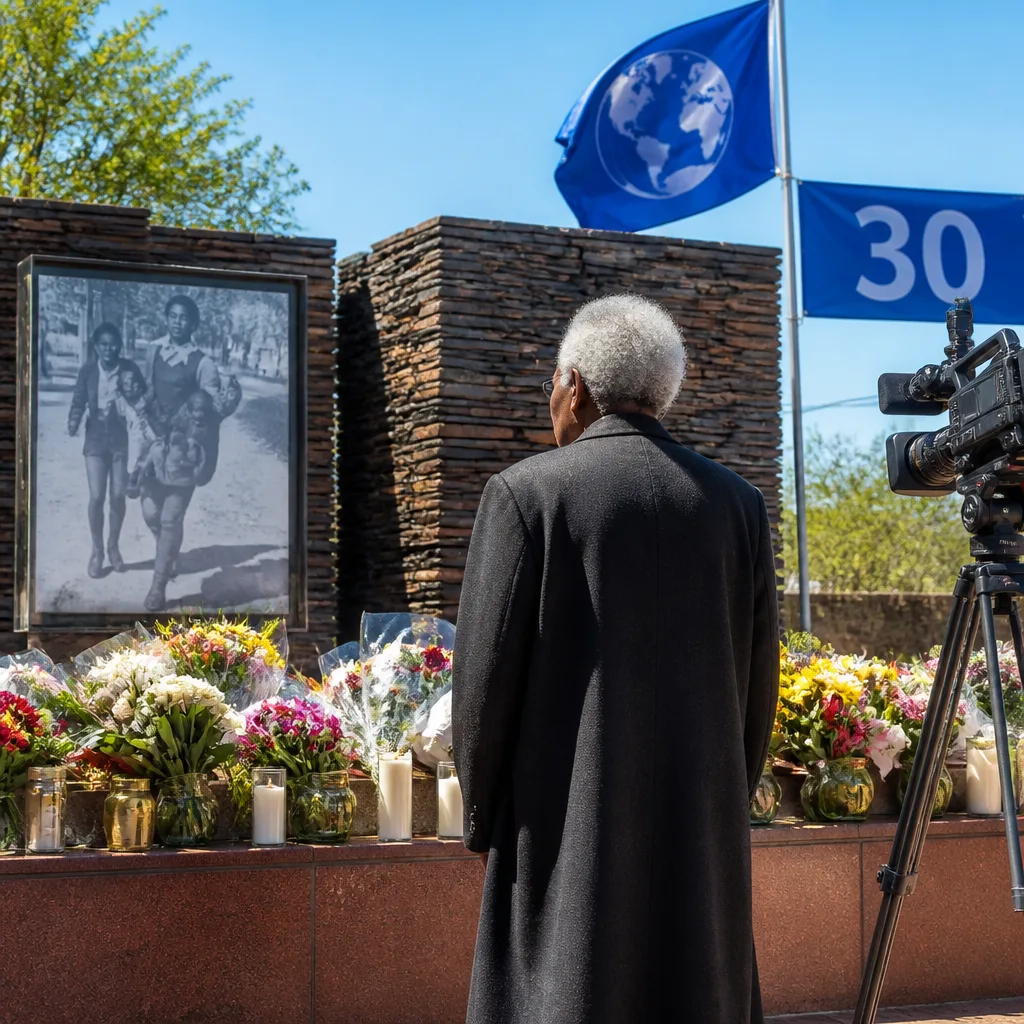
Fifty years after the 16 June 1976 Soweto Uprising, the country’s unfinished journey towards dignity, equality and justice was the focus of a recent commemorative encounter in Soweto. The meeting between Seth Mazibuko — a former student leader and one of the youngest members of the committee that led the protests — and Abigail Noko, the UN Human Rights Office regional representative for Southern Africa, was used to press a single point: memory must prompt action.
From a memorial meeting to a campaign
Noko met Mazibuko at the Hector Pieterson Memorial and Museum during a visit described in a report by the UN Human Rights Office. She said Mazibuko’s life serves as a bridge between history and conscience and that his story demonstrates how remembrance should be forward-looking. “To speak with him is to encounter not only a survivor of one of South Africa’s defining moments but a man who has spent decades insisting that memory must do more than lament,” she said.
The visit coincides with two symbolic milestones: the 50th anniversary of the Soweto Uprising, when hundreds of schoolchildren marched against the imposition of Afrikaans as a language of instruction under the Bantu Education system and were met with police tear gas and live ammunition; and the 30th anniversary of the South African Constitution. The UN Human Rights Office in Southern Africa and SABC News have marked the constitutional milestone with a #30for30 campaign, spotlighting the 30 articles of the Universal Declaration of Human Rights alongside reflections on South Africa’s constitutional order.
- Soweto Uprising (16 June 1976): a student-led protest against compulsory Afrikaans instruction and the Bantu Education system; met with violent state force.
- Constitutional milestone: the country marks 30 years since its Constitution was adopted; the UN and SABC have launched a commemorative campaign linking the Constitution to the Universal Declaration of Human Rights.
- Memory as mandate: Mazibuko’s life and testimony were presented as an argument that remembrance should compel social and political action.
History, human rights and the present
The UN report emphasised the symbolic resonance of Mazibuko’s life. He was the youngest member of the students’ committee that organised the peaceful march in Soweto. The report recalled how students took to the streets to protest dehumanising apartheid-era education policies and how the state responded with lethal force. Many children were killed or injured.
The account notes a deliberate link between two landmark documents: the Universal Declaration of Human Rights and South Africa’s Constitution. It says both were adopted on 10 December in their respective years and have served as beacons for human dignity and constitutional democracy. The #30for30 campaign pairs this linkage with public reflection on the practical meaning of rights in contemporary South Africa.
According to the UN Human Rights Office, Mazibuko’s testimony carries particular moral force because his life embodies continuity between struggle-era sacrifice and the demands of today. He has spent decades insisting that the act of remembering must be productive: a foundation to build laws, policies and social programmes that address inequality and protect rights.
The report stops short of outlining specific policy prescriptions. Instead it frames remembrance as an ethical and political obligation: to translate historical memory into sustained efforts for social justice, improved education, and protection of civil and political rights.
What remains under discussion
Details about any particular follow-up initiatives stemming from the meeting were not included in the UN report. It remains unclear whether the #30for30 campaign will lead to targeted interventions, further public consultations, or government commitments tied directly to the commemorations. Observers of the country’s democratic trajectory will likely watch how memory-focused campaigns influence civic debate and policymaking in the coming months and years.
“To speak with him is to encounter not only a survivor of one of South Africa’s defining moments but a man who has spent decades insisting that memory must do more than lament,”
The meeting at the Hector Pieterson Memorial and the UN’s commemorative framing underline a wider conversation in South Africa: how to honour the past while making constitutional rights meaningful in the present. For many, the measure of commemoration will be whether it prompts concrete measures that improve access to quality education, reduce inequality, and strengthen democratic institutions.














