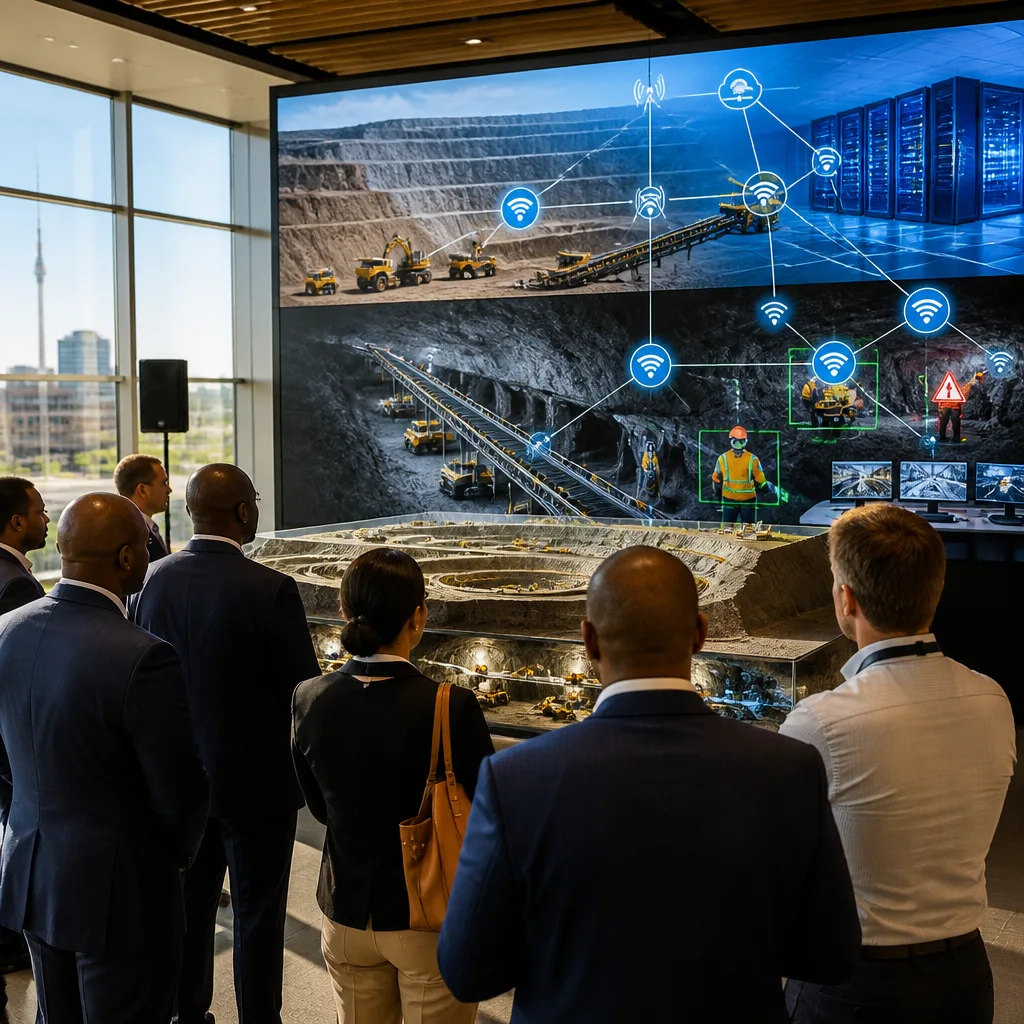
Mining companies, technology partners and university researchers met in Johannesburg at Huawei South Africa Connect 2026 to debate the practical steps required to shift from merely connected operations to intelligent mining. The discussion focused on matching connectivity technologies to mining environments and on applying AI where it delivers clear value.
Connectivity tailored to the mine
Speakers outlined different connectivity models for the two dominant mining environments. For open-pit operations, the event highlighted private 5G as a way to support high-volume data transmission without recurring public network data charges. For underground mines, delegations recommended Wi‑Fi Mesh to extend networks into changing work areas.
The conference also raised sensing technologies that move beyond communications. Optical‑fibre sensing, and specifically distributed fibre sensing, were presented as options to extend perception across a site: the fibre itself acts as a continuous sensor to detect unusual vibration or sound patterns. That allows a shift from scheduled inspections to condition‑based maintenance, potentially spotting conveyor idler faults and other mechanical issues earlier.
Start AI with clear business problems
Participants warned against deploying AI as a technology fashion. Instead, projects should start from specific mining value chains and measured outcomes. The round table identified several practical AI use cases already applicable in Southern African operations, including:
- conveyor belt inspection and oversized material detection
- equipment health monitoring and predictive maintenance
- perimeter protection and personal protective equipment (PPE) detection
- driver fatigue monitoring and automated operational reporting
Computer vision was singled out as a pragmatic entry point because many mines already operate extensive CCTV networks. By moving intelligence to the edge, existing camera feeds can be analysed locally to flag unsafe behaviour or equipment problems without imposing heavy central data costs.
“Connectivity is the starting point, not the goal. The real challenge is no longer how to connect equipment on a mine. It is how to turn operational data into safer working conditions and measurable gains in productivity,” said Li.
Speakers also showcased academic work. Gang Yu from the University of Pretoria presented robotics and AI research aimed at underground mining applications, illustrating how earlier-stage research can inform practical deployments.
Implications for South African mining
The messages at the event carry several implications for the local industry. First, investments in networks must be matched with planning for where and how analytics will be applied. Second, condition‑based sensing and edge AI can reduce inspection costs and improve safety but require integration with existing maintenance and reporting systems. Finally, collaboration between miners, technology vendors and universities remains essential to move trials into everyday operations.
Delegates left with a clear refrain: building digital foundations is a collaborative task that requires aligning connectivity, sensing and AI with specific operational problems — not chasing the latest technology for its own sake.
| Technology | Primary application |
|---|---|
| Private 5G | High-volume data for open-pit operations |
| Wi‑Fi Mesh | Extending connectivity in underground changing areas |
| Distributed fibre sensing | Continuous vibration/acoustic monitoring for condition maintenance |
| Edge AI / Computer vision | Real-time safety monitoring and equipment inspection |