
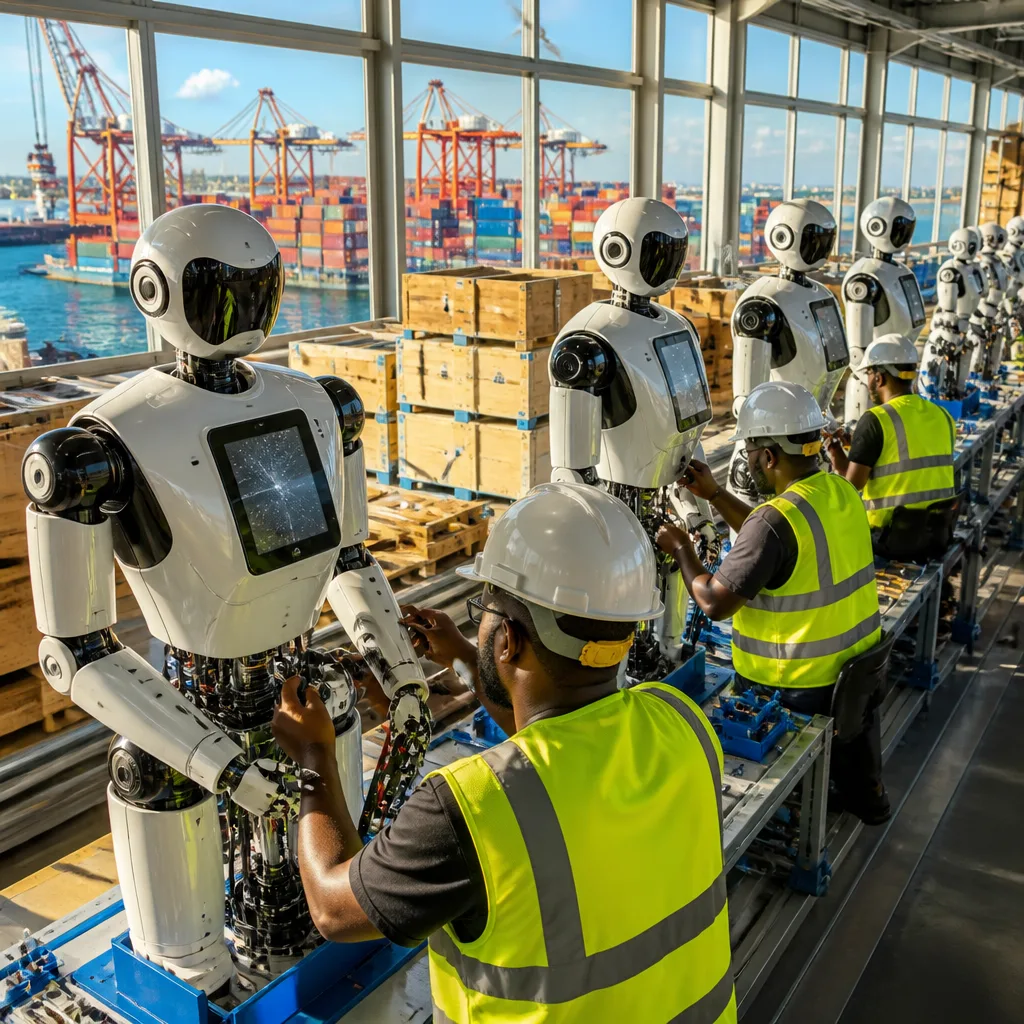
The Department of Science, Technology and Innovation has opened a manufacturing facility at Durban’s Dube TradePort to produce humanoid tutor devices called IRIS, the department announced on Monday. The company behind the project, BSG and Technologies, says the robots are designed to assist teachers with tasks such as marking and curriculum analysis and to provide learner support in South Africa’s 11 official languages.
Robots intended as classroom assistants, not replacements
BSG and Technologies chief executive Thandoh Gumede—a former maths and physical sciences teacher—said the humanoid devices are intended to assist rather than replace educators. She described the machines as tutor robots that teachers can prompt by keyboard input or voice, offering visual feedback on a chest display and audio through speakers.
“She is a tutor robot, which means that she is assisting our teachers. Our teachers are going through a lot. They work at school, then get back home and are still working, when are they getting their time with their families?”
The IRIS units use artificial intelligence and machine learning to provide information and personalise learning. Gumede said earlier interviews indicated ambitions to deploy IRIS devices across the schooling system, with a long-term goal of reaching all 23 000 schools in South Africa.
Claims on jobs and the national context
Deputy Minister Nomalungelo Gina welcomed the Durban facility, saying the initiative could create up to 20 000 jobs over the next five years and serve as an example of innovation driving industrial development. The announcement comes against a backdrop of persistent teacher shortages: as of August 2026 there were about 27 000 vacant teaching posts nationally, with the Eastern Cape accounting for more than 5 000 vacancies and KwaZulu-Natal among the provinces with high shortfalls.
Proponents say IRIS could help alleviate administrative burdens on teachers—such as marking and analysing learner results—and provide extra support in classrooms. The company asserts the devices will be capable of explaining concepts in multiple official languages, which could help multilingual classrooms.
- Location: Dube TradePort, Durban
- Manufacturer: BSG and Technologies
- Deployment goal: IRIS at up to 23 000 schools
- Jobs projected: Up to 20 000 over five years
- Teaching vacancies (Aug 2026): ~27 000 nationally; Eastern Cape >5 000
Questions on cost, rollout and classroom impact
The announcement does not include details on the cost of each unit, procurement plans, or how rollout would be prioritised across provinces and quintiles. It is also unclear whether deployment would be centrally funded by the national government, supported through provincial education budgets, or subject to public–private partnerships with schools and districts.
Beyond procurement, there are practical questions about connectivity, power, maintenance and data privacy. Many schools—particularly in rural and under-resourced areas—face intermittent electricity and limited internet access. If IRIS units rely on cloud-based services or continuous connectivity for AI features, those dependencies will shape their real-world usefulness.
Teacher unions and education policy analysts have previously cautioned that technology must complement well-resourced classrooms and qualified educators rather than substitute for them. With 27 000 vacant posts nationally, the immediate policy challenge is recruiting and retaining teachers while improving conditions so educators can make effective use of any new tools.
The Durban manufacturing plant marks a step in the local production of educational robotics. Whether IRIS becomes a widespread classroom assistant or a niche technology will depend on transparent procurement plans, funding commitments and practical pilots that demonstrate measurable improvements in learning outcomes and teacher workload.










