Seven of the nine planetary boundaries that underpin Earth’s life‑support systems are being breached at their worst recorded levels, according to the latest assessment by an international coalition of scientists working under the auspices of the Potsdam Institute for Climate Impact Research.
What the assessment says
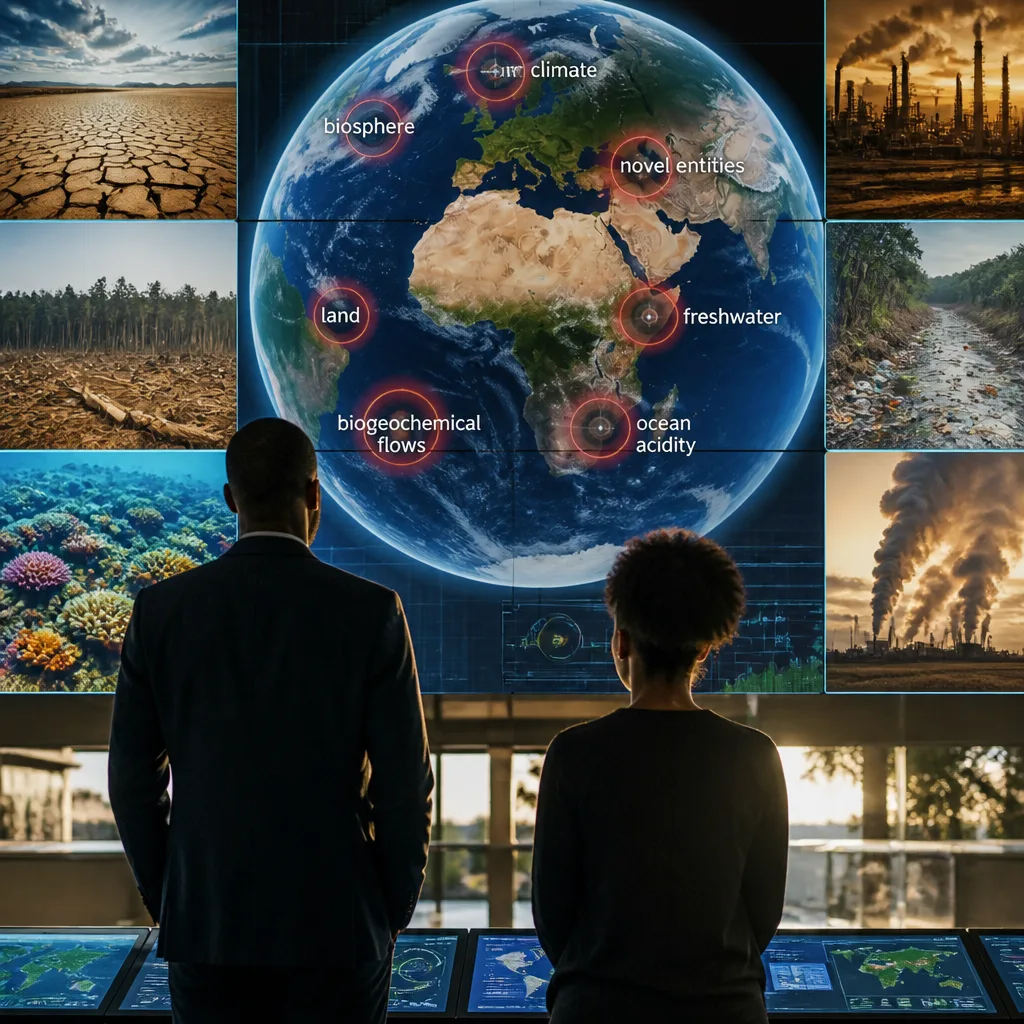
The annual “planetary health check” — a framework that tracks the condition of defined Earth system processes and the safe operating space for humanity — found that pressure is rising across every boundary that is already outside the safe range. The coalition of about 60 scientists reported that the areas most deeply transgressed include climate change, biosphere integrity, land system change, freshwater change, modification of biogeochemical flows, introduction of novel entities and, for the first time last year, ocean acidification.
“The diagnosis is unambiguous – pressure is rising across every planetary boundary already outside the safe operating space,”
the report’s lead author, Boris Sakschewski, said. He added that the risk of “large‑scale, persistent and potentially irreversible change is increasing, while our margin for error in tackling these problems is shrinking.”
Two areas show improvement, but with caveats
Only two of the nine boundaries — stratospheric ozone depletion and atmospheric aerosol loading — have shown improvement over the past decade. The authors caution that aerosol loading remains a regional problem because aerosols are a major component of air pollution in many parts of the world.
Johan Rockström, a climate scientist and co‑author, said humanity still possesses the knowledge and capacity to return to a safer operating space, but that action must be accelerated.
“Accelerating action to return to the safe operating space across all planetary boundaries is essential to protect lives and livelihoods,”
he said.
Why this matters for South Africa
The planetary boundaries framework is not a prediction model; rather, it defines guardrails based on Earth system processes that make long‑term societies possible. Breaches of these boundaries have direct consequences for South Africa through increased climate extremes, threats to biodiversity that underpin agriculture, water stress and ocean changes that affect coastal communities and fisheries.
For policymakers and planners, the assessment underlines the narrowing window for effective intervention. It reinforces the need to integrate climate mitigation, biodiversity protection, sustainable land use and pollution control into national development strategies and sectoral policy — from water resource management to agriculture and energy planning.
Key takeaways from the report
- Seven planetary boundaries are breached at their highest ever levels of transgression.
- Two boundaries — stratospheric ozone depletion and atmospheric aerosol loading — have improved over the last decade, though aerosols remain problematic in some regions.
- Ocean acidification entered the set of seven transgressed boundaries for the first time last year.
The authors underscore that, despite the dire assessment, there remains scientific and technical capacity to act. That means policies that reduce greenhouse‑gas emissions, protect and restore ecosystems, cut pollution and better manage Earth’s freshwater and nutrient cycles could stabilise or reverse trends — but they must be deployed at far greater speed and scale.
| Planetary boundary | Current status (from report) |
|---|---|
| Climate change | Breached — highest recorded transgression |
| Biosphere integrity (biodiversity) | Breached — highest recorded transgression |
| Land system change | Breached — highest recorded transgression |
| Freshwater change | Breached — highest recorded transgression |
| Biogeochemical flows (nutrients) | Breached — highest recorded transgression |
| Introduction of novel entities (pollutants) | Breached — highest recorded transgression |
| Ocean acidification | Breached — newly included among the severely transgressed boundaries |
| Stratospheric ozone depletion | Improving over the last decade |
| Atmospheric aerosol loading | Improving overall, but still a regional problem |
For the science community and decision‑makers, the report is a clear call to link environmental objectives with social and economic policy to preserve the conditions that allow societies to flourish. The assessment stresses urgency: delayed action will reduce the options for effective and equitable responses and increase the likelihood of crossing thresholds that are difficult or impossible to undo.
As a diagnostic, the planetary boundaries update does not prescribe a single policy solution. It does, however, provide a scientific basis for prioritising rapid, systemic change — from decarbonisation and nutrient management to habitat protection and stricter controls on new chemical entities — if the world is to return to a safer operating space.