
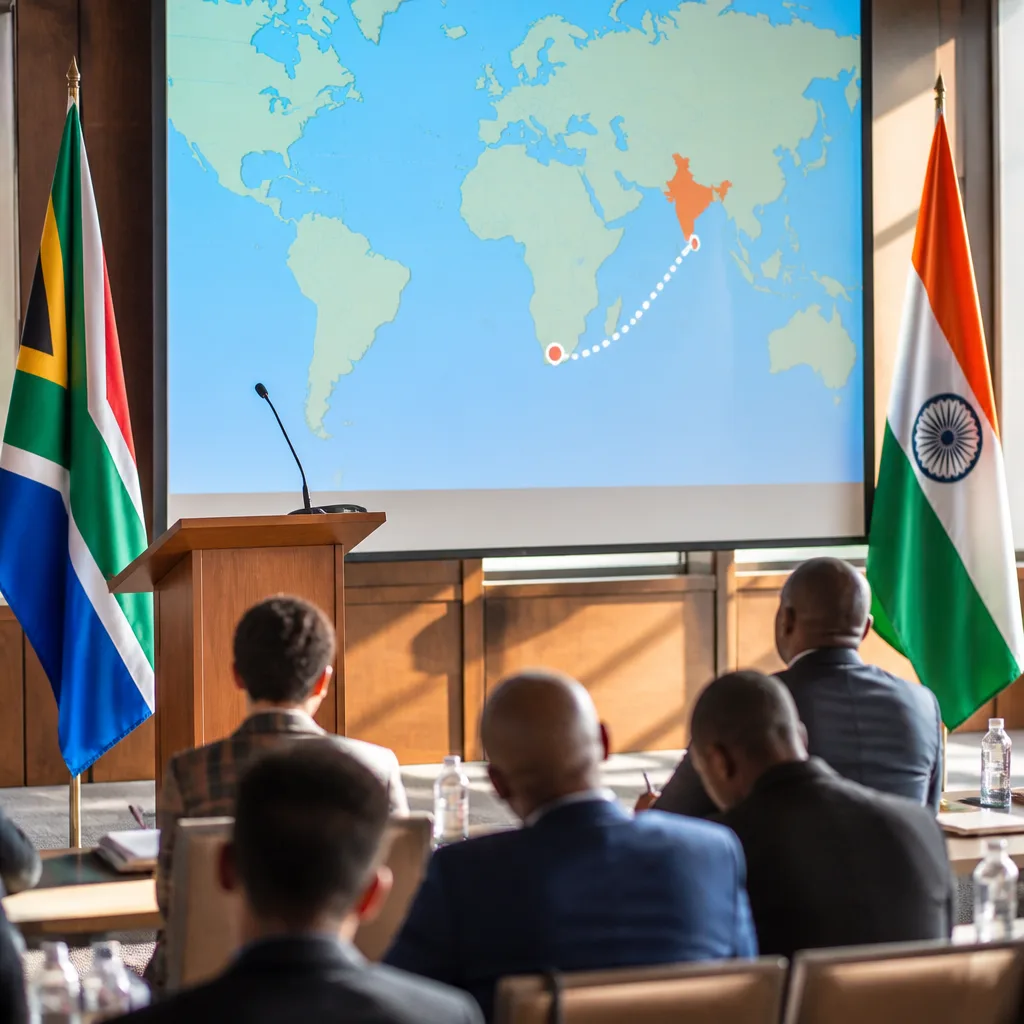
South Africa and India share deep historical and political ties, but questions remain about whether that alignment can be converted into greater economic, climate and practical cooperation, the South African Institute of International Affairs (SAIIA) says.
SAIIA to host expert on Africa–India cooperation
SAIIA’s Western Cape branch will host Dr Prabhat Upadhyaya on 26 August to examine the current state and future prospects of the bilateral relationship. Dr Upadhyaya is the Senior Adviser for Africa–India Cooperation at the African Climate Foundation (ACF) and led the ACF’s G20 engagement strategy during South Africa’s 2025 G20 Presidency, according to SAIIA.
The discussion aims to probe where the relationship is already strong — and where it falls short. SAIIA described a paradox underpinning the partnership: strong political alignment on international issues has not been matched by equally strong economic or practical ties.
Areas of convergence and outstanding gaps
SAIIA highlights several areas where South Africa and India have found common ground. These include:
- Climate and energy — shared interests in shaping global climate responses and energy transitions.
- Global South advocacy — cooperative positions in multilateral forums on reform and representation.
- Medical diplomacy — collaboration stemming from public-health responses such as HIV/AIDS and COVID‑19.
- People-to-people links — cultural ties and sport, notably cricket, that sustain public goodwill.
Despite these overlaps, SAIIA says the economic and commercial dimension remains relatively underdeveloped. The institute will explore why strong diplomatic alignment has not automatically produced deeper trade, investment or technology partnerships.
Why it matters for South Africa
As geopolitical competition intensifies, South Africa’s external partnerships carry strategic weight. Closer practical cooperation with India could offer policy and investment options across several priority areas for South Africa:
- Energy security and low‑carbon transition collaboration.
- Capacity building in health and technology.
- Stronger trade and investment ties within a diversified export strategy.
SAIIA frames the timing of the conversation within a changing global order where both countries are navigating a more contested, multipolar system while seeking agency for the Global South.
| Area | Existing strength | Policy gap |
|---|---|---|
| Climate & energy | Shared advocacy in multilateral forums | Limited joint projects and technology transfer |
| Health diplomacy | Cooperation during HIV/AIDS and COVID‑19 | Scale-up of collaborative health manufacturing and R&D |
| Trade & investment | Cultural and political goodwill | Underdeveloped commercial links |
What SAIIA will ask
According to SAIIA’s event outline, Dr Upadhyaya will interrogate whether the political alignment between South Africa and India can be turned into deeper and more consequential cooperation. The discussion will consider diplomatic history, shared interests, and practical steps both countries might take to strengthen economic and technical ties.
The session follows Dr Upadhyaya’s role advising Africa–India cooperation at the ACF and his involvement in G20 engagement during South Africa’s 2025 Presidency, details SAIIA provided. His experience in multilateral affairs informs the framing of the event: the focus is not only on bilateral sentiment but on how leverage in international institutions can be converted into on‑the‑ground outcomes.
SAIIA’s Western Cape event will therefore be watched by diplomats, policy makers and analysts concerned with South Africa’s foreign-policy orientation and practical economic diplomacy. It is part of a broader effort to clarify how South Africa can deepen ties with partners in Asia while advancing domestic development priorities.
Details on livestreaming or public attendance were not included in SAIIA’s release. The institute will host the talk on 26 August.














