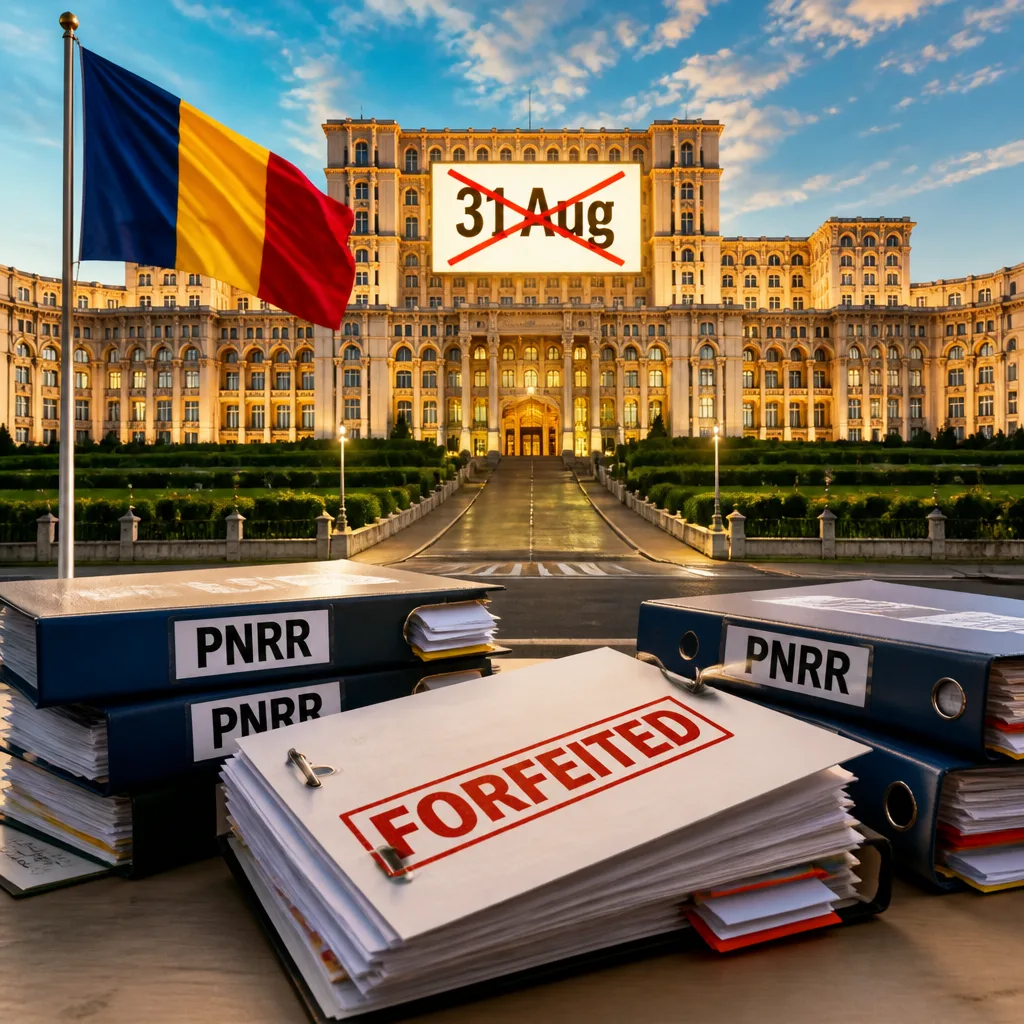
Bucharest is poised to lose roughly €770 million after its interim government and parliament failed to approve a key reform required under the European Union’s recovery programme before a 31 August deadline, the Romanian presidency said on Friday. The measure was part of Romania’s National Recovery and Resilience Plan (PNRR) and concerned changes to public‑sector pay meant to unlock the final tranche of post‑pandemic funds.
Political stalemate costs public purse
The impasse means projects already budgeted with the expectation of EU support will now fall back onto Romania’s national finances. Officials had already assumed the money would be available and had incorporated it into multi‑year spending plans. The shortfall therefore creates a direct pressure on an already stretched fiscal position.
European Funds Minister Dragoș Pîslaru told media that despite the setback Romania would still absorb more than 90% of the available grants under the recovery facility. That assessment suggests the bulk of the plan will be implemented, but the loss of the final payment reduces the room for investment in the current package.
Integrity reforms stir controversy in Brussels
The missed deadline came amid wider debate over an integrity package approved this week by Romania’s authorities. The new measures allow for the removal of elected officials over past findings of incompatibility or conflicts of interest. Brussels has been watching the package closely because it is tied to future PNRR payments.
Critics, including figures in the European People’s Party (EPP) and Renew Europe groups in the European Parliament, say one retroactive clause — dubbed the “Fritz amendment” by opponents — appears targeted at Timișoara Mayor Dominic Fritz. They argue it could remove him from office for a resolved administrative incompatibility.
"Immoral," said interim Prime Minister Ilie Bolojan of one provision when defending the package, according to reports.
European institutions have not publicly decided to withhold additional payments on this basis. The European Commission indicated it will assess the integrity measures as part of Romania’s sixth payment request, which has yet to be submitted.
Wider political and financial consequences
Former prime minister and finance minister Florin Cîțu, who negotiated Romania’s recovery plan, criticised subsequent governments for abandoning the fiscal and structural path he said would have attracted further grant funding. Cîțu told Euractiv that an additional €9 billion in grants for infrastructure could have been secured had Romania pursued a smaller, leaner state and deeper reforms.
The immediate effect of missing the deadline is the probable forfeiture of the final payment. Over the medium term, the episode highlights the fragility of conditional EU transfers when domestic politics derail agreed reform trajectories. For Romania, which has factored these funds into budgetary planning, the gap sharpens trade‑offs between investment, deficit management and debt.
- Loss to Romania: ~€770 million expected to be forfeited.
- Remaining grants: Government expects to access over 90% of the recovery funds.
- Political flashpoint: Integrity package and retroactive provision criticised by EU political groups.
| Item | Impact |
|---|---|
| Missed PNRR deadline | Forfeiture of ~€770m |
| Integrity package | Potential EU scrutiny of future payments |
| Government stance | Claims retention of majority of grants (>90%) |
For South African readers watching international governance, the Romanian case is a cautionary example of how fragile multilateral funding arrangements can be when domestic partisan battles intrude. The EU’s recovery facility ties money to reforms; where those reforms stall, so do payments. That mechanism is designed to ensure structural change, but it transfers a political problem in national capitals into fiscal pain on the ground.
How Brussels responds to the integrity clause will shape whether any further instalments are delayed or denied. The assessment of Romania’s sixth payment request will be closely watched by governments across the Union — and by others that rely on conditional international financing — for signals about the EU’s tolerance for politically sensitive domestic measures.