
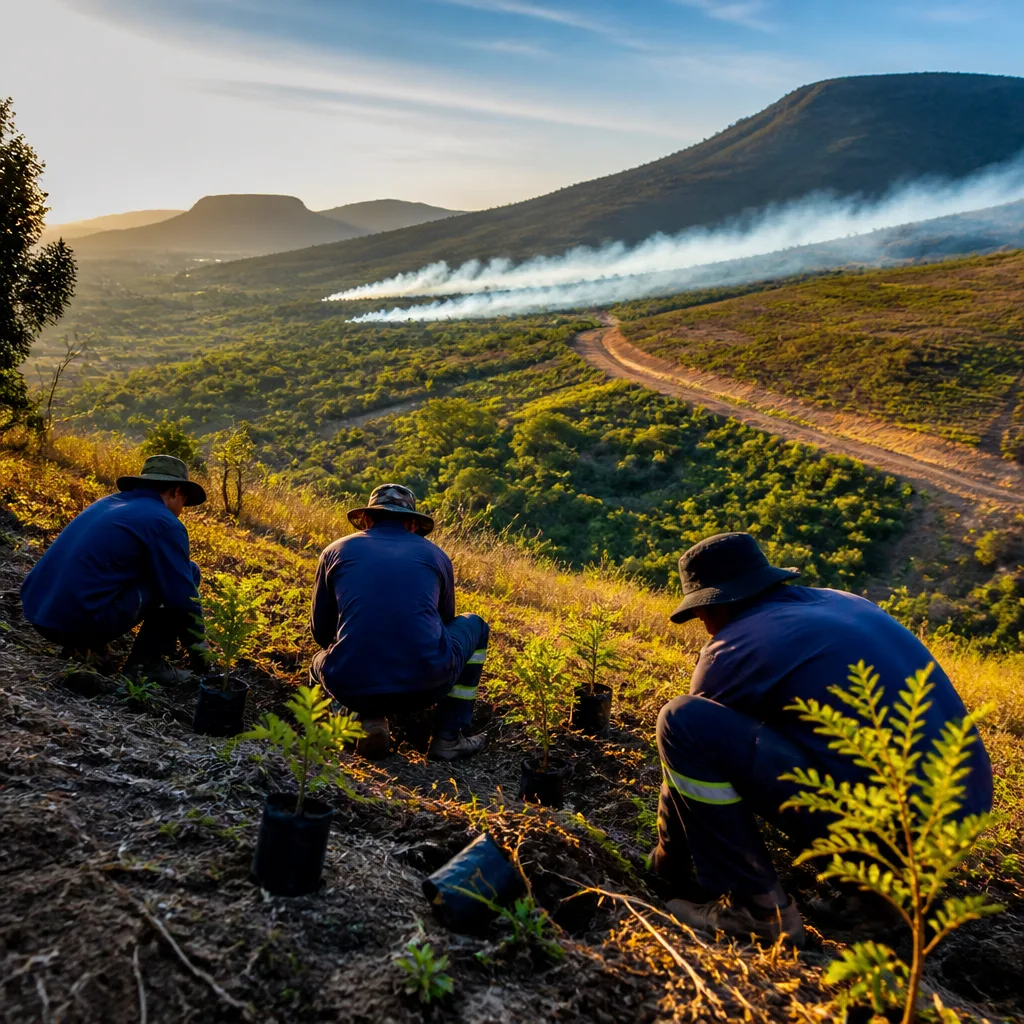
Communities in Spain’s Muga Valley and South Africa’s Langkloof are using ecosystem restoration and fire-aware management to reduce the risk that wildfires become catastrophic, a new commentary reports. The piece says restoring degraded landscapes changes how fire behaves and can act as a form of natural insurance for people, economies and biodiversity.
Why restoration and fire management are linked
The authors argue that fire is a natural element in many ecosystems, but when landscapes are degraded or invaded by non-native vegetation they become fuel reservoirs that increase the chance a spark will turn into large, destructive fires. By improving the health of the landscape, they say, fire can be managed so that it connects rather than destroys communities.
“It is the health of the landscape that will determine whether fire acts as a force of connection or destruction. The choice, in effect, is whether we leave that risk unmanaged, or begin to build insurance into the land itself,”
The commentary cites the experiences of the Muga Valley in Spain and the Langkloof in South Africa. Both regions have histories of poor land management that left them degraded and more prone to high-intensity fires. Instead of only relying on firefighting after ignition, the authors say, restoring the landscape and managing fire as part of that restoration reduces the likelihood that fires will escalate into disasters.
Practical implications for communities and economies
The piece frames healthy landscapes as a kind of risk infrastructure. Restored ecosystems can:
- reduce fuel loads by replacing invasive species with indigenous vegetation;
- alter fire behaviour so flames do not spread as rapidly or burn as hot;
- support biodiversity and local livelihoods that depend on functioning ecosystems.
According to the commentary, these approaches do not eliminate fire — which can be an important ecological process — but change its intensity and pattern so communities face lower risk of catastrophic loss.
Comparing the valleys
| Region | Historic issue | Restoration focus |
|---|---|---|
| Muga Valley (Spain) | Degraded landscapes, increased fuel from poor management | Restore native vegetation and manage fire within restoration planning |
| Langkloof (South Africa) | Similar history of poor management leaving area exposed to wildfire | Use ecosystem restoration to reduce wildfire risk and protect livelihoods |
The commentary presents these cases as examples of a broader principle: landscape health determines whether fire is a renewing force or a destructive one. It urges a shift from treating fire only as an emergency to integrating fire management into restoration and land stewardship.
What this means for South Africa
For South African policymakers, land managers and communities, the Langkloof example underscores two practical priorities: preventing invasive plant proliferation and incorporating controlled, planned fire or other management techniques into restoration work. The commentary positions such measures as investments in long-term risk reduction, protecting both biodiversity and local economies tied to the land.
Details on specific programmes, costs or agencies involved were not provided in the commentary. The authors present the argument as a conceptual and practical case for rethinking how landscapes are managed to reduce exposure to catastrophic wildfire.
Further reporting is needed to track which interventions in the Langkloof are already under way, which government or civil-society bodies are leading them, and what measurable outcomes are emerging from restoration efforts.














