
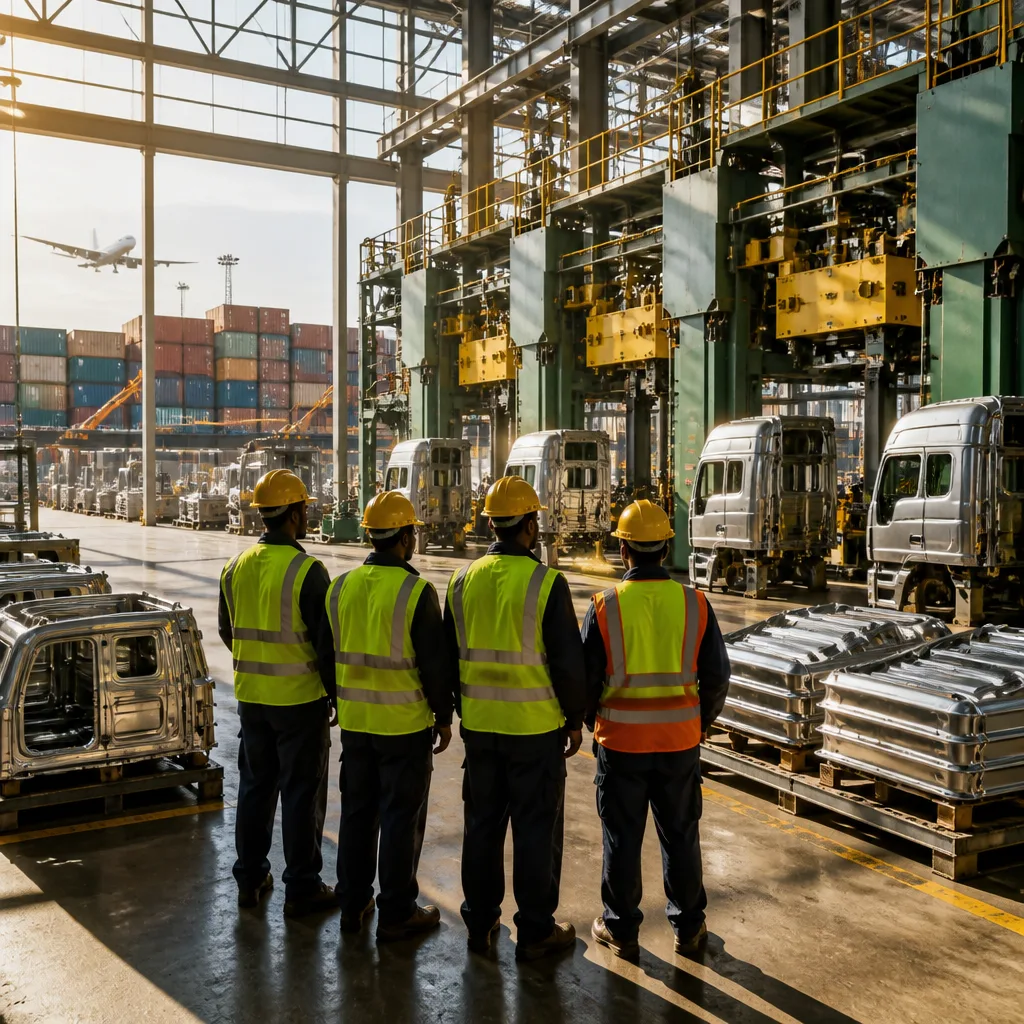
A R1.1 billion parts manufacturing facility at Dube TradePort in KwaZulu-Natal has opened a window of optimism for South Africa's struggling automotive sector, even as the industry reports the loss of thousands of jobs and multiple factory closures in recent years.
The 32 000m2 plant, operated by Ogihara South Africa, will produce about 25 000 tonnes of pressed steel components a year and manufacture 101 inner body parts for the Toyota Hilux, according to recent reporting. The development is the largest investment Dube TradePort has secured to date.
Scale of job losses and industry pressure
Industry groups and observers say the sector has endured a bruising period. The National Association of Automotive Component and Allied Manufacturers (Naacam) has reported that the auto component sector lost about 7 500 jobs and at least 15 businesses closed over three years. Sixty-three percent of Naacam members say they are either cutting jobs or considering cuts.
High-profile closures and retrenchments cited in recent reporting include the 2025 shutdown of a long-standing tyre plant in the Eastern Cape with the loss of more than 900 jobs, Nissan’s sale of the Rosslyn plant and the cessation of local car assembly, and a Ford reduction of close to 500 posts.
Why manufacturers are under strain
The sector faces several overlapping pressures, according to industry commentary. Cheap imports mainly from China, and increasingly from India, arrive at domestic prices that local factories find hard to match. Rising energy and logistics costs and unreliable electricity supply add to production expense. At the same time, a global shift towards electric and new-energy vehicles is changing demand for traditional components.
Industry observer William Kelly is reported as saying that converting a vehicle line from an internal combustion drivetrain to electric is largely a retooling exercise and that South African plants could build electric vehicles if an investment case existed. Yet investors are weighing global production economics; manufacturers ask why to retool local lines when models are produced more cheaply elsewhere.
Naacam’s chief operating officer, Nduduzo Chala, highlighted the direct human impact of OEMs scaling back vehicle volumes. The recent reporting quoted him noting the downstream effect on component makers when an original equipment manufacturer reduces production forecasts:
“When an OEM says it will 'now make 80, 70 or 50 vehicles' instead of what was planned, component makers don't have a choice — they cut shifts and then they cut people.”
What the new plant means — and limits
The Ogihara facility localises parts that were previously imported from Thailand. The project’s size and its localisation of 101 inner body parts for a high-volume model represent a significant step for the supply chain and for Dube TradePort’s industrial profile.
But the plant does not erase the structural challenges the sector faces. Recent reporting emphasises that while such investments are welcome, they must be replicated across the value chain. The industry’s competitiveness will continue to depend on factors beyond single investments — including trade policy, energy reliability, logistics costs and incentives that make localisation viable versus importing from lower-cost production hubs.
| Metric | Figure |
|---|---|
| Investment value | R1.1 billion |
| Plant footprint | 32 000 m² |
| Annual steel localised | 25 000 tonnes |
| Parts produced | 101 inner body parts |
| Reported job losses in component sector | 7 500 |
| Reported business closures (three years) | 15 |
Policy and next steps
Industry leaders and analysts have called for coordinated policy responses to protect local manufacturing capacity. Measures discussed in recent reporting include strengthened trade remedies against unfairly priced imports, incentives for local content and retooling support to enable production of electric vehicle components.
For now, the Ogihara plant offers a concrete example that localisation is possible. Whether it becomes a template for broader industrial recovery depends on further investment, supportive policy and improvements in cost and infrastructure fundamentals.
- Immediate benefit: local production of key pressed-steel parts for a high-volume vehicle model.
- Ongoing risk: cheap imports, unreliable power and rising costs continue to threaten component makers.
- Policy need: incentives and trade measures to make retooling and localisation attractive.
Details remain under development as the broader impact of the new plant on employment and supplier networks unfolds.














