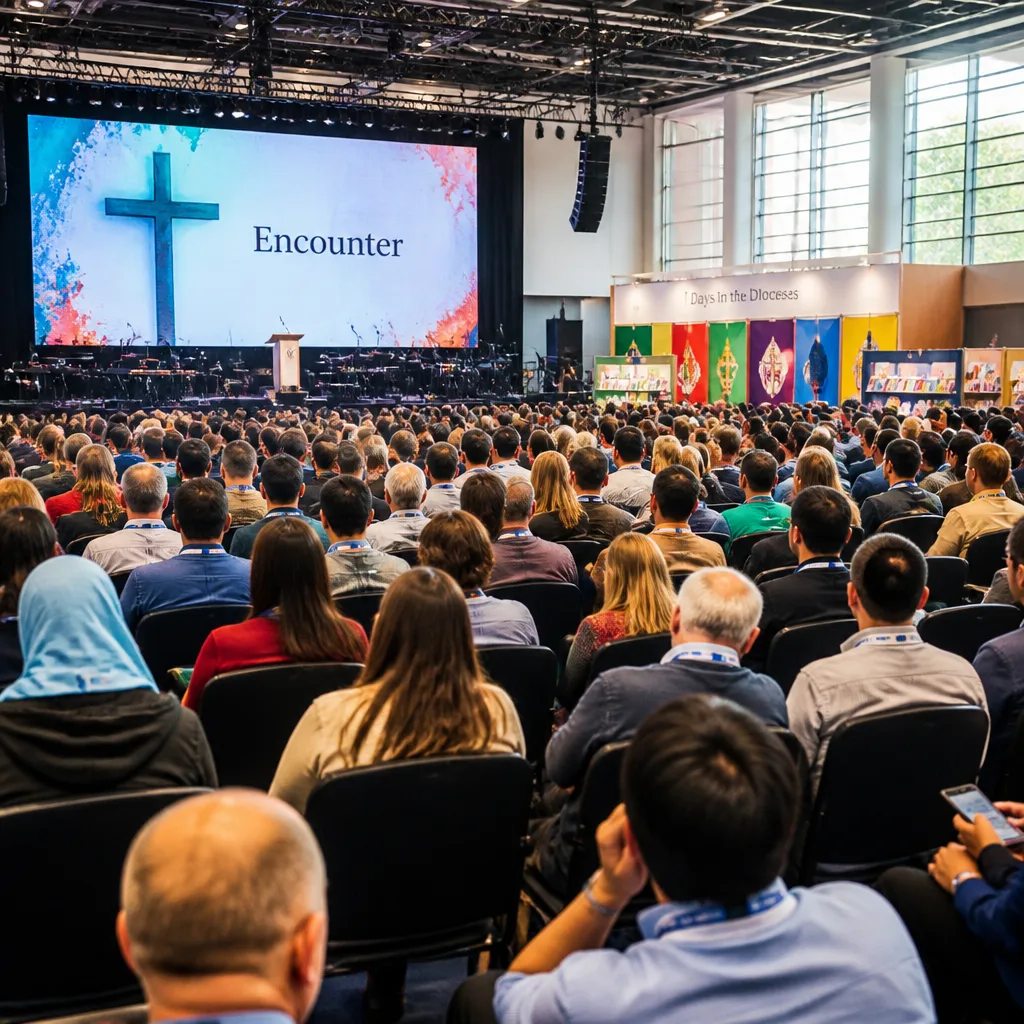
More than 400 representatives from over 100 countries concluded a four-day preparatory meeting in Seoul on 17 September as organisers finalise plans for World Youth Day (WYD) Seoul 2027. The gathering, convened by the Dicastery for Laity, Family and Life together with the local organising committee, emphasised pastoral encounter and accompaniment rather than attendance figures.
Invitation as encounter
Archbishop Peter Soon-taick Chung of Seoul told delegates that inviting a young person to WYD should mean more than adding a name to a list of participants. He urged organisers and diocesan representatives to consider WYD primarily as an opportunity for a personal encounter with the Lord.
“You are not simply gathering participants,” Archbishop Chung said, “You are inviting a young person to encounter the Lord.”
Delegates at the meeting represented more than 160 dioceses, religious congregations and ecclesial movements. The programme included liturgies, practical workshops and exhibitions such as the "Days in the Dioceses" expo, intended to help local organisers design events that extend the WYD experience beyond the central gatherings in Seoul.
Pastoral priorities and practical guidance
Speakers framed WYD preparation as a mission to reach young people who are still searching, not only those already engaged with the Church. On 16 September Archbishop Chung celebrated Mass at Myeongdong Cathedral, reiterating the need to invite more broadly and to accompany young people facing uncertainty.
Cardinal Kevin Farrell opened the meeting with a Mass in which he encouraged preparations that would enable young people to turn towards Christ and find communion across cultural differences. At the closing Mass, Bishop Paul Kyung-sang Lee, the organising committee’s general coordinator, said the core of the mission is helping young people experience the reality of being loved by God and welcomed by the Church.
“Before anything else, young people need to discover that they are loved — loved by God, loved by the Church, and welcomed as they are,” Bishop Lee said at the closing Mass.
The meeting sought to equip delegates with practical approaches for local implementation. That mandate was framed as moving from encounter in Seoul to sustained pastoral work at home: translating the international preparatory experience into diocesan programmes, parish outreach and movement activity.
- Scale of participation: more than 400 delegates from over 100 countries.
- Representation: delegates came from more than 160 dioceses, congregations and ecclesial movements.
- Pastoral emphasis: prioritising invitation, accompaniment and welcome rather than mere registration.
| Item | Figure |
|---|---|
| Delegates | 400+ |
| Countries represented | 100+ |
| Dioceses, congregations and movements | 160+ |
Implications for local church life
The meeting’s emphasis on companionship and outreach frames WYD not simply as an international festival but as a catalyst for local pastoral renewal. Delegates leave Seoul with an explicit challenge: to turn international inspiration into concrete activity in parishes, schools and youth ministries.
For South African dioceses and youth ministers who will monitor the outcomes of the Seoul meeting, the message is clear: preparations should focus on engaging those who are distant from the Church and creating spaces where young people can discover they are welcomed. The "Days in the Dioceses" concept, showcased at the meeting, offers a mechanism for extending the WYD encounter into local contexts through smaller-scale events and ongoing accompaniment.
Organisers have framed WYD Seoul 2027 as an occasion to support young people facing uncertainty, division and competition by offering a communal experience that orients them spiritually and pastorally. Delegates now return to their home communities with practical guidance and a renewed invitation to place encounter at the heart of recruitment and formation efforts.
As the global Catholic community prepares for the event in 2027, the Seoul meeting has underlined that the success of World Youth Day will be judged less by numbers in the stadium and more by the depth of personal and pastoral encounters fostered in dioceses around the world.