
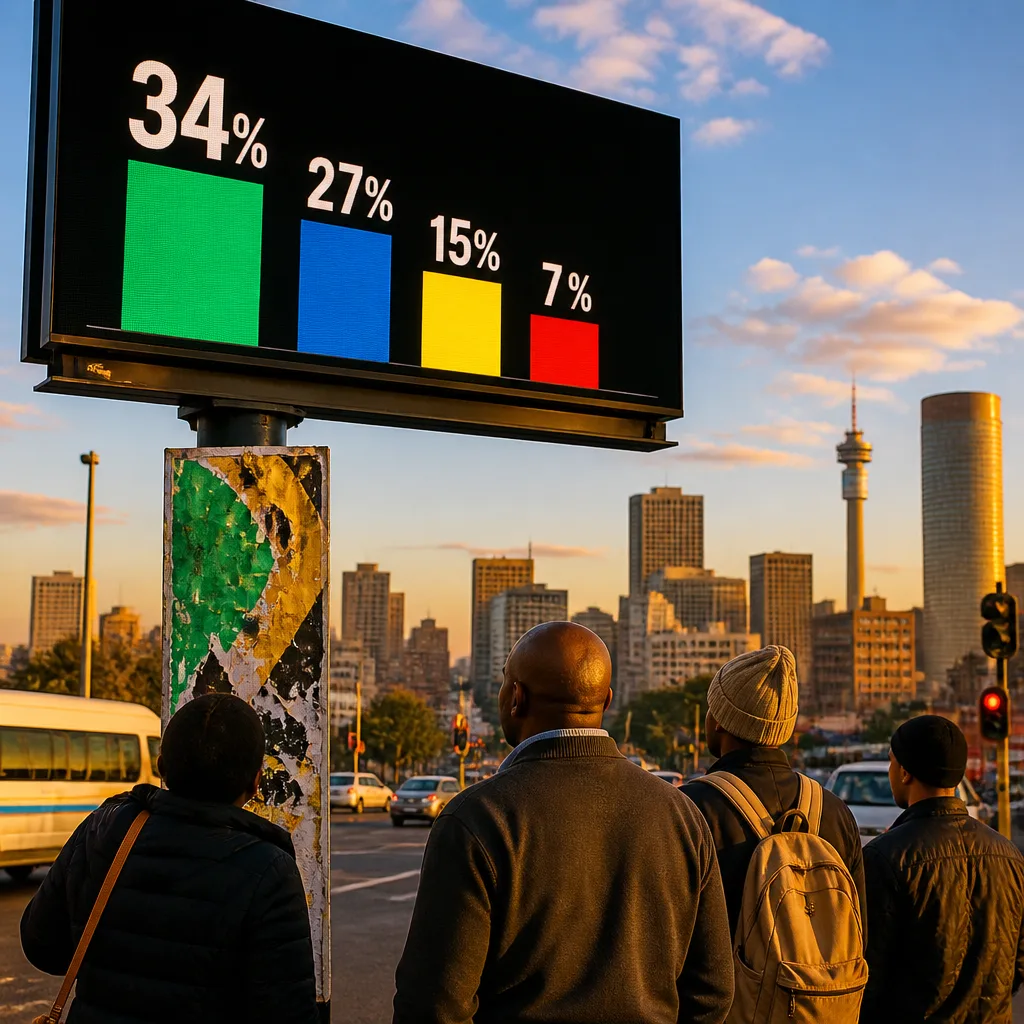
The latest Social Research Foundation poll places the African National Congress (ANC) at 34% nationally, with the Democratic Alliance (DA) on 27%, the MK Party on 15% and the Economic Freedom Fighters (EFF) on 7%. The results, which record sharp urban losses for the ANC, confirm a longer-term slide rather than a single polling blip.
Numbers underline a structural decline
According to the polling data, the ANC’s support in Johannesburg has fallen to 18%, while in eThekwini it is reported to be below 20%, where it trails both the MK Party and the DA. Only in Tshwane, at 32%, does the party remain close to its nearest competitor.
Those figures come three years after the 2024 national election, when the ANC won 40.18% of the vote and lost its outright parliamentary majority for the first time since 1994. The new poll sharpens questions party strategists have been asking for years: why has support been eroding steadily, especially among urban and younger voters?
Causes and accelerants
Political analysts and internal party assessments have long pointed to structural factors inside the ANC: weakening branch structures, factionalism, poor succession planning and faltering municipal performance. The poll suggests those deeper problems, rather than a single crisis, are driving voter realignment.
Recent scandals and high-profile controversies have acted as accelerants. Events such as Phala Phala and ongoing hearings before the Madlanga commission, the poll indicates, have compounded public scepticism about the seriousness of the party’s ethical renewal. They have also diminished the contrast that President Cyril Ramaphosa once claimed to represent between reformist intent and the corruption of prior years.
But the polling reinforces that those episodes alone cannot explain the slow-motion shift in voting behaviour: urban voters have been drifting away for over a decade and economic malaise—stagnant growth and entrenched unemployment—has become a persistent political liability.
- National standings: ANC 34%, DA 27%, MK Party 15%, EFF 7%
- Urban collapse: Johannesburg 18%, eThekwini below 20%, Tshwane 32%
- Historical context: 2024 national vote for ANC was 40.18%
| Area | ANC | Closest competitor |
|---|---|---|
| National | 34% | DA 27% |
| Johannesburg | 18% | DA / MK Party (reported leads) |
| eThekwini | <20% | MK Party / DA (reported leads) |
| Tshwane | 32% | DA (close) |
Who benefits — and who pays?
The immediate beneficiaries are opposition formations that have been consolidating urban protest votes. The MK Party’s double-digit support in the poll reflects its traction among voters disillusioned with the ANC’s performance and credibility. The DA strengthens as the principal opposition nationally, while the EFF remains a smaller but steady actor on the left.
Voters pay the political price when governing capacity erodes. Declining support for the ANC is mirrored by worrying public-service indicators: municipal failures, load-shedding and slow economic recovery that affect job creation. In practical terms, a weakened governing party means more coalition bargaining at national and local levels — and that frequently translates into policy compromises and slower decision-making.
For the ANC, the challenge is both organisational and narrative. Restoring trust will require rebuilding branch-level engagement, demonstrating effective municipal governance and showing credible consequences for corrupt or incompetent officials — tasks that are easier to describe than to deliver.
The poll does not predict a sudden collapse but it does mark a political reality that the ANC must confront: the party’s dominance is no longer guaranteed, and South Africa’s political landscape is continuing its shift toward competitive, coalition-era politics.












