
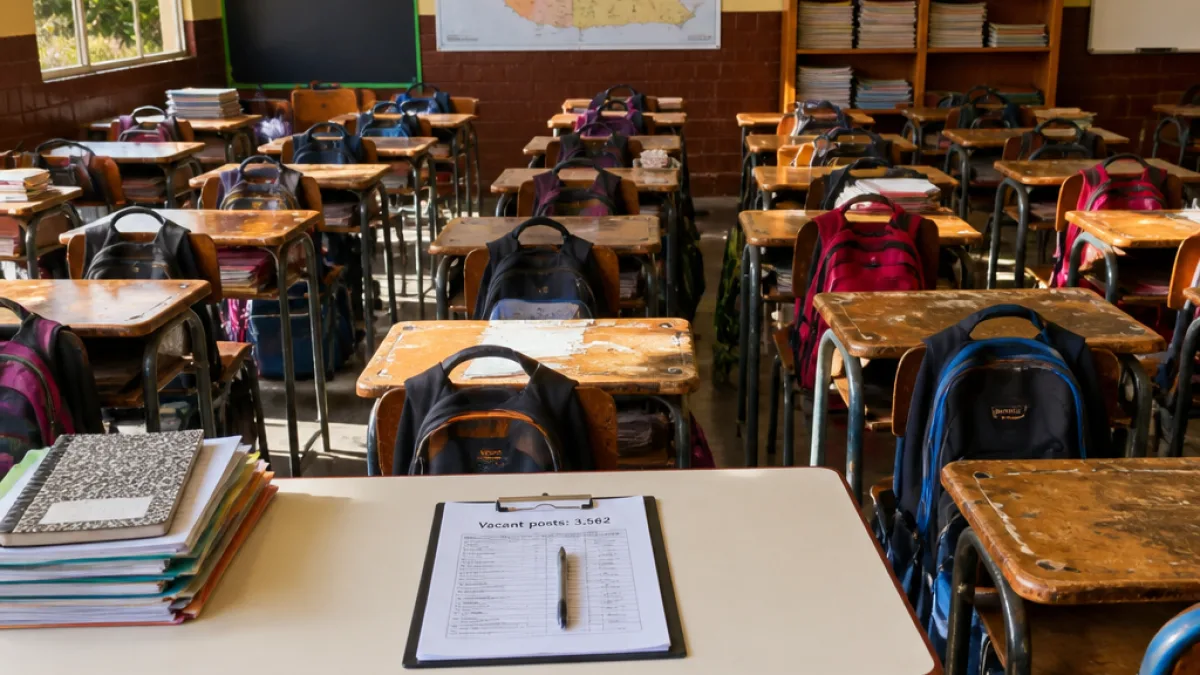
The Department of Basic Education has recorded 27 092 vacant teaching posts across public schools in South Africa as of 30 June 2026, with the Western Cape accounting for 3 562 of those gaps, the department said in a written parliamentary reply.
Vacancies concentrated in the Eastern Cape, KZN and WC
The figures, provided by Basic Education Minister Siviwe Gwarube, show the distribution of vacancies by province. The Eastern Cape has the largest total at 5 730 vacant posts, followed by KwaZulu‑Natal with 4 700 and Gauteng with 3 994.
| Province | Vacant posts |
|---|---|
| Eastern Cape | 5 730 |
| KwaZulu‑Natal | 4 700 |
| Gauteng | 3 994 |
| Western Cape | 3 562 |
| Limpopo | 3 097 |
| North West | 2 346 |
| Mpumalanga | 1 866 |
| Northern Cape | 1 521 |
| Free State | 276 |
Class sizes and pupil‑to‑educator ratios
The department said the national educator vacancy rate stands at 7%. These shortfalls sit alongside already high pupil‑to‑educator ratios. The Department of Basic Education’s School Realities 2025 report, published in February 2026, put the national average at 34 pupils per state‑paid educator in ordinary public schools.
The report showed Limpopo and the Western Cape recorded the highest ratios at 35.7:1, with other provinces ranging from about 31.8:1 to 35.6:1. The DBE said the 2025 ratios are preliminary and based on provincial uploads as of July 2025.
“The learner‑pupil ratio is practically impossible. You find that... we still have teachers teaching more than 70 learners in each and every classroom,”
The quotation above was reported from National Teachers’ Union (Natu) president Sibusiso Malinga, reflecting unions’ concerns that averages mask extreme conditions in specific schools.
What the numbers mean for classrooms in the Western Cape
In the Western Cape the combination of 3 562 vacant posts and a high pupil‑to‑educator ratio suggests pressure points in both urban and rural schools. While provincial education authorities have relatively more managerial capacity than many other provinces, school heads still face daily choices about which posts to prioritise when substitutes are scarce.
Teacher unions argue that vacancies lead to overlarge classes, increased workloads for existing staff and a heavier administrative burden for school leadership. The DBE noted that 2 654 of the vacant posts nationally were recorded as having a “frozen” status as of 30 June 2026, but added that this status does not necessarily indicate posts were deliberately frozen for budgetary reasons.
Possible consequences and responses
Education experts say prolonged vacancies can undermine foundations built by successful early‑grade programmes and stretch support for higher‑need learners, including those needing remedial support or language interventions. Unions in KwaZulu‑Natal, where the second‑highest number of vacancies is recorded, described difficulties obtaining substitute teachers as particularly acute.
- High vacancies increase workload for remaining teachers and can reduce instructional time.
- Overlarge classes make differentiated teaching and learner support more difficult.
- Vacant specialist posts (e.g. maths, science) can damage progress in critical subjects.
The parliamentary reply and School Realities report provide a snapshot rather than a full explanation of causes. Recruitment bottlenecks, teacher attrition, the location of posts and the availability of subject specialists are among the factors that education authorities and unions cite in public statements on staffing shortages.
For parents and schools in the Western Cape, the immediate concern will be how provincial education management allocates scarce human resources and whether national and provincial budgets and hiring practices can be adjusted to stem the gap before the 2027 school year. The DBE’s published figures give policymakers a clearer picture of where interventions are most urgent but leave open the question of how quickly vacancies can be filled and whether working conditions will improve enough to retain new hires.
As the new school term approaches, the Cabinet and provincial education departments face pressure from unions and communities to translate the numbers into a concrete plan for recruitment, deployment and classroom support.












