Subtle changes to estuary vegetation may be reducing structural habitat for the Knysna seahorse
Recent underwater surveys by SANParks personnel have found signs that the Knysna Estuary is undergoing shifts in its vegetation communities — changes that, if sustained, could reduce the structural habitat available to the endangered Knysna seahorse.
Scientists working in the estuary collected plant and invertebrate samples from seagrass and algal beds to answer a focused question: what do Knysna seahorses eat and how available is that food across the estuaries they inhabit? Those samples, according to SANParks scientist Clement Arendse, revealed redistribution of key habitat-forming species rather than a stable system.
"This is not a trivial change. It speaks to a loss of structure in the environment, and for a species like the Knysna seahorse with their poor swimming ability, structure is survival."
The report highlights several local observations from recent dives:
- Codium, previously common in areas around Thesens Island Marina, was largely absent where it once formed dense beds.
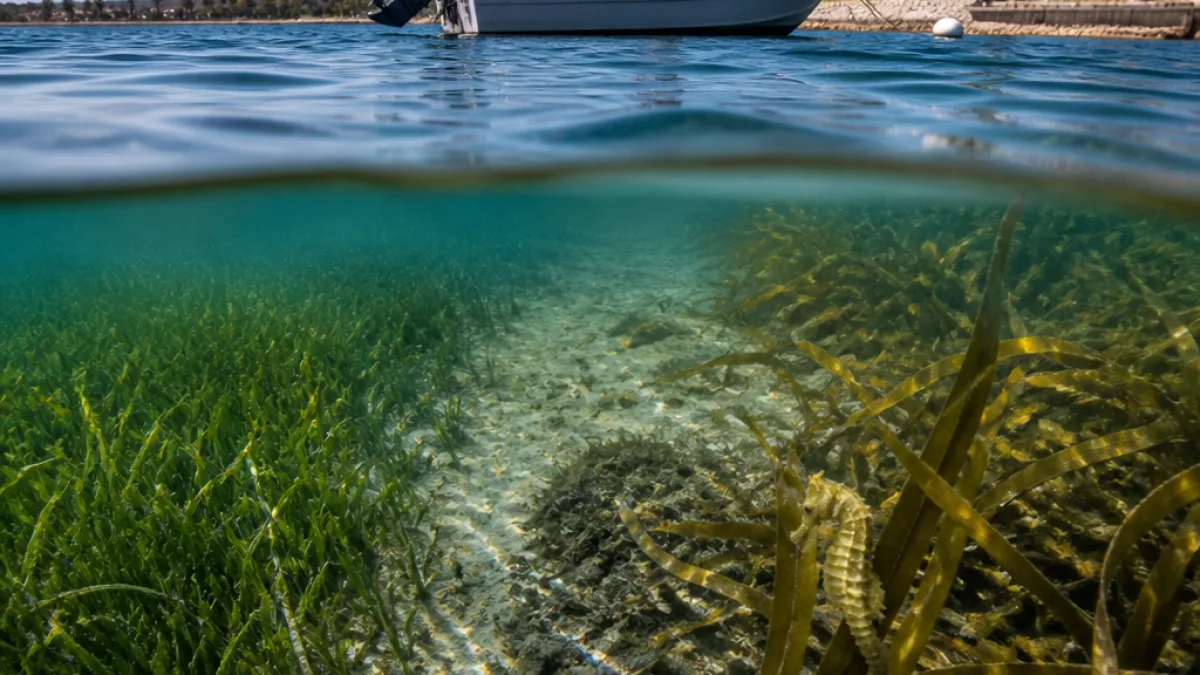
- Patches of bare sediment appeared where vegetation used to provide cover; seahorses were seen clinging to isolated vegetation or resting on sand.
- Cape eelgrass is locally being replaced by strap Caulerpa in some places, while in other areas eelgrass is expanding into spaces formerly occupied by spiral ditchgrass.
These are not isolated anecdotes, the scientist emphasised: the pattern suggests directional shifts in the composition and distribution of underwater vegetation rather than random, evenly distributed change. But SANParks qualifies the findings — whether the observations represent a seasonal fluctuation or a longer-term directional trend remains uncertain and will require repeated monitoring to resolve.
Why the shifts matter for seahorses and the estuary
The concern is ecological and practical. Knysna seahorses are poor swimmers that rely on the physical structure provided by vegetation to anchor themselves, hide from predators and access prey — the small invertebrates that live within eelgrass and algal beds. Loss or redistribution of that vegetation could reduce the availability of both shelter and food.
Although the dive team focused on the seahorse’s diet, their sampling also functions as an early warning for wider ecosystem change. Vegetation changes can influence sediment stability, water clarity and the distribution of invertebrate communities — all of which feed back on fish, birds and other estuary-dependent wildlife.
Local consequences and the need for monitoring
For Knysna residents and managers, the findings point to several immediate implications:
- Conservation efforts for the Knysna seahorse will need to consider not only population counts but also habitat quality and spatial distribution of vegetation.
- Any management interventions should be guided by time-series data to distinguish seasonal variability from persistent change.
- Monitoring that links vegetation mapping with invertebrate abundance will help clarify whether food availability for seahorses is being reduced.
| Observed change | Potential consequence |
|---|---|
| Loss of Codium at Thesens Island Marina | Reduced structural habitat for seahorses and invertebrates |
| Expansion of strap Caulerpa into eelgrass areas | Altered community composition; unknown effects on prey species |
| Patches of bare sediment | Less shelter; increased vulnerability for seahorses |
SANParks’ field observations, reported by Arendse, do not yet provide a definitive cause for the shifts. Multiple drivers could be at work, from localised disturbances to broader environmental drivers such as changing water quality or hydrodynamics. Without long-term data these remain hypotheses rather than conclusions.
For a town that relies on its waterways for livelihoods, leisure and biodiversity value, the initial findings are a reminder of the estuary’s dynamism and vulnerability. Continued, systematic monitoring — tying underwater vegetation surveys to invertebrate sampling and seahorse sightings — will be essential to understand trajectories and to design appropriate management responses.
Until such monitoring yields a clearer picture, the message from SANParks is precautionary: what appears calm from the surface can conceal meaningful shifts beneath, and those shifts matter for the Knysna seahorse and the wider estuary community.