
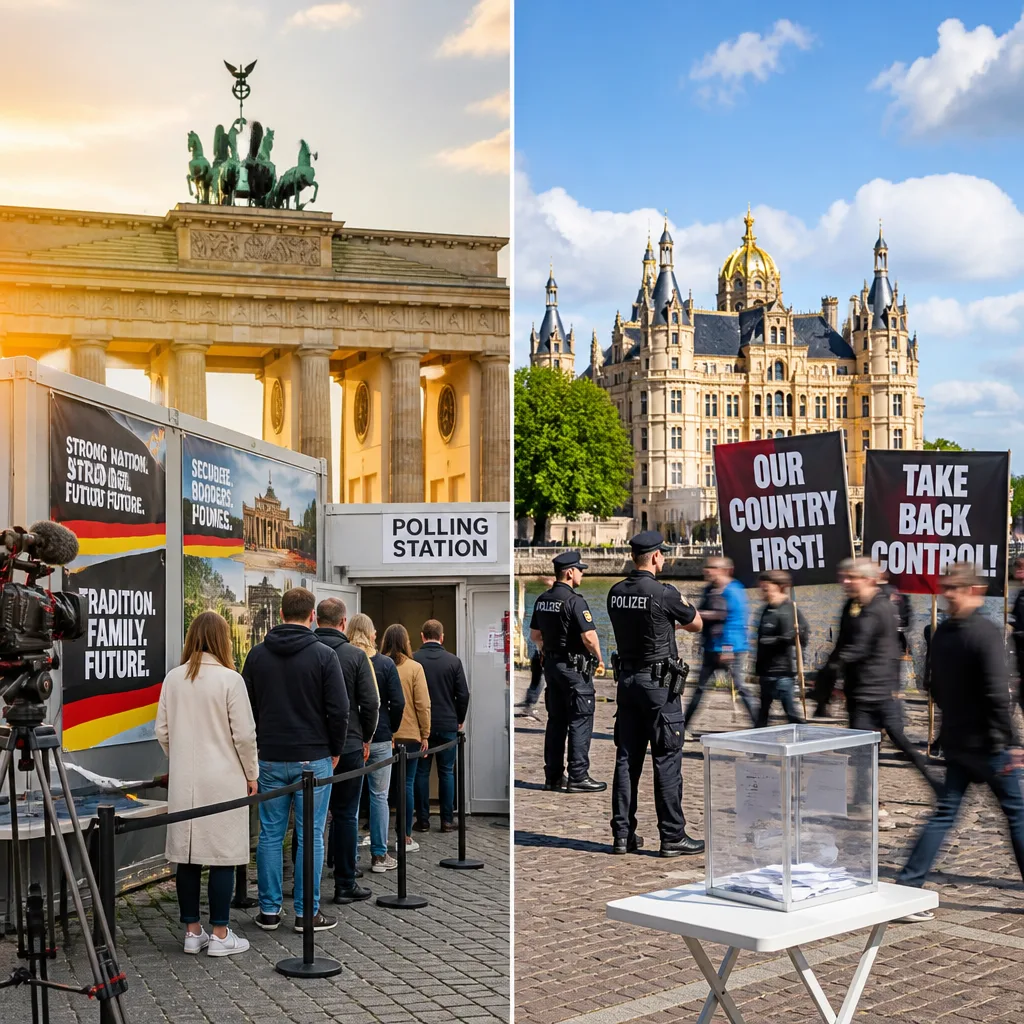
Two state elections in Germany on Sunday will be watched closely in Berlin and across Europe, with the fortunes of Chancellor Friedrich Merz and his Christian Democratic Union at stake. Around 4 million voters are eligible to cast ballots in the two contests, which could reshape the balance of power nationally despite being regional votes.
Different contests, similar risks for the centre‑right
In the capital, Berlin, the Christian Democrats are battling to retain influence in a city where they have historically lagged. Farther north in Mecklenburg‑Western Pomerania — affectionately known to locals as Meckpomm — the CDU is fighting simply to remain represented in the state parliament.
The two races present sharply contrasting dynamics. Mecklenburg‑Western Pomerania has about 1.6 million residents, but only some 1.2 million voters will decide its outcome. There, the far‑right Alternative for Germany (AfD) has surged in recent regional polls and could come first, mirroring a dramatic performance two weeks earlier when the AfD secured 43.8% of the vote in Saxony‑Anhalt amid record turnout.
Those results have concentrated national attention on the small state capital, Schwerin, where campaigning has been polarised and visibly confrontational. An envoy from Germany’s pro‑democracy establishment rolled into town in a touring bus called the “Adenauer SPR+”, equipped with speakers and intended to disrupt the far right. That kind of direct mobilisation has met with irritation from some: “
What does that even stand for?” one protester asked, according to reporting from the scene.
Schwesig the bulwark
The principal obstacle to a far‑right breakthrough in Meckpomm is incumbent Social Democrat Manuela Schwesig, a 52‑year‑old who has governed the state for almost a decade. Her campaign has been deliberately personalised and combative — she has styled herself as a defender of democracy and a direct counter to the AfD, adopting the self‑description “
woman against blue”.
Schwesig’s prominence in the campaign has squeezed out finer policy debates, according to observers, turning the contest into a referendum on identity and temperament rather than detailed governance programmes. Her main rival on the ballot is AfD candidate Leif‑Erik Holm, who presents a simpler message on campaign banners: “
ready”. Polling during the campaign placed the two parties within reach of one another at roughly 36% each, although Schwesig had reportedly gained about 10 percentage points in the closing period, narrowing the gap.
Why this matters beyond regional borders
Regional elections in Germany can have outsized national effects. A strong AfD performance would deepen pressure on centre‑right parties and complicate coalition arithmetic in Berlin. For Chancellor Merz, who leads a CDU federal government seeking to assert itself after recent losses in regional ballots, the stakes are straightforward: poor showings could weaken his hand at home and encourage opponents across Europe who warn about the normalisation of far‑right forces.
Campaign confrontations in Schwerin have been raw. Protest material at rallies has been explicit: black‑and‑white banners read
“F*ck AFD”, while other activists carried rainbow flags bearing the slogan “racism is no alternative”. The atmosphere signals a highly polarised electorate where mobilisation — of both supporters and opponents — may be decisive.
- 4 million voters across the two states decide on Sunday.
- 1.2 million voters in Mecklenburg‑Western Pomerania will be closely watched by national parties.
- The AfD won 43.8% in Saxony‑Anhalt two weeks earlier, raising expectations and alarm ahead of these contests.
| State | Population (approx.) | Notable figure |
|---|---|---|
| Mecklenburg‑Western Pomerania | 1.6 million | 1.2 million eligible voters |
The immediate outcome will determine which parties control regional legislatures and, by extension, who can credibly claim momentum ahead of future national contests. It will also test whether personalised campaigning — such as Schwesig’s high‑profile effort to cast herself as a bulwark against the AfD — can blunt the far right’s advances.
For observers in South Africa and elsewhere, the elections will offer a snapshot of how mainstream parties respond when confronted with a surging radical alternative: whether through mobilisation, coalition‑building, or personalised leadership appeals. For Chancellor Merz, the result is likely to be read as a barometer of public sentiment towards his party and its capacity to contain the AfD at a time of growing political volatility.












