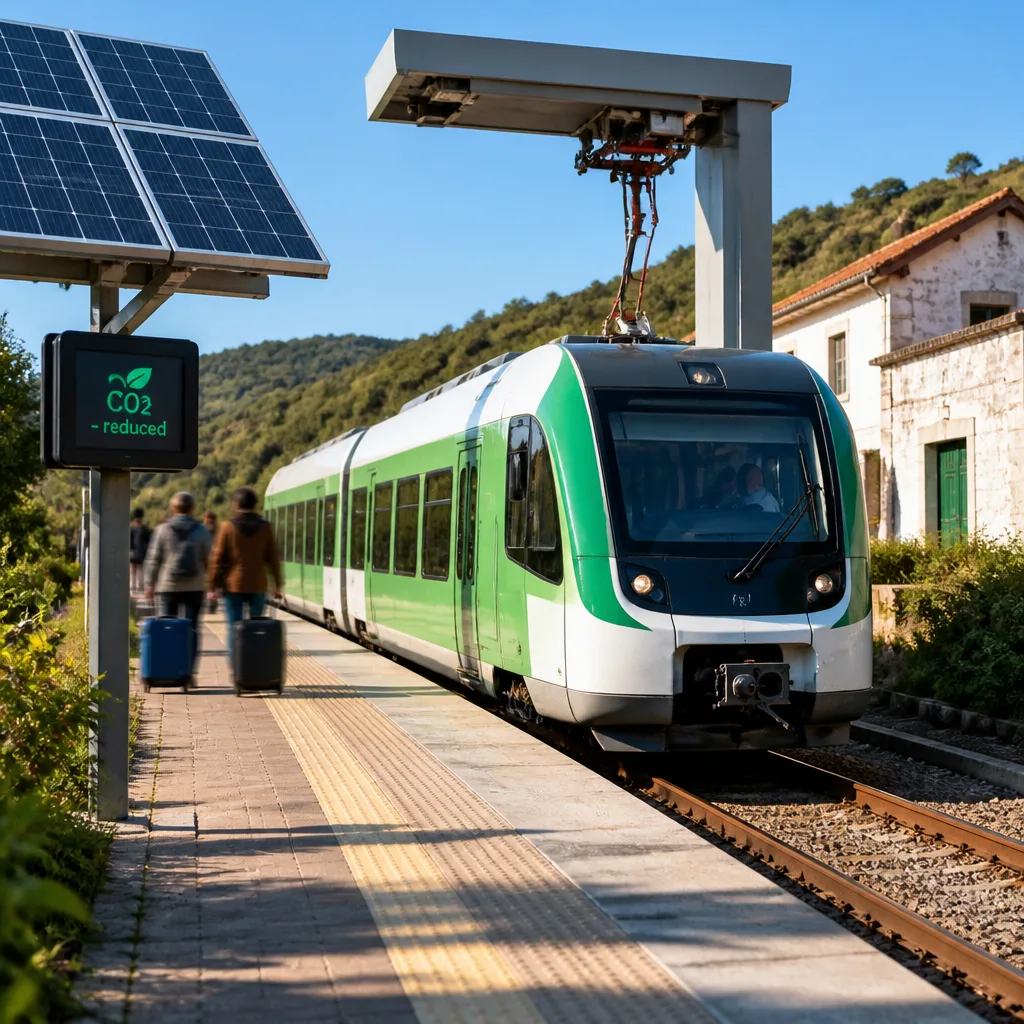
Italy’s rail safety regulator ANSFISA has authorised the first Stadler SRBe 312 battery‑electric trainset to enter passenger service on the 950 mm network operated by Ferrovie Appulo Lucane, Railway Gazette reported. The operator intends to deploy the train primarily on the 27.4 km Altamura–Matera route, a regional line in southern Italy.
What has been authorised and where it will run
The approval covers the SRBe 312, which project partners describe as Italy’s first battery‑powered narrow‑gauge multiple unit. The two‑car trainset is intended for operation on the isolated metre‑narrow network used by Ferrovie Appulo Lucane, initially serving the short interurban connection between Altamura and Matera.
- Trainset configuration: two cars
- Length: 36.5 m
- Width: 2 500 mm
- Capacity: 164 passengers, including 87 seated
- Route: 27.4 km Altamura–Matera line
Funding and supporting infrastructure
The launch is being financed through Italy’s National Recovery & Resilience Plan, which receives backing from the European Union, and includes the installation of fast‑charging equipment at Altamura and Matera. Ferrovie Appulo Lucane ordered seven of the SRBe 312 trainsets during 2023–24, signalling a modest fleet renewal focused on battery traction.
| Specification | Detail |
|---|---|
| Model | SRBe 312 (Stadler) |
| Gauge | 950 mm |
| Cars per set | 2 |
| Passenger capacity | 164 (87 seated) |
| Expected CO2 reduction | more than 1 300 tonnes per year (fleet) |
Environmental and operational implications
Railway Gazette reported that the operator estimates the seven‑trainset fleet will cut carbon dioxide emissions by over 1 300 tonnes annually. The battery‑electric multiple unit, or BEMU, is intended to replace diesel units on non‑electrified regional lines where full electrification is not economical, offering a means to reduce greenhouse‑gas output while retaining flexible operations on isolated or narrow‑gauge routes.
For South Africa, the Italian example is relevant in several ways. Our country operates extensive non‑electrified regional and branch lines, and has a mix of standard and narrow‑gauge legacy routes in certain provinces. Battery traction offers a lower‑cost alternative to overhead electrification, especially for short or low‑frequency services where the capital expense of catenary infrastructure is difficult to justify. The Italian project also demonstrates how public recovery funding can be channelled into greener transport technology and charging infrastructure at terminals.
Limitations and considerations
Battery trains are best suited to short runs and networks where charging points can be installed at termini or intermediate depots. Their practical range and performance depend on battery capacity, charging speed, route gradients and service patterns. The SRBe 312 authorisation is a milestone for narrow‑gauge BEMUs, but it does not imply a one‑size‑fits‑all solution for long‑distance or heavy freight services that still require higher energy density or continuous power supply that only overhead electrification or alternative fuels can provide.
Italy’s procurement of seven units is a measured start rather than a full fleet conversion. The effectiveness of the programme will hinge on operational experience, maintenance regimes, battery lifecycle costs and the integration of charging infrastructure into existing yards and stations.
Railway Gazette’s coverage places the SRBe 312 in the context of wider European efforts to decarbonise rail and to pilot technologies adapted to regional needs. For South African policymakers and operators, such pilots provide useful data on costs, emissions savings and operational constraints when considering similar investments here.
Technical innovation, targeted funding and realistic route selection appear to be the core lessons from Italy’s narrow‑gauge BEMU move — an incremental but tangible step towards cleaner regional rail services.