
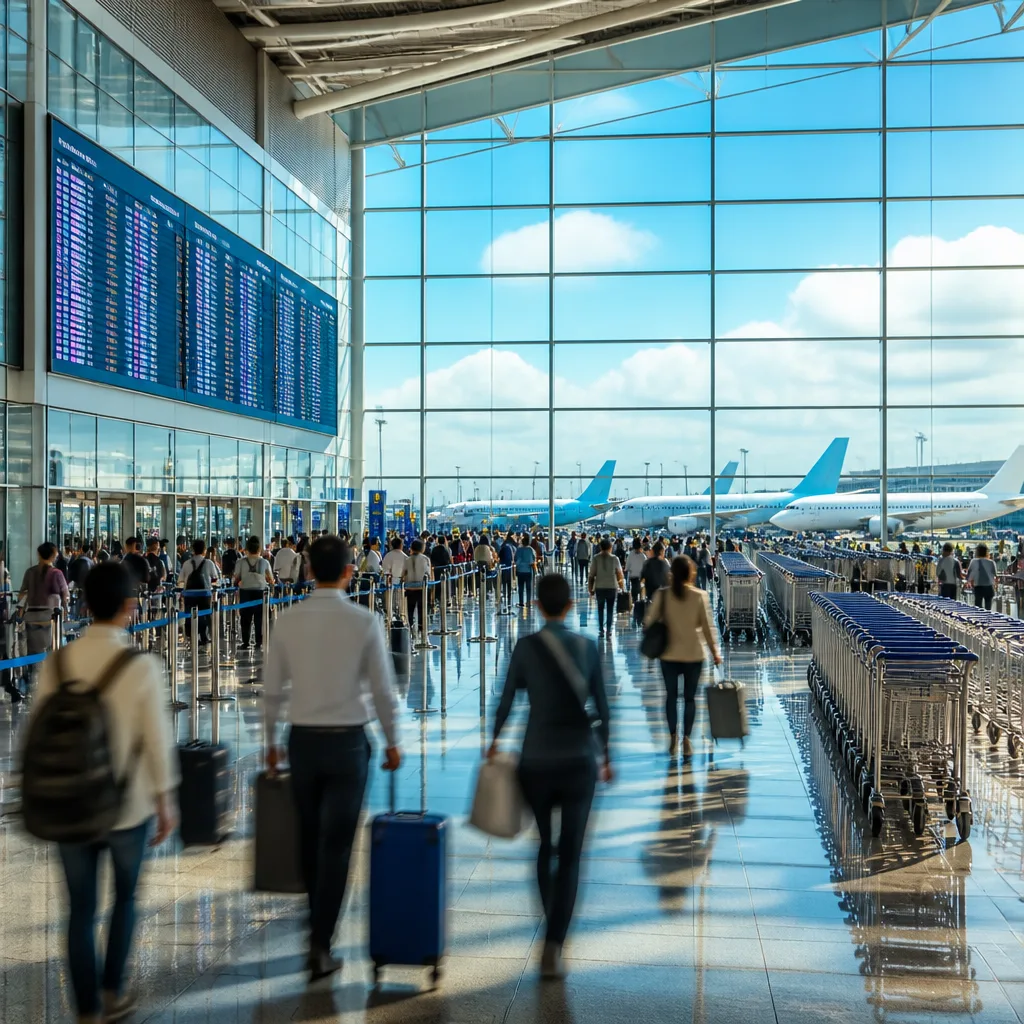
Incheon International Airport has overtaken London Heathrow and Singapore Changi to become the world’s busiest international passenger hub in the first half of 2026, handling 38.39 million international travellers, data from Airports Council International show.
Rapid rise after expansion and changing transfer patterns
The preliminary figures, which cover 1,234 airports, place Heathrow second on 37.79 million and Changi third on 34.53 million. Incheon’s climb to first follows years of steady gains: it rose from 10th in 2002 to fifth in 2018, third in 2024 and now first for the six-month period.
The airport’s performance rests on two related drivers. First, a major capacity build-out completed in November 2024 — the four-phase expansion — increased international capacity to 106 million annual passengers, making it the world’s third-largest in terms of designed international throughput behind Hong Kong and Dubai. Second, shifting geopolitics have altered transfer patterns: the conflict between the United States and Iran has constrained transfer traffic through Middle Eastern hubs, diverting passengers to East Asian gateways such as Incheon.
Transfer and inbound travel gains
Transfer passengers at Incheon rose to 4.24 million in the first half, an increase of 18.1% year-on-year. European transfer traffic surged even more sharply, up 63.2%. Inbound tourism also strengthened: foreigners accounted for a record 44.4% of Incheon’s passenger traffic in the second quarter, up from 39.5% a year earlier, led largely by visitors from China and Japan.
- International passengers (H1 2026): Incheon 38.39m; Heathrow 37.79m; Changi 34.53m.
- Transfer passengers: Incheon 4.24m, +18.1% year-on-year; European transfers +63.2%.
- Foreign share of traffic (Q2): 44.4% at Incheon, a record high.
| Metric | Incheon (H1 2026) | Comparator |
|---|---|---|
| International passengers | 38.39 million | Heathrow 37.79m; Changi 34.53m |
| Transfer passengers | 4.24 million (+18.1%) | European transfers +63.2% |
| Capacity (annual international) | 106 million | Third-largest globally after Hong Kong and Dubai |
Incheon now connects 183 cities across 53 countries via 101 carriers. The airport also passed the milestone of 1 billion cumulative passengers just over 25 years after opening, the fastest such rise among major international gateways.
What this means for global and South African travel links
The reordering of international hubs carries practical effects for airlines, freight operators and passengers. Airlines and alliance partners reassess routing and hub investments when transfer demand shifts, influencing ticketing, flight frequencies and codeshares. For South African travellers and carriers, the change underscores that long-haul transfer options can be reshaped by geopolitical events as much as by airline strategy or airport investment.
Airports Council International’s dataset reflects the six-month mobility picture; full-year rankings can still change. Nonetheless, Incheon’s rise reinforces how infrastructure expansion, sustained service quality — Incheon has been top-ranked for service quality for 12 consecutive years — and external geopolitical factors together reshape the global aviation map.
The development will be watched by aviation planners in South Africa and elsewhere as national carriers, travel agents and policymakers consider how shifting hub dynamics affect connectivity, tourism flows and cargo corridors.
Analysts will also track whether Dubai and other long-standing transfer hubs regain lost traffic as geopolitical pressures ease, and how airports in Africa position themselves in response to an evolving pattern of intercontinental connectivity.
For passengers, the immediate effect is practical: more routing options through East Asia, potentially shorter total journey times depending on connections, and broader carrier choices when booking long-haul travel.









